


A supply chain risk matrix is a visual tool used to assess, prioritize, and communicate risks across the supply chain based on their likelihood of occurrence and potential impact. It plots identified risks on a grid — typically with probability on one axis and severity on the other — allowing procurement and supply chain teams to focus mitigation efforts on the highest-priority threats. The risk matrix in supply chain management provides a structured approach to comparing diverse risks on a common scale.
Read more: Digitizing the Kraljic Matrix: A Framework for 21st Century Procurement Strategies
Why Supply Chain Risk Matrix Matters in Procurement
Supply chains face a wide range of risks: supplier insolvency, geopolitical disruption, quality failures, logistics delays, regulatory changes, and natural disasters. Without a structured way to evaluate these risks, organizations either spread resources too thin or focus on the wrong threats. A risk matrix in supply chain contexts forces disciplined assessment, helps stakeholders align on priorities, and supports investment decisions for risk mitigation. For procurement leaders, it translates complex risk exposure into actionable intelligence.
Read more: Procurement Risk Management: A Cognitive Data-Driven Approach
The Core Process of Supply Chain Risk Matrix
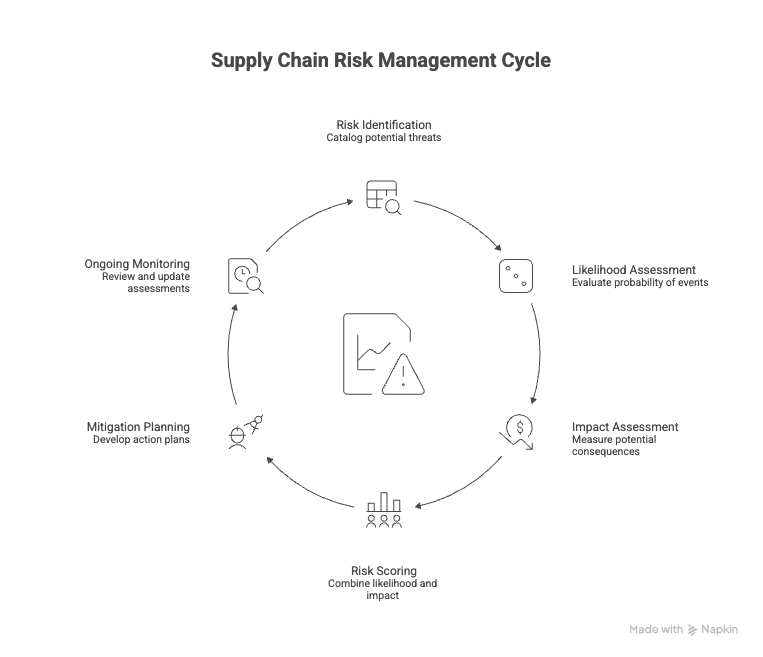
The process begins with risk identification. Procurement and supply chain teams catalog potential risks across categories such as supplier risk, logistics risk, demand risk, regulatory risk, and external disruptions. Each risk is described in specific terms — what could happen, where, and to which suppliers or supply lines.
Read more: Supplier Risk Management Guide 2026: Strategy, Process & Best Practices
Next, each risk is assessed for likelihood and impact. Likelihood reflects how probable the event is over a defined time horizon. Impact measures the severity of consequences if the event occurs — considering cost, revenue, operational disruption, and reputational damage. Both dimensions are scored on a consistent scale, typically low, medium, or high.
Risks are then plotted on the matrix. High-likelihood, high-impact risks land in the critical zone and demand immediate attention. Low-likelihood, low-impact risks may be accepted or monitored passively. The matrix provides a visual map that makes prioritization intuitive.
Finally, mitigation plans are developed for priority risks. Actions may include supplier diversification, safety stock adjustments, contract protections, or contingency sourcing. The matrix is reviewed periodically and updated as risks evolve or new threats emerge.
Key Benefits of Supply Chain Risk Matrix
- Prioritizes risk response by focusing resources on threats with the highest likelihood and impact.
- Improves stakeholder alignment by providing a clear, visual representation of supply chain risk exposure.
- Supports informed decision-making on supplier selection, contract terms, and inventory strategies.
- Creates accountability for mitigation actions by linking specific risks to owners and timelines.
- Enhances supply chain resilience through proactive identification and management of vulnerabilities.
Common Pitfalls of Supply Chain Risk Matrix
Subjective scoring without criteria: If likelihood and impact are assessed inconsistently, the matrix loses credibility. Define clear scoring guidelines.
Treating the matrix as static: Risks evolve. A matrix created once and never updated becomes irrelevant as conditions change.
Ignoring low-likelihood, high-impact risks: Rare but catastrophic events — like a key supplier facility fire — deserve contingency planning even if the probability is low.
Failing to act on findings: A risk matrix is only valuable if it drives mitigation. Without action, it becomes a compliance artifact rather than a management tool.
Risk Categories to Include
Financial risk: Supplier insolvency, credit deterioration, or cash flow issues that threaten the continuity of supply.
Operational risk: Capacity constraints, quality failures, production disruptions, or key personnel dependencies.
Geopolitical risk: Trade restrictions, tariffs, sanctions, political instability, or regulatory changes in supplier regions.
Concentration risk: Over-reliance on a single supplier, geography, or facility for critical materials or services.
Logistics risk: Transportation disruptions, port congestion, carrier failures, or route vulnerabilities.
Compliance risk: Regulatory violations, environmental non-compliance, labor issues, or reputational exposure.
KPIs of Supply Chain Risk Matrix
| Dimension | Sample KPIs |
| Risk Coverage | Percentage of suppliers assessed, percentage of spend covered by risk evaluation |
| Mitigation | Percentage of critical risks with mitigation plans, mitigation action completion rate |
| Disruption | Number of supply disruptions, average disruption recovery time |
| Review Cadence | Risk matrix update frequency, time since last review |
Key Terms in Supply Chain Risk Matrix
- Risk Appetite: The level of risk an organization is willing to accept in pursuit of its objectives.
- Inherent Risk: The level of risk before any mitigation controls are applied.
- Residual Risk: The level of risk remaining after mitigation measures have been implemented.
- Risk Owner: The individual accountable for monitoring and managing a specific risk.
- Mitigation Strategy: The approach taken to reduce the likelihood or impact of a risk — such as avoidance, transfer, reduction, or acceptance.
- Single Point of Failure: A supplier, facility, or process with no backup, where failure would cause significant disruption.
FAQs
Q1. What is a supply chain risk matrix?
A visual tool that plots risks based on likelihood and impact, helping teams prioritize mitigation efforts across the supply chain.
Q2. How is the matrix structured?
Typically, a grid with likelihood on one axis and impact on the other, divided into zones such as low, medium, high, and critical.
Q3. Who is responsible for maintaining the risk matrix?
Procurement, supply chain, or risk management teams typically own the matrix, with input from category managers, logistics, and finance.
Q4. How often should the matrix be updated?
Quarterly reviews are common, with ad-hoc updates when significant changes occur — new suppliers, geopolitical events, or disruption incidents.
Q5. What risks should be included?
Supplier financial health, single-source exposure, logistics disruptions, regulatory changes, quality failures, and external events like natural disasters.
Q6. Can a risk matrix replace detailed risk assessments?
No. The matrix is a prioritization tool. High-priority risks should still undergo deeper analysis and formal mitigation planning.
References
For further insights into these processes, explore Zycus’ dedicated resources related to the Supply Chain Risk Matrix:
- Building Ethical Supply Chains: How a Supplier Code of Conduct Can Help
- Procure to Pay Consulting: How Generative AI is Transforming Advisory Services
- Why make Accounts Payable Walk when it can run a Race?
- Show Them the Money: Building the AP Automation Business Case
- Business Transformation Keynote: Aatish Dedhia’s Strategic Insights