




EAU, or Estimated Annual Usage, refers to the projected quantity of a product or service that an organization expects to consume over a one-year period. It is a foundational planning metric used across sourcing, contracting, and supplier negotiations to align demand forecasts with procurement strategies.
Rather than being a static number, EAU represents a forward-looking demand signal, combining historical consumption, business growth assumptions, seasonality, and operational requirements. When used correctly, EAU enables procurement teams to move from reactive buying to planned, value-driven sourcing.
Why EAU Matters in Procurement
Procurement decisions are only as strong as the demand assumptions behind them. Inaccurate or poorly defined usage estimates often lead to overbuying, stockouts, weak negotiations, or contract misalignment.
EAU plays a critical role in ensuring that procurement:
- Negotiates contracts based on realistic demand volumes
- Secures optimal pricing tiers and volume-based discounts
- Aligns supplier capacity with business needs
- Avoids emergency sourcing and last-minute purchases
- Supports long-term budgeting and category planning
In essence, EAU connects operational demand with commercial strategy.
Where EAU Is Used Across the Procurement Lifecycle
EAU is not limited to sourcing events—it influences multiple stages of the procurement lifecycle.
During strategic sourcing, EAU defines the volume baseline used in RFQs, RFPs, and reverse auctions. Suppliers price more aggressively when demand is clear and credible.
In contract management, EAU shapes pricing slabs, rebate structures, minimum order commitments, and capacity reservations.
Within inventory and supply planning, EAU helps balance service levels with carrying costs by aligning order quantities to actual consumption patterns.
For supplier performance and risk management, EAU provides context—helping teams assess whether suppliers are meeting expected volume commitments and scalability expectations.
Key Components of EAU in Procurement
1. Demand Forecasting Inputs
EAU begins with demand forecasting. Procurement collaborates with finance, operations, and business units to understand historical consumption, upcoming projects, seasonality, and growth assumptions.
This ensures EAU reflects real business needs—not arbitrary estimates.
2. Historical Spend and Usage Analysis
Past purchase orders, invoices, and consumption data provide the baseline for EAU calculation.
Patterns such as peak usage periods, demand volatility, or declining consumption trends are factored in to refine forecasts.
Accurate historical analysis prevents overestimation and contract overcommitment.
3. Category and Specification Standardization
EAU is most effective when demand is consolidated across similar items or services.
Standardizing specifications and categories allows procurement to aggregate demand across departments, locations, or projects, strengthening negotiating power.
This is especially important for indirect spend, MRO, and services.
4. Supplier Capacity and Market Constraints
EAU planning must account for supplier capacity and market realities.
Procurement evaluates whether suppliers can reliably support projected volumes and whether market conditions (raw materials, labor, logistics) may affect supply availability.
This reduces execution risk once contracts are in place.
5. Contractual Alignment
EAU directly informs contract structures.
Pricing tiers, volume discounts, minimum commitments, penalties, and service levels are aligned to estimated annual usage to protect both buyer and supplier interests.
Well-aligned contracts prevent value leakage and renegotiation friction.
6. Continuous Review and Adjustment
EAU is not a “set-and-forget” metric.
Usage patterns change due to market shifts, business growth, or operational changes. Procurement teams periodically review EAU assumptions and adjust sourcing strategies, contracts, and supplier allocations accordingly.
This keeps procurement agile and demand-aligned.
Key Benefits of Using EAU Effectively
- Cost Optimization: Clear volume forecasts unlock better pricing and commercial terms
- Operational Efficiency: Planned demand reduces ad-hoc purchases and urgent sourcing
- Risk Mitigation: Suppliers are selected and contracted based on realistic capacity needs
- Stronger Negotiations: Credible usage data strengthens procurement’s negotiation position
- Scalability: EAU supports growth planning without increasing procurement complexity
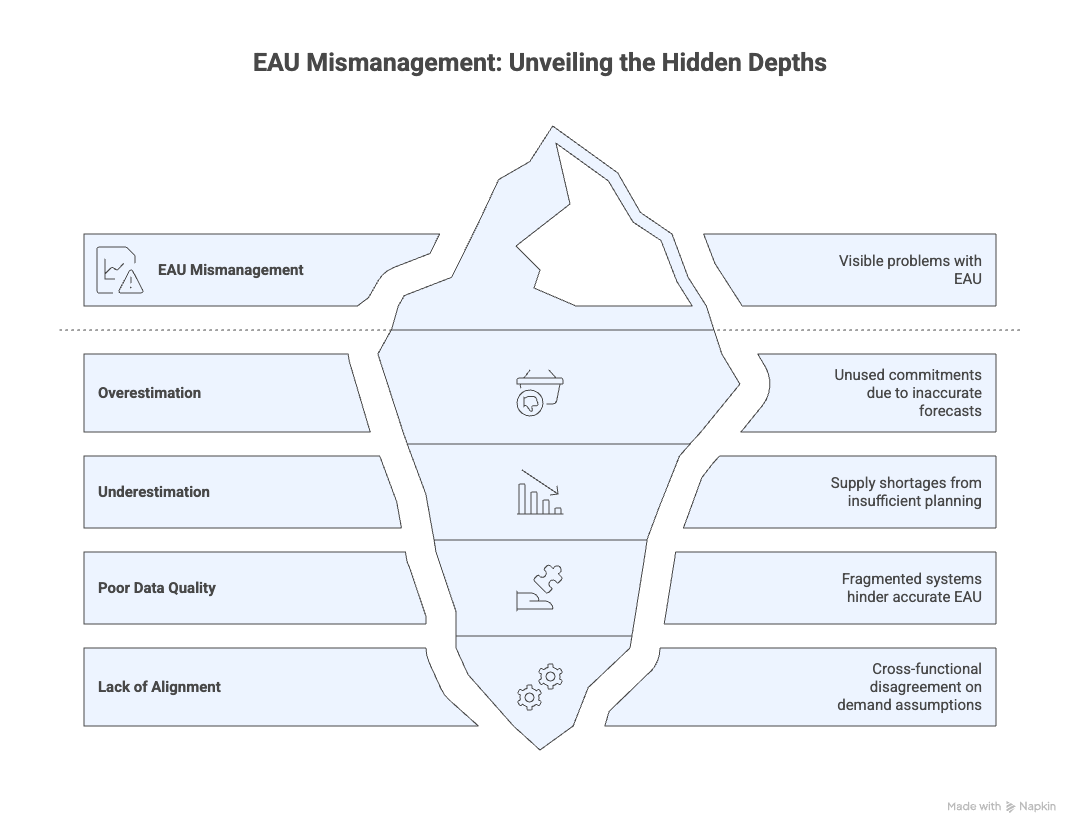
Addressing these challenges requires strong data governance and collaboration.
Key Terms
- Demand Forecasting – Predicting future consumption based on historical and planned inputs
- Volume-Based Pricing – Pricing structures tied to committed usage levels
- Spend Consolidation – Aggregating demand to improve sourcing leverage
- Capacity Planning – Ensuring suppliers can support forecasted demand
FAQs
Q1. What is EAU in procurement?
EAU (Estimated Annual Usage) is the projected quantity of a product or service an organization expects to consume over a year, used to plan sourcing strategies, contracts, and supplier negotiations.
Q2. Why is EAU important for sourcing decisions?
EAU provides suppliers with clear demand visibility, enabling better pricing, volume-based discounts, capacity commitments, and more accurate sourcing outcomes.
Q3. How do you calculate EAU? (Formula + example)
Formula:
EAU = Historical annual usage ± forecasted change (growth/decline)
Example:
If last year’s usage was 10,000 units and expected growth is 10%,
EAU = 10,000 + 1,000 = 11,000 units
Q4. What is the difference between EAU, MOQ, and forecasted demand?
- EAU: Annual demand estimate used for sourcing and contracts
- MOQ: Minimum quantity a supplier requires per order
- Forecasted demand: Broader planning estimate that may span multiple timeframes and scenarios
EAU bridges operational forecasts and commercial negotiations.
Q5. What are common use cases of EAU in strategic sourcing?
EAU is used to define bid volumes in RFPs, structure pricing tiers, negotiate rebates, reserve supplier capacity, and consolidate demand across business units or regions.
Q6. When should EAU be used?
EAU should be used during sourcing events, contract renewals, category planning, and whenever procurement needs to negotiate volume-based terms.
References
For further insights into these processes, explore Zycus’ dedicated resources related to EAU in Procurement:
-
- The Business Case for Autonomous Sourcing: Savings, Speed & Scale
- Inventory Management in Procurement: A Strategic Guide for Efficiency and Optimization
- Intake Management Automation: Revolutionizing Procurement Requests
- Beyond Breakdown: Transforming MRO Procurement for Operational Excellence
- Unleashing Next-Gen Efficiency Using Generative AI in Supply Chains
- Top 10 Winning Skills for Procurement Professionals
- Scripting the Contract Story – Finding the Right Camera
- Ethical Implementation of GenAI in Procurement
- Digital Social Procurement for Governance: Learnings from the Public Transport Authority of Western Australia










