



RFx is a collective term for the formal solicitation documents used in procurement to gather information, proposals, or pricing from potential suppliers. The “x” represents the variable type of request: RFI (Request for Information), RFP (Request for Proposal), and RFQ (Request for Quotation). Each serves a distinct purpose in the sourcing process, from early market exploration to final pricing competition. Understanding when and how to use each RFx type is fundamental to effective strategic sourcing.
Read more: Transform RFx Management: Go Smarter, Faster with AI
Why RFx in Procurement Matters
RFx processes bring structure, fairness, and competition to supplier selection. Without formal solicitation, sourcing decisions rely on existing relationships or incomplete information, missing opportunities for better value. A well-executed RFx ensures that requirements are clearly communicated, suppliers compete on equal footing, and selection decisions are defensible. For procurement professionals, mastering RFx processes is essential to driving savings, improving supplier quality, and maintaining compliance with organizational and regulatory requirements.
Read more: RFI, RFQ, and RFP Explained: A Practical Guide
The Core Process of RFx in Procurement
The process begins with defining requirements. Procurement works with stakeholders to document what is needed — specifications, quantities, delivery requirements, service levels, and evaluation criteria. Clear requirements are essential to receiving comparable, relevant responses.
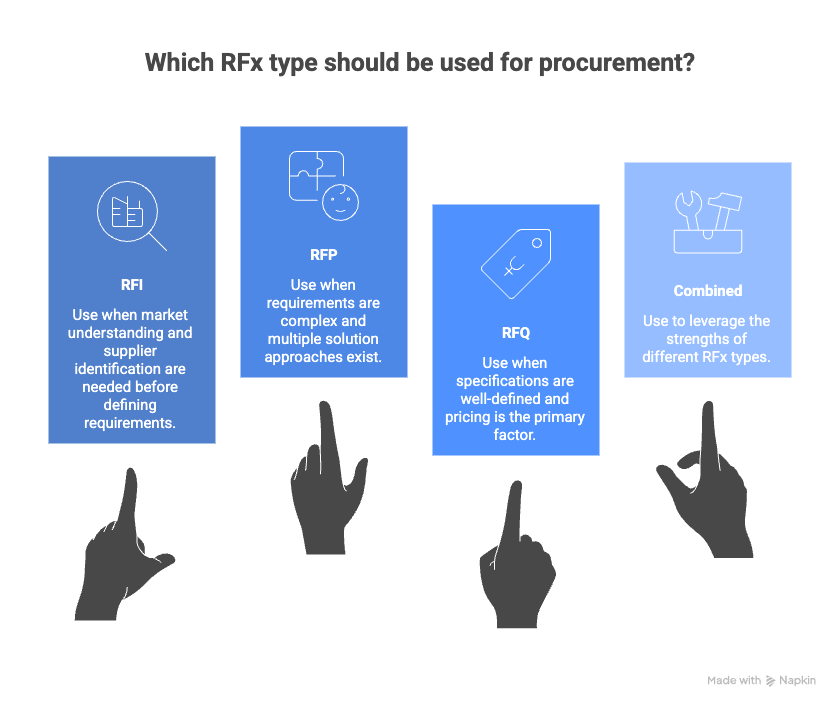
The appropriate RFx type is selected based on the sourcing objective. An RFI gathers market information early in the process. An RFP solicits comprehensive proposals for complex requirements. An RFQ requests specific pricing for well-defined goods or services.
The RFx is issued to qualified suppliers with clear instructions and deadlines. Suppliers submit their responses, and procurement may conduct clarification rounds to address questions or ambiguities in submissions.
Responses are evaluated against defined criteria. Scoring may include price, technical capability, quality, risk, and other factors. Negotiations may follow with shortlisted suppliers before final selection and contract award.
Core Components of RFx in Procurement
- Request for Information (RFI). A preliminary inquiry used to gather market intelligence, assess supplier capabilities, or narrow the field before a formal sourcing event.
- Request for Proposal (RFP). A comprehensive solicitation for complex purchases where suppliers propose solutions, not just pricing, and evaluation considers multiple factors.
- Request for Quotation (RFQ). A pricing-focused request for well-defined requirements where specifications are clear and the primary variable is cost.
- Evaluation Criteria. The factors and weightings used to assess and compare supplier responses objectively.
- Supplier Response. The formal submission from vendors containing information, proposals, or pricing as requested in the RFx.
Key Benefits of RFx in Procurement
- Ensures competitive pricing by soliciting bids from multiple qualified suppliers simultaneously.
- Improves decision quality through structured evaluation of supplier capabilities and proposals.
- Creates documentation and audit trails supporting compliance and governance requirements.
- Levels the playing field by giving all suppliers equal access to requirements and evaluation criteria.
- Reduces bias in supplier selection through objective scoring and transparent processes.
- Gathers market intelligence about available solutions, pricing benchmarks, and supplier capabilities.
Common Pitfalls of RFx in Procurement
- Vague requirements. Ambiguous specifications lead to non-comparable responses. Be specific about what you need.
- Using the wrong RFx type. An RFQ for complex services or an RFP for commodity items wastes time. Match the tool to the need.
- Overly complex documents. Lengthy RFx documents burden suppliers and may discourage participation. Keep it focused.
- Unrealistic timelines. Insufficient response time yields rushed, incomplete proposals. Allow adequate time for quality responses.
KPIs of RFx in Procurement
| Dimension | Sample KPIs |
| Participation | Supplier response rate, number of qualified bids received |
| Efficiency | RFx cycle time, time from issue to award, cost per sourcing event |
| Outcomes | Savings achieved, cost avoidance, award-to-budget variance |
| Quality | Supplier performance post-award, requirement accuracy, rebid rate |
Key Terms in RFx in Procurement
- RFI (Request for Information): A preliminary inquiry to gather supplier information and market intelligence before formal sourcing.
- RFP (Request for Proposal): A solicitation requesting detailed proposals for complex requirements with multi-factor evaluation.
- RFQ (Request for Quotation): A pricing request for well-defined goods or services where cost is the primary variable.
- Bid: A supplier’s formal response to an RFx, containing pricing, proposals, or information as requested.
- Award: The decision to select a supplier and grant them the business following RFx evaluation.
- Shortlist: A reduced list of qualified suppliers selected to advance to the next stage of evaluation.
Technology Enablement
Modern Source-to-Pay platforms provide integrated RFx management with templates, automated distribution, online supplier response portals, scoring tools, and collaboration features. These capabilities streamline sourcing events, improve response quality, and create complete audit trails of the solicitation process.
FAQs
Q1. What does RFx stand for?
RFx is a collective term for Request for Information (RFI), Request for Proposal (RFP), and Request for Quotation (RFQ).
Q2. What is the difference between RFP and RFQ?
An RFP solicits comprehensive proposals evaluated on multiple factors. An RFQ focuses on pricing for well-defined specifications.
Q3. When should I use an RFI?
Use an RFI early in the process to gather market intelligence, assess capabilities, or identify qualified suppliers before formal sourcing.
Q4. How many suppliers should receive an RFx?
Enough to ensure competition, typically 3–7 for an RFP or RFQ. RFIs may go to a broader market.
Q5. Can RFx types be combined?
Yes. A common approach is RFI for market research, RFP for solution proposals, then RFQ for final pricing with finalists.
Q6. How long should suppliers have to respond?
Typically 2–4 weeks for an RFP, 1–2 weeks for an RFQ, depending on complexity.
References
For further insights into these processes, explore Zycus’ dedicated resources related to RFx in Procurement:
- Integrating P2P with Strategic Sourcing Solutions
- GenAI Enabled Sustainable Sourcing Software: Pathway to Enterprise Success
- Change the Game
- Client-Centered Procurement Advantage: Reinventing Your Procurement Organization’s Stakeholder Experience
- Strengthening Supply Chains with AI-Enabled Resilience










