



Backwards integration is a strategy in which an organization expands operations upstream into its own supply chain, taking ownership or control of activities previously performed by suppliers. Rather than purchasing a component or service from an external party, the organization produces it internally. It represents the make-rather-than-buy decision, with significant implications for how procurement manages affected categories and the supply relationships that are displaced as a result.
Why Backwards Integration Matters in Procurement
Backward integration decisions directly reshape procurement’s scope and supplier landscape. When an organization integrates backward into a category, procurement transitions from managing an external supply relationship to supporting an internal production function. Categories that were previously sourced competitively become internal cost centers, and procurement’s role shifts toward managing the raw material inputs that feed the new internal operation. Understanding backward integration helps procurement leaders assess make-vs-buy decisions analytically, manage the supplier transitions that integration requires, and identify the new sourcing requirements that the integrated operation creates.
The Core Process of Backwards Integration
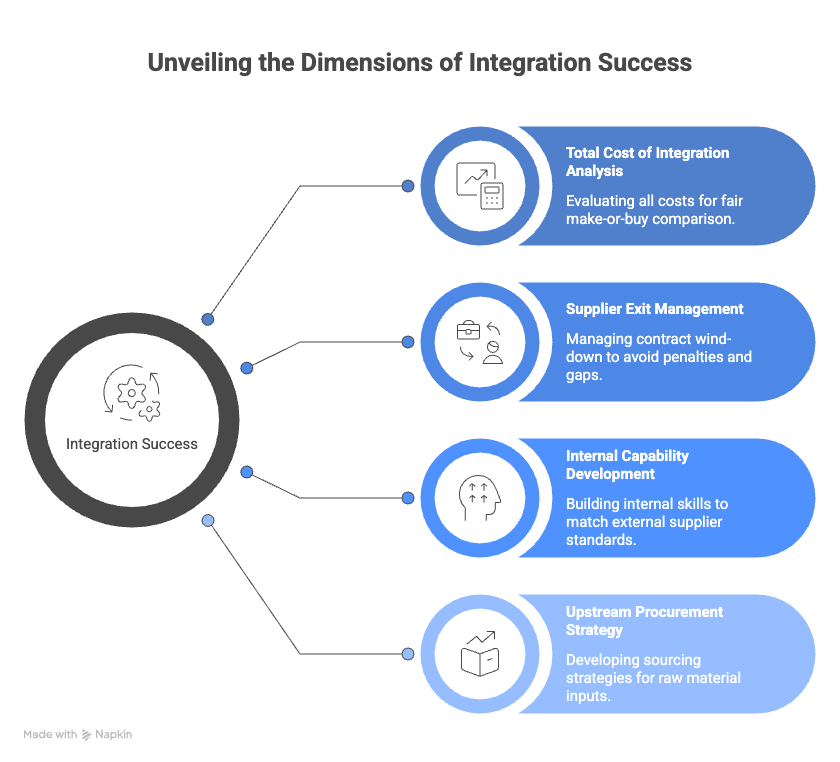
- Make-vs-Buy Analysis: The process begins with a rigorous cost comparison between continuing to source externally and producing internally. The analysis must capture the full cost of integration capital investment, operational overhead, management capacity, and loss of external supplier competition against the expected savings from internalizing the margin previously captured by the supplier.
- Capability Assessment: Before integration proceeds, the organization assesses whether it has — or can develop the technical capability, workforce, facilities, and management systems required to produce the good or service to the required quality and volume. Capability gaps that cannot be closed economically should prevent the integration decision from proceeding.
- Transition Planning: If integration is approved, a transition plan is developed that addresses how existing supplier contracts will be wound down, how intellectual property and tooling will be transferred, and how supply continuity will be maintained during the changeover from external supply to internal production.
- Ongoing Procurement Realignment: Once integration is live, procurement realigns its scope to manage the raw material and component inputs required by the new internal operation. The sourcing strategy for these upstream inputs becomes more strategically important, as any failure in their supply now disrupts an internal production capability rather than a supplier relationship.
Key Benefits of Backwards Integration
- Eliminates supplier margin from the cost of a category, potentially reducing total cost if internal production can be achieved efficiently.
- Reduces dependency on external suppliers for critical components, improving supply continuity assurance for the integrated category.
- Protects proprietary technology or process knowledge that the organization does not wish to share with external manufacturing partners.
Common Pitfalls of Backwards Integration
- Underestimating the true cost of internal production: Make-vs-buy analyses frequently underestimate overhead, management attention, and capital maintenance costs. The external supplier’s margin often reflects genuine efficiency advantages that disappear when production is internalized.
- Overestimating internal capability: Organizations lacking the technical depth or workforce capability of specialist suppliers will produce at lower quality or higher cost, negating the expected integration benefit.
- Creating irreversible commitments: Significant capital investment creates exit barriers that make it costly to reverse the integration decision if expected benefits do not materialize.
When Backward Integration Is and Is Not Appropriate
- Appropriate when: The supplier’s margin is large and sustainable internal production is demonstrably feasible. The category is strategically critical and supply security justifies the investment. Proprietary technology or process knowledge must be protected from external exposure.
- Not appropriate when: The supplier has genuine economies of scale or specialization that internal production cannot replicate. The organization lacks the capability or management bandwidth to operate the integrated function effectively. The capital requirement creates financial risk disproportionate to the strategic benefit.
- Consider partial integration: Rather than full ownership, partial integration — securing a minority stake in a key supplier, entering a joint venture, or establishing a captive supplier agreement — can provide supply security and cost insight without the full burden of ownership.
KPIs of Backwards Integration
| Dimension | Sample KPIs |
| Cost Performance | Internal production cost vs. prior external supply cost, cost per unit trend |
| Quality | Internal defect rate vs. external supplier baseline, specification compliance rate |
| Supply Continuity | Internal production uptime, raw material supply reliability |
| Transition | Supplier exit completion on schedule, supply gap incidents during transition |
Key Terms in Backwards Integration
- Make-vs-Buy Decision: The strategic choice between producing a good or service internally or sourcing it from an external supplier.
- Forward Integration: The opposite of backward integration — expanding downstream toward the customer, such as a manufacturer acquiring a distribution network.
- Vertical Integration: The broader strategy of owning multiple stages of a supply chain, of which backward integration is the upstream direction.
- Captive Supplier: An external supplier that is exclusively or predominantly dedicated to serving one buyer, providing supply security without full ownership.
- Total Cost of Ownership (TCO): The comprehensive cost framework used in make-vs-buy analysis to compare the full cost of internal production against external sourcing.
Technology Enablement
Source-to-Pay platforms support backward integration decisions through spend analytics that quantify the cost and volume of categories under consideration, supplier performance data that benchmarks external supply quality, and contract management tools that govern the exit of displaced supplier agreements. After integration, procurement systems manage the new upstream raw material categories that the integrated operation creates.
FAQs
Q1. What is backward integration?
A strategy in which an organization takes ownership or control of activities previously performed by suppliers, producing internally what it previously bought externally.
Q2. How is backward integration different from forward integration?
Backward integration moves upstream toward raw materials and components. Forward integration moves downstream toward distribution and the end customer.
Q3. What are the main risks of backward integration?
Underestimating internal production costs, overestimating organizational capability, creating irreversible capital commitments, and losing the competitive market intelligence that external sourcing provides.
Q4. What is a captive supplier and how does it differ from full integration?
A captive supplier is externally owned but dedicated to one buyer — providing supply security without the capital burden of full ownership.
Q5. How should procurement manage the supplier whose output is being internalized?
Through a structured wind-down that honours contractual obligations, preserves the relationship where future collaboration may be needed, and ensures uninterrupted supply until internal production is fully operational.
References
For further insights into these processes, explore the following Zycus resources related to Backwards Integration:










