



Open Tendering is a procurement method where an organization publicly invites suppliers to submit bids for a defined requirement—such as goods, services, or a project.
Unlike restricted sourcing methods, open tendering allows any qualified supplier to participate, making it one of the most transparent and competitive procurement approaches. It is commonly used in public sector procurement, regulated industries, and high-value sourcing events where fairness, documentation, and auditability are critical.
In the Source-to-Pay (S2P) lifecycle, open tendering sits within strategic sourcing, typically following requirement definition and supplier discovery, and leading into evaluation, award, and contracting.
Read more: Mastering Open Tendering: A Comprehensive Guide to Public Procurement Success
Why Open Tendering Matters in Procurement
Open tendering is designed for situations where procurement must demonstrate transparent supplier selection, controlled evaluation, and defensible award decisions.
It becomes especially important when:
- spend value is high and must be competitively sourced
- governance requires equal supplier access
- the buyer needs formal documentation for audits
- procurement must reduce bias and favoritism risk
- regulatory frameworks mandate open competition
In simple terms, it protects procurement integrity while improving value-for-money outcomes.
Key Benefits of Open Tendering
Stronger competition and better value
A wider supplier pool leads to competitive pricing and stronger proposal quality, helping buyers compare offers more effectively.
Fairness and equal supplier opportunity
Open tendering provides a level playing field, especially useful for public tenders, supplier diversity participation, and regulated environments.
Higher accountability and audit readiness
Because every step is documented, requirements, evaluation logic, award reasoning, open tendering supports procurement governance and reduces dispute risk.
Broader supplier access and innovation
Open invitations often surface alternative suppliers, new technologies, or improved delivery models that may not be visible through limited RFx rounds.
Lower risk of favoritism or bias
With structured scoring, standardized documentation, and formal timelines, open tendering strengthens decision transparency.
Where Open Tendering Fits in the Procurement Lifecycle
Open tendering is typically used when the organization needs to source in a way that is defensible, competitive, and policy-compliant.
A standard sequence looks like this:
- Define the need and tender scope
- Publish tender and invite bids
- Enable supplier clarification and submissions
- Evaluate bids using pre-defined criteria
- Select supplier and issue award notice
- Finalize contract and begin execution
This ensures the sourcing process stays controlled from start to finish.
The Open Tendering Process (Step-by-Step)
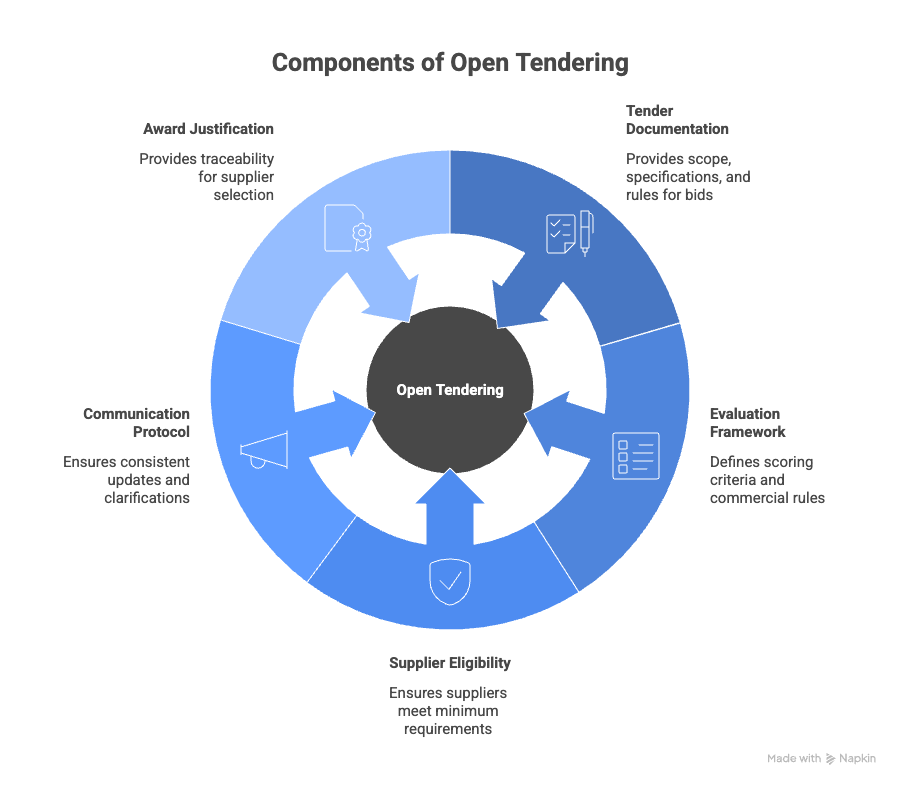
1. Requirement Definition and Tender Scope
The process begins by defining what is being purchased, why it’s needed, and what success looks like. This includes specifications, volume expectations, delivery timelines, compliance needs, and service-level expectations.
A strong scope reduces supplier confusion, improves bid quality, and lowers the risk of rework later.
2. Tender Publication and Supplier Participation
Once the tender is ready, it is published publicly through official tender portals, procurement networks, or sourcing platforms.
Suppliers are given a defined window to participate, review requirements, and prepare responses. Open tendering ensures suppliers are not selectively invited, everyone gets access.
3. Bid Submission and Controlled Communication
Suppliers submit proposals in a standardized format, typically including pricing, technical capability, delivery model, compliance documentation, and supporting evidence.
During this phase, procurement ensures communication stays fair and consistent, clarifications are managed formally so no supplier gains an unfair advantage.
4. Evaluation and Bid Comparison
This is the decision stage. Bids are evaluated against criteria that are typically defined upfront, such as:
- price competitiveness
- technical fit and quality
- service capabilities and delivery readiness
- supplier compliance and certifications
- risk profile and business continuity strength
Most organizations use weighted scoring to ensure decisions are based on measurable value, not subjective preferences.
5. Award Decision and Supplier Selection
After evaluation, procurement selects the supplier that offers the best balance of cost, capability, compliance, and risk fit.
In mature procurement environments, this step includes award documentation that clearly states:
- why the selected supplier won
- how scoring was applied
- what trade-offs were accepted
- what risks were identified and managed
This protects award decisions from dispute or audit escalation.
6. Contracting and Execution Readiness
Open tendering typically transitions directly into contracting, where final commercial terms, SLAs, obligations, pricing models, and compliance clauses are formalized.
Once signed, the supplier becomes active for purchasing and delivery, moving into the Procure-to-Pay cycle for PO issuance, invoicing, and payment control.
When Open Tendering Is the Best Choice (And When It Isn’t)
Open tendering works best when:
- the requirement is clearly defined
- supplier competition is desired
- transparency is mandatory
- spend is large and high-impact
It may not fit well when:
- the requirement is urgent and time sensitive
- the need is highly specialized with very few suppliers
- the organization requires negotiation-heavy sourcing
- internal teams cannot support a formal evaluation cycle
In those cases, restricted tendering, negotiated sourcing, or direct sourcing may be more effective.
KPIs to Track Open Tendering Performance
| KPI Area | Example Metrics |
| Competition Health | number of qualified bids received, bid participation rate |
| Efficiency | sourcing cycle time, evaluation turnaround time |
| Value | savings vs baseline, total value score achieved |
| Compliance | audit readiness %, documented award justification rate |
| Quality of Bids | % bids meeting requirements, disqualification rate |
| Risk Control | suppliers meeting compliance threshold, high-risk supplier count |
Key Terms in Open Tendering
- Tender notice — public invitation for supplier bids
- Bid submission — supplier response including pricing and capability
- Evaluation criteria — rules used to score and compare offers
- Weighted scoring model — structured method to select best-fit supplier
- Award notice — confirmation of winning supplier decision
- Procurement governance — policies that ensure fairness and compliance
FAQs
Q1. What is open tendering?
Open tendering is a procurement method where bids are publicly invited, allowing any eligible supplier to participate.
Q2. How does open tendering work?
It works by publishing a tender, collecting supplier bids, evaluating them against defined criteria, and awarding the contract transparently.
Q3. What is the difference between open tender and limited tender?
Open tendering invites bids from all qualified suppliers publicly, while limited tendering invites only a shortlisted group.
Q4. What are the advantages of open tendering?
Open tendering increases competition, improves transparency, strengthens audit readiness, and helps achieve better value-for-money.
Q5. What are the disadvantages of open tendering?
It can take longer, attract unqualified bids, increase evaluation workload, and may reduce flexibility in negotiations.
Q6. When should procurement use open tendering?
Use open tendering for high-value sourcing, regulated procurement, public sector purchases, or when supplier selection must be fully defensible.
Q7. What is the role of digital tender management in open tendering?
Digital tender platforms streamline bid submission, automate evaluation workflows, maintain audit trails, and improve governance and control.
Q8. How do you evaluate bids in open tendering?
Bids are evaluated using predefined scoring criteria such as pricing, technical fit, compliance readiness, delivery capability, and risk profile.
References
For further insights into these processes, explore Zycus’ dedicated resources related to Open Tendering:
- Can Game Theory Revolutionise Procurement Practices in the UK?
- Procurement Automation: Overcoming dearth of supplier adoption
- How to Automate Invoice Processes Using 3 Way Invoice Matching Software
- Procurement 2025: A CPO’s Guide to Strategic Priorities, Trends, and Innovations
- Unlocking Strategic Sourcing and Logistics Insights at Horizon 2023 with Karl Foreman










