



Paperless office in the context of procurement and accounts payable (AP) refers to the elimination of paper-based processes through digital capture, storage, routing, and approval of documents. AP maturity describes the progression of the accounts payable function from manual, paper-intensive processing toward fully automated, integrated, and analytically capable operations. Together they represent the journey from a reactive, document-handling function to a strategic capability that provides real-time payment visibility, enforces procurement policy at the point of payment, and contributes to working capital optimization.
Why Paperless Office and AP Maturity Matter in Procurement
Procurement’s commercial outcomes are only as good as the AP processes that execute them. A contract negotiated at favorable terms delivers no benefit if invoices are not matched against those terms or if payment delays damage supplier relationships. AP maturity is the operational infrastructure that translates procurement’s commercial work into financial reality. For procurement teams measuring savings realization and contract compliance, AP maturity is not a back-office concern — it is the mechanism through which procurement value is confirmed or eroded.
The Core Process of Paperless Office and AP Maturity
- Document Digitization: The journey begins with eliminating paper at the point of entry — replacing paper invoices with electronic formats (EDI, PDF, XML, or supplier portal submission) and capturing physical documents digitally at receipt. OCR technology extracts structured data from incoming invoices, eliminating manual data entry and creating the digital records that automation requires.
- Automated Matching and Validation: Digitized invoices are matched automatically against purchase orders and goods receipts. Three-way matching confirms that what was ordered, received, and invoiced is consistent before an invoice is approved for payment. Exceptions — quantity variances, price discrepancies, missing POs — are routed to the appropriate resolver rather than queuing in a manual processing backlog.
- Approval Workflow Automation: Approved invoices are routed through configurable digital approval workflows based on value, category, cost center, and policy rules. Approvers review and authorize on mobile or desktop without paper or email chains. Escalation rules manage non-responsive approvers to maintain cycle time targets.
- Payment Execution and Analytics: Approved invoices are scheduled for payment according to terms and cash flow priorities. Payment analytics track DPO, discount capture rates, early payment programme utilization, and supplier payment compliance — providing procurement and finance with the visibility needed to manage working capital and supplier payment relationships actively.
Core Components of Paperless Office and AP Maturity
- E-invoicing capability enables suppliers to submit invoices electronically in structured formats — eliminating paper, reducing data entry errors, and providing the machine-readable invoice data that automated matching and analytics require.
- Three-way matching engine automatically compares invoice data against the purchase order and goods receipt, identifying discrepancies before they reach the approver. High three-way match rates are the primary driver of touchless invoice processing.
- Payment analytics provides real-time visibility into outstanding liabilities, payment term compliance, early payment discount capture, and DPO trends — the data procurement and finance use to manage working capital and supplier relationships.
Key Benefits of Paperless Office and AP Maturity
- Reduces invoice processing cost and cycle time by automating matching, validation, and approval routing for the majority of invoices without manual intervention.
- Improves contract compliance by systematically checking invoice prices against contracted rates before payment — catching discrepancies that manual processing misses.
- Enables working capital management by providing real-time payment schedule visibility and supporting dynamic discounting and supply chain finance programmes.
- Strengthens supplier relationships by reducing payment errors, shortening reimbursement cycles, and providing suppliers with transparent invoice status tracking.
Common Pitfalls of Paperless Office and AP Maturity
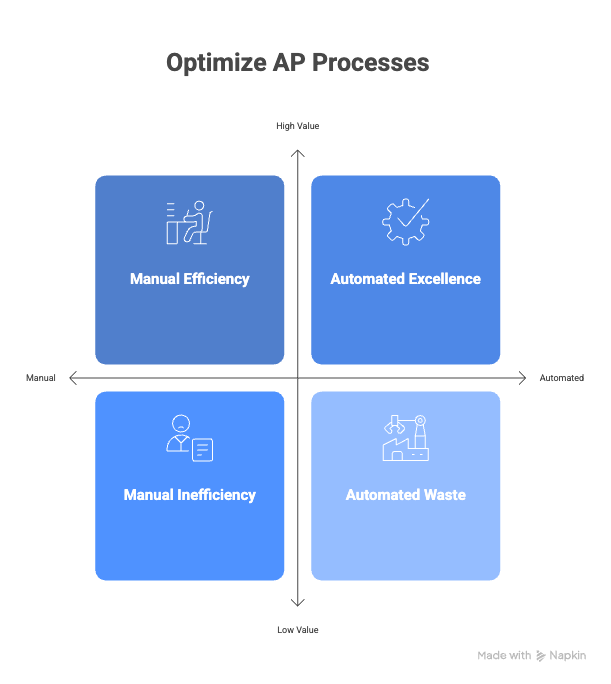
- Digitizing broken processes rather than redesigning them: Scanning paper invoices into a document management system is not AP automation — it is paper with extra steps. Genuine AP maturity requires process redesign alongside digitization.
- Low PO coverage undermining match rates: Three-way matching only works where purchase orders exist. Organizations with significant off-PO spend cannot achieve high touchless invoice rates regardless of AP system quality. PO compliance is a prerequisite for AP automation maturity.
- Treating AP maturity as a technology project rather than a change programme: Supplier onboarding to e-invoicing, buyer behavior change on PO creation, and approval process adoption all require sustained change management investment beyond the technology deployment.
- Neglecting supplier onboarding to e-invoicing: AP automation benefits accrue only from invoices received electronically in structured formats. Organizations that deploy automation without onboarding suppliers to e-invoicing see limited improvement in processing efficiency.
AP Maturity Stages
- Stage 1 — Manual: Paper invoices, manual data entry, physical approval routing. High cost per invoice, long cycle times, limited visibility.
- Stage 2 — Partial digitization: Scanning and OCR applied to invoices, basic electronic approval workflows. Reduced data entry but significant manual exception handling remains.
- Stage 3 — Automated matching: Three-way matching, automated approval routing, exception management. Touchless rates above 70% and analytics visibility into invoice and payment status.
- Stage 4 — Strategic AP: Full e-invoicing integration, real-time analytics, supply chain finance, AI-powered anomaly detection, and continuous data-driven improvement.
KPIs of Paperless Office and AP Maturity
| Dimension | Sample KPIs |
| Automation | Touchless invoice rate, three-way match rate, processing cost per invoice |
| Cycle Time | Average invoice approval cycle time, % paid within terms |
| Compliance | PO coverage rate, price match compliance vs. contracted terms |
| Working Capital | Days payable outstanding, dynamic discounting capture rate |
Key Terms in Paperless Office and AP Maturity
- Three-Way Matching: The automated comparison of an invoice against its corresponding purchase order and goods receipt to confirm consistency before payment approval.
- Touchless Invoice: An invoice processed through automated matching and approval to payment without any manual intervention.
- E-Invoicing: The electronic submission of invoices in structured digital formats — EDI, XML, or supplier portal — that enables automated processing.
- Days Payable Outstanding (DPO): The average number of days taken to pay supplier invoices — a key working capital metric influenced by AP maturity and payment term strategy.
Technology Enablement
AP automation platforms provide e-invoicing portals, OCR-based digitization, three-way matching engines, approval workflow automation, and payment analytics. Integration with procurement platforms ensures that contracted prices flow automatically into matching rules, while connection to treasury and ERP systems enables real-time working capital visibility and dynamic discounting programme management.
FAQs
Q1. What is AP maturity?
The progression of accounts payable operations from manual, paper-intensive processing toward fully automated, analytically capable, and strategically integrated invoice management.
Q2. What is a touchless invoice rate?
The proportion of invoices processed from receipt to payment without any manual intervention — the primary efficiency metric for AP automation maturity.
Q3. What is three-way matching?
The automated comparison of an invoice against the corresponding purchase order and goods receipt — confirming that what was ordered, received, and invoiced is consistent before payment.
Q4. Why is PO coverage important for AP maturity?
Three-way matching requires a purchase order to match against. Off-PO invoices cannot be automatically matched, limiting touchless rates regardless of automation capability.
Q5. How does AP maturity connect to procurement value?
AP is the mechanism through which procurement’s contracted terms are enforced in payment. High AP maturity confirms that negotiated prices are actually paid and that suppliers are paid in accordance with agreed terms.
Q6. How long does AP maturity transformation take?
Typically twelve to twenty-four months depending on supplier e-invoicing adoption, PO compliance improvement, and the complexity of the existing process environment.
References
- Whitepaper: E-invoicing Maturity Model for Accounts Payable Process Improvement
- Navigating the Shift: What is a Paperless Accounts Payable System?
- 8 Signs Your Business Needs Automated AP Systems
- AP Automation: E Invoicing Compliance Guidelines & Benefits: Zycus
- Reap The Benefits Of Autonomous Accounting By Embracing Touchless AP Processes Today










