



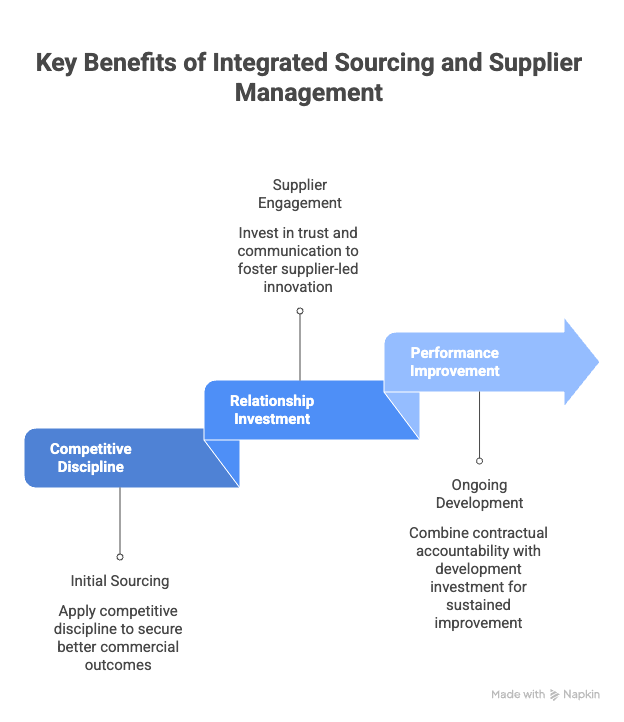
Better sourcing and supplier management describes the integration of competitive procurement discipline with sustained supplier relationship investment to deliver outcomes that neither approach achieves independently. Sourcing without supplier management produces contracts that underperform because relationships are not invested in and supplier capability is not developed. Supplier management without effective sourcing produces dependency and commercial complacency because competitive tension is never applied. Better sourcing and supplier management recognizes these as two sides of the same procurement value equation and manages them together.
Read more: Supplier Relationship Management: A Complete Guide to Strategic SRM
Why Better Sourcing And Supplier Management Matter in Procurement
High-performing procurement functions do not choose between competitive sourcing and deep supplier relationships — they sequence and balance both deliberately. They run rigorous competitive processes at renewal, then invest in the winning supplier to maximize relationship value. They develop strategic suppliers, then benchmark competitively to confirm market value. The integration of sourcing rigor and relationship investment is what separates genuinely high-performing procurement from functions that are either purely transactional or purely relational.
Download Report: Seven Keys to Better Sourcing and Supplier Management
The Core Process of Better Sourcing And Supplier Management
- Strategy and Segmentation: The process begins with category strategy that defines which suppliers are strategic, preferred, or transactional. Strategic suppliers receive relationship investment; preferred suppliers receive structured management; transactional suppliers are managed through efficient, competitive processes. The segmentation drives how sourcing and relationship management are balanced for each category.
- Competitive Sourcing Discipline: For categories where contracts are approaching renewal or new requirements emerge, rigorous competitive sourcing applies market testing, should-cost analysis, and structured evaluation to ensure commercial terms remain competitive. Supplier relationships do not exempt incumbents from competition — they are evaluated on merit alongside alternatives.
- Post-Award Relationship Investment: Following contract award, procurement transitions from competitive evaluation to relationship development. For strategic suppliers, this means joint planning sessions, business reviews, innovation pipeline engagement, and performance improvement programmes. The goal is to capture value from the relationship that the sourcing event alone cannot produce.
- Continuous Improvement and Benchmarking: Active supplier relationships are benchmarked against market performance continuously. If a strategic supplier’s pricing drifts above market or performance deteriorates, procurement has the data and the relationship capital to address it constructively before it escalates to a sourcing event.
Core Components of Better Sourcing And Supplier Management
- Supplier segmentation determines which suppliers receive which type of procurement investment — strategic relationship management for the few, structured performance management for the many, efficient transactional management for the rest. Misapplying strategic management to transactional suppliers wastes resource; misapplying transactional management to strategic suppliers destroys value.
- Sourcing rigor ensures commercial terms remain competitive through market testing, objective evaluation, and intelligence-backed negotiation. Relationship investment should produce better-than-market terms from suppliers who value the account.
- Joint value creation is the outcome of mature strategic relationships — shared innovations, process improvements, and capability development that generate returns for both parties.
- Performance governance maintains accountability through structured reviews, KPI tracking, and escalation processes that address underperformance before it becomes entrenched.
Common Pitfalls of Better Sourcing And Supplier Management
- Treating sourcing and supplier management as separate functions: Organizations that separate competitive sourcing from relationship management often find that neither delivers its full potential — sourcing wins contracts that relationships fail to maximize, or relationships preserve incumbents that sourcing would improve.
- Applying the same approach across all supplier segments: Deep relationship investment applied uniformly to all suppliers is inefficient; pure competitive focus applied to strategic suppliers destroys partnership value. Segmentation-driven differentiation is essential.
- Using relationship investment as a substitute for competitive benchmarking: Strong supplier relationships must be periodically tested against the market to confirm they still represent value. Unchallenged incumbency creates commercial complacency in suppliers and strategic blindness in procurement.
- Defining ‘better’ only as cheaper: Better sourcing and supplier management delivers better pricing, but also better quality, lower risk, faster innovation, and stronger supply continuity. Procurement functions measured only on savings optimize for one dimension at the expense of others.
What ‘Better’ Looks Like in Practice
- In sourcing: More structured processes, shorter cycle times, higher response rates, and award decisions that are analytically defensible.
- In supplier management:Higher satisfaction scores, more proactive issue escalation, joint innovation, and relationship health that sustains preferential treatment from key suppliers.
- In the combination: Category strategies reflecting both market intelligence and supplier knowledge; contracts that are commercially sharp and operationally workable.
KPIs of Better Sourcing And Supplier Management
| Dimension | Sample KPIs |
| Sourcing Outcomes | Savings delivered, contract coverage rate, sourcing cycle time, competitive market testing rate |
| Supplier Relationship | Strategic supplier satisfaction score, preferred customer status rate, innovation pipeline value |
| Combined Value | Total value delivered (cost + quality + risk + innovation) vs. category baseline |
| Segmentation Health | % of suppliers managed in the correct segment, review completion rate by tier |
Key Terms in Sourcing And Supplier Management
- Supplier Segmentation: The classification of suppliers into strategic, preferred, approved, and transactional tiers based on spend, strategic importance, and relationship value.
- Joint Value Creation: The collaborative generation of commercial or operational benefit by buyer and supplier together, beyond what either could achieve through transactional exchange alone.
- Preferred Customer Status: A designation from a supplier indicating that the buying organization receives priority treatment — capacity, pricing, innovation — based on relationship quality.
- Competitive Benchmarking: The periodic testing of incumbent supplier commercial terms against market alternatives to confirm ongoing value.
Technology Enablement
Source-to-Pay platforms support better sourcing and supplier management through integrated environments where sourcing event data, contract terms, supplier performance records, and relationship health metrics coexist in a single view. This integration enables category managers to move seamlessly between competitive sourcing activity and supplier development investment — maintaining both disciplines as part of a unified category management approach.
FAQs
Q1. What does better sourcing and supplier management mean?
The integration of competitive procurement discipline with sustained supplier relationship investment — applying rigorous sourcing to maintain market competitiveness and relationship management to capture value beyond the contract.
Q2. Do you have to choose between good sourcing and good supplier relationships? No. The best procurement functions do both — running rigorous competitive processes at renewal and investing deeply in strategic relationships between events.
Q3. How do you balance competitive sourcing with relationship investment? Through supplier segmentation. Strategic suppliers receive relationship investment; preferred suppliers receive structured management; transactional suppliers are managed through efficient competitive processes.
Q4. Does relationship investment reduce the need for competitive sourcing? No. Relationships must be periodically tested against the market to remain credible. Unchallenged incumbency leads to commercial complacency. Relationship investment should produce better-than-market terms — and competitive testing confirms it does.
Q5. What is joint value creation? The collaborative generation of commercial or operational benefit by buyer and supplier together — innovations, process improvements, shared savings — that pure transactional exchange cannot produce.
Q6. How do you know if your supplier management is genuinely better? Through supplier satisfaction scores, bid participation rates, preferred customer designations, and evidence of supplier-initiated improvements — behavioral indicators that the relationship is delivering value beyond compliance.










