


Supplier-centric procurement is an approach in which the buying organization deliberately designs its procurement processes, systems, and behaviors to reduce friction for suppliers and make engagement easier, more transparent, and more rewarding. Rather than treating supplier experience as incidental to procurement efficiency, supplier-centric procurement recognizes that the organizations most valued by their suppliers those that are easy to do business with, pay reliably, communicate clearly, and offer genuine partnership consistently attract better pricing, priority capacity, and supplier innovation than those that optimize exclusively for buyer-side control.
Why Supplier-Centric Procurement Matters
Being a preferred customer is a strategic asset. Suppliers allocate their best people, reserve capacity, and share intelligence with the customers they value most. Procurement functions that focus entirely on extraction — squeezing price, imposing process burden — systematically erode their preferred customer status. Supplier-centric procurement rebalances this by applying the same rigor to measuring and improving the supplier experience that procurement applies to its own operational performance.
The Core Process of Supplier-Centric Procurement
- Supplier Experience Mapping: The process begins by mapping the supplier’s journey through procurement — from initial qualification through onboarding, sourcing participation, purchase order receipt, delivery, invoicing, and payment. At each stage, friction points are identified: complex portals, slow approvals, unclear requirements, late payments, inconsistent communication.
- Priority Setting: Not all friction points carry equal weight. Procurement prioritizes improvements based on their impact on supplier behavior and the commercial value of the supplier relationships most affected. Improvements that affect strategic suppliers or high-volume categories are prioritized ahead of those affecting transactional relationships.
- Process and System Improvement: Identified friction is addressed through process redesign, system configuration, policy change, or behavior change within procurement teams. Common improvements include simplified onboarding, faster payment terms for strategic suppliers, clearer RFx requirements, and proactive communication on sourcing timelines.
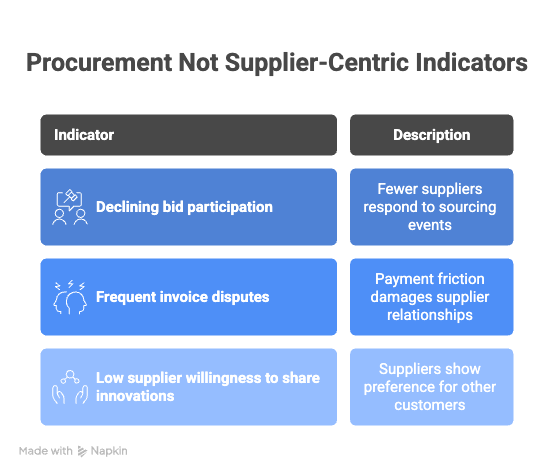
- Measurement and Feedback: Supplier experience is measured through structured surveys, relationship health assessments, and tracking of behavioral indicators — bid participation rates, response quality, willingness to negotiate. Results are shared with procurement leadership and used to drive continuous improvement.
Core Components of Supplier-Centric Procurement
- Supplier onboarding experience is often the first direct procurement interaction a new supplier has with the organization. Complex, slow, or opaque onboarding signals how the relationship will be managed and can deter capable suppliers from investing in the account.
- Payment reliability and terms transparency is one of the most consistently cited factors in supplier preference. Organizations that pay accurately, on time, and without requiring suppliers to chase outstanding invoices are disproportionately valued.
- Sourcing process clarity ensures that RFx documents are well-specified, evaluation criteria are published, timelines are realistic, and outcomes are communicated promptly. Suppliers who participate in clear, well-run processes are more likely to invest in quality responses.
- Relationship investment for strategic suppliers goes beyond transactional management to include regular business reviews, joint planning sessions, and genuine consideration of supplier feedback in procurement decisions.
Key Benefits of Supplier-Centric Procurement
- Increases the organization’s attractiveness as a customer, securing priority access to supplier capacity, preferential pricing, and first access to new capabilities.
- Improves sourcing event quality by attracting higher-quality responses from suppliers who regard the organization as a worthwhile partner to invest in.
- Reduces supplier attrition from the preferred supply base by making the relationship worth maintaining from the supplier’s perspective.
- Enables supplier innovation by creating the trust and communication channels through which suppliers share ideas and capabilities proactively.
Common Pitfalls of Supplier-Centric Procurement
- Treating supplier-centric procurement as a supplier relations initiative: Supplier experience is shaped by every procurement interaction — payment accuracy, system usability, process clarity. Improving it requires operational change, not relationship gestures.
- Applying supplier-centric principles uniformly across all tiers: Investment in supplier experience should be proportionate to the strategic value of the relationship. Strategic suppliers warrant deep investment; transactional suppliers need clear, efficient processes.
- Confusing supplier-centric with supplier-permissive: Supplier-centric procurement does not mean abandoning commercial discipline. It means applying standards in a way that is transparent, fair, and consistently communicated.
KPIs of Supplier-Centric Procurement
| Dimension | Sample KPIs |
| Supplier Experience | Supplier satisfaction score, onboarding completion rate, bid participation rate |
| Payment Performance | % of invoices paid on time, average payment cycle time, dispute rate |
| Sourcing Quality | Supplier response rate per RFx, average response quality score |
| Preferred Status | % of strategic suppliers rating buyer as preferred customer |
Key Terms in Supplier-Centric Procurement
- Preferred Customer Status: A designation given by a supplier to buyers who receive priority treatment — best pricing, first access to capacity, proactive sharing of innovations — based on the quality of the relationship.
- Supplier Experience: The cumulative impression a supplier forms of an organization based on every interaction across the procurement relationship lifecycle.
- Supplier Onboarding: The process through which a new supplier is registered, qualified, and activated — a critical first impression that shapes the supplier’s perception of the relationship.
- Bid Participation Rate: The proportion of invited suppliers who submit a compliant response to a sourcing event — a behavioral indicator of how attractive the organization is as a customer.
Technology Enablement
Source-to-Pay platforms support supplier-centric procurement through self-service supplier portals that simplify onboarding and invoice submission, transparent status tracking for purchase orders and payments, and supplier satisfaction survey tools integrated into the relationship management workflow. Analytics dashboards track bid participation rates, payment performance, and onboarding completion — the behavioral indicators that reveal how procurement is being experienced from the supplier’s perspective.
FAQs
Q1. What is supplier-centric procurement?
An approach that deliberately reduces friction for suppliers and improves the supplier experience across every procurement interaction, to secure preferred customer status and access better commercial outcomes.
Q2. Why should procurement care about the supplier experience?
Because suppliers allocate their best resources, pricing, and capacity to the customers they value most. Being an easy, reliable, and fair partner is a commercial advantage, not just a courtesy.
Q3. Does supplier-centric procurement mean giving up commercial discipline?
No. It means applying commercial standards in a way that is transparent, fair, and consistently communicated — not abandoning them in favour of supplier preferences.
Q4. How do you measure preferred customer status?
Through supplier satisfaction surveys, bid participation rates, willingness to innovate with the account, and direct conversations with key supplier contacts about how they rank the relationship.
Q5. What is the most impactful single improvement procurement can make for supplier experience?
Payment reliability — paying accurately and on time — is consistently the highest-ranked factor in supplier preference surveys and the most operationally straightforward to improve.
Q6. How often should supplier experience be measured?
Annual surveys for the broader supply base; ongoing relationship health tracking for strategic suppliers through business review feedback and account manager input.
References
- Supplier Relationship Management: A Complete Guide to Strategic SRM
- Unlocking Efficiency: The Pros and Cons of Supplier Managed Inventory
- Supplier Management–Benefits, Process, & Best Practices
- Supplier Vetting 101: Best Practices for Identifying Top Performers
- A 5-Step Process to Effective Supplier Management
- Supplier Risk And Performance Management: Best Practices For KPI Creation
- Essential Components of a World-Class Supplier Performance Management Tool: A MENA Perspective