



Managing supply chain volatility is the discipline of designing procurement and supply chain operations to absorb, respond to, and recover from rapid changes in demand, supply, cost, and conditions — without sacrificing service to the business or value to the enterprise. It is not about eliminating volatility, which has become structural in global supply chains, but about reducing the cost of operating within it. Volatility management blends strategic choices (sourcing footprint, supplier diversification, inventory positioning) with operational capabilities (early warning, rapid response, dynamic re-planning) to keep the supply chain steady when the environment is not.
Why It Matters in Procurement
The era of stable demand patterns, predictable lead times, and slow-moving costs is over. Procurement teams now operate inside persistent volatility in commodity prices, supplier availability, logistics capacity, and geopolitical conditions — and the businesses they serve still expect service, savings, and supplier performance to hold steady. Without deliberate volatility management, procurement absorbs every disruption through emergency response, premium spend, and stakeholder firefighting. With deliberate volatility management, procurement converts disruption into a category of risk it is structurally prepared to handle — preserving margin, service, and credibility through the cycle.
The Core Process of Managing Supply Chain Volatility
- Volatility Source Identification. The process begins by identifying where volatility actually originates in the supply chain — demand-side (customer behaviour, seasonality, market shifts), supply-side (supplier capacity, raw material availability), logistics (capacity, transit time), cost (commodity, currency, energy). Each source has different signals and different responses.
- Exposure Assessment. Each category and supplier relationship is assessed for volatility exposure — which categories are most volatile, which suppliers most vulnerable, which inputs most concentrated. Exposure assessment focuses investment where it most reduces vulnerability.
- Strategic Positioning. Strategic choices reduce volatility exposure structurally — supplier diversification, geographic footprint, dual-sourcing, longer-term agreements with flexibility clauses, strategic inventory positioning. These decisions take time to implement but shape long-term resilience.
- Early Warning and Signal Monitoring. Continuous monitoring detects volatility before it becomes disruption — commodity indices, supplier financial health, logistics capacity signals, geopolitical developments, demand pattern shifts. Earlier signals enable earlier response.
- Dynamic Response Activation. When signals indicate impending volatility, predefined responses activate — alternative supplier engagement, inventory build, contract clause execution, customer prioritisation. The response is planned, not improvised.
- Recovery and Learning. As each volatility event resolves, structured review captures what worked, what failed, and how the next response can be sharper. Volatility management compounds through institutional learning.
Core Components of Managing Supply Chain Volatility
- Volatility intelligence is the continuous information flow that detects volatility early — internal signals, supplier signals, market signals, geopolitical signals — aggregated and prioritised for procurement attention.
- Scenario library captures the volatility scenarios procurement has prepared for — demand shocks, supplier failure, commodity spikes, logistics disruption — with response plans ready to activate.
- Flexibility clauses in supplier contracts create the contractual room to respond — volume bands, term flex, price adjustment mechanisms, alternative sourcing rights — built into the agreement rather than negotiated under pressure.
- Inventory and capacity buffers position physical resilience where it most reduces volatility exposure — finished goods for demand volatility, raw materials for supply volatility, capacity headroom for surge events.
- Cross-functional response capability connects procurement to demand planning, operations, finance, and the business — because volatility responses almost always require cross-functional decisions made quickly.
Key Benefits of Managing Supply Chain Volatility
- Reduces the cost of disruption by replacing emergency response with rehearsed response — premium spend, expedite costs, and lost service all decline.
- Protects service levels through periods of supply or demand instability, preserving customer trust and revenue.
- Improves financial predictability by limiting the volatility that flows through to procurement cost and supply availability.
- Strengthens procurement’s strategic credibility by demonstrating the function can deliver value even when conditions are adverse.
- Creates competitive advantage in industries where peers are absorbing volatility less effectively.
Common Pitfalls of Managing Supply Chain Volatility
- Confusing absence of recent volatility with absence of exposure. A category quiet for two years may be one geopolitical event from severe disruption. Exposure assessment matters even when conditions are calm.
- Buying resilience without optimising its cost. Inventory buffers, dual-sourcing, and capacity reserves all cost money. Volatility management should target the most cost-effective resilience, not maximum resilience regardless of cost.
- Treating volatility as a temporary state to wait out. Procurement leaders who assume conditions will return to pre-volatility norms have built strategies that no longer fit the operating environment. Volatility is structural; planning should reflect that.
- Underinvesting in signal infrastructure. Volatility responses are only as good as the signals that trigger them. Organizations with strong response playbooks but weak detection respond too late.
Where Volatility Most Often Hits Procurement
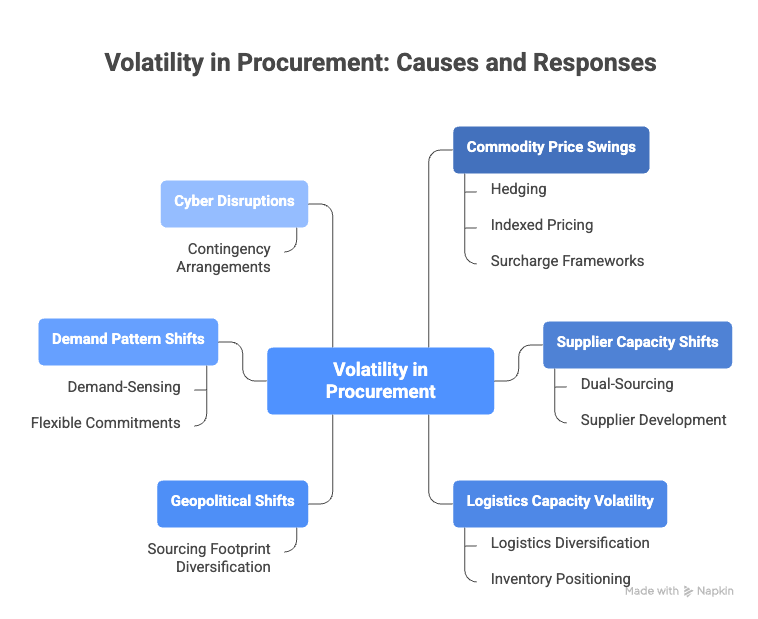
- Commodity price swings. Raw materials, energy, and freight prices move rapidly and substantially — directly affecting cost positions and supplier viability. Hedging, indexed pricing, and surcharge frameworks are common responses.
- Supplier capacity and availability shifts. Suppliers tighten capacity, exit categories, or fail entirely — leaving demand without supply. Dual-sourcing and supplier development reduce exposure.
- Logistics capacity and lead time volatility. Ocean, air, and ground capacity fluctuate with cost, availability, and reliability all moving — particularly across major lanes. Logistics diversification and inventory positioning provide buffer.
- Geopolitical and regulatory shifts. Tariffs, sanctions, trade restrictions, and regulatory changes redraw sourcing maps with little notice. Sourcing footprint diversification provides structural resilience.
- Demand pattern shifts. Customer behaviour changes — accelerating in some categories, collapsing in others — leaving procurement with mismatched supply commitments. Demand-sensing and flexible commitments provide response room.
- Cyber and operational disruptions. Supplier cyber incidents, plant outages, and operational failures translate to supply disruption, often with little forward warning. Contingency arrangements matter most here.
KPIs of Managing Supply Chain Volatility
| Dimension | Sample KPIs |
| Exposure | % of critical spend with diversified sourcing, supplier concentration in critical categories |
| Detection | Mean time from volatility signal to internal awareness, % of disruption events detected before service impact |
| Response | Mean time from signal to response activation, premium cost incurred per volatility event |
| Outcome | Service level maintained during volatility events, cost variance vs. plan during volatility periods |
Key Terms in Managing Supply Chain Volatility
- Volatility: Rapid, often large, fluctuation in demand, supply, cost, or operating conditions — the operating environment procurement increasingly works within.
- Resilience: The capacity of the supply chain to absorb disruption and recover with minimal lasting impact — the structural counterpart to volatility management.
- Dual-Sourcing: Maintaining two qualified suppliers for a category to reduce exposure to single-supplier failure — a primary volatility-management lever.
- Flexibility Clause: A contractual provision allowing volume, term, or price adjustment in response to defined conditions — built-in volatility response.
- Demand Sensing: Short-cycle demand signal capture that improves forward visibility — reducing the surprise component of demand volatility.
- Surge Capacity: Pre-arranged ability to scale supply quickly when demand or disruption requires — purchased through agreements, inventory, or capacity reservations.
Technology Enablement
Modern Source-to-Pay platforms support volatility management through continuous risk and market intelligence, supplier capacity visibility, contract flexibility tracking, and scenario modeling tools that let procurement test responses before deploying them. Platform-native deployment compresses detection-to-response cycles and provides the data foundation volatility management depends on.
FAQs
Q1. What is supply chain volatility?
Rapid, often large, fluctuation in demand, supply, cost, or operating conditions across the supply chain — the structural operating environment most categories now face.
Q2. How is volatility management different from risk management?
Risk management focuses on identifying and mitigating specific risks. Volatility management focuses on the operating capability to absorb and respond to rapid change — broader and more continuous than discrete risk events.
Q3. Can procurement eliminate volatility?
No. Volatility is structural in global supply chains. The discipline is to manage exposure, accelerate response, and reduce the cost of operating within volatility — not to eliminate it.
Q4. What is the role of inventory in managing volatility?
Inventory absorbs volatility — demand-side or supply-side — at the cost of working capital. Strategic inventory positioning targets the categories where the cost of holding is less than the cost of volatility exposure.
Q5. Why is dual-sourcing a common volatility response?
Because single-source dependence concentrates volatility exposure in one supplier’s capacity, availability, and reliability. Dual-sourcing creates response options when one source becomes constrained.










