



Contract story scripting is the practice of structuring the narrative behind a contract negotiation or renewal — defining the commercial story procurement will tell, the sequence in which it will be told, and the evidence that supports each element. It applies storytelling discipline to contract preparation: understanding the audience, identifying the key messages, anticipating objections, and constructing a logical arc from current state to desired outcome. Contract story scripting transforms negotiation preparation from a data-gathering exercise into a persuasion strategy.
Why Contract Story Scripting Matters in Procurement
Procurement professionals who win better contract outcomes are rarely those with the most data — they are those who present their case most compellingly. Data without narrative is noise. A compelling contract story organizes evidence into a sequence that moves the counterparty toward the desired outcome by framing the procurement position persuasively, addressing objections before they are raised, and making the desired resolution feel inevitable rather than contested. In complex negotiations — renewals, multi-year agreements, strategic partnerships — the quality of the commercial story determines outcomes as much as the underlying commercial position.
The Core Process of Contract Story Scripting
- Audience and Stakeholder Analysis: The script begins with understanding who will be in the room — their authority level, commercial priorities, risk appetite, and what a successful outcome looks like from their perspective.
- Current State Definition: The story establishes where the organization is today — current pricing, performance history, contract terms, and the gap between current value received and what the market demonstrates is available. This section must be fact-based and defensible; it is the foundation on which the desired outcome rests.
- Market Evidence Assembly: Procurement assembles the intelligence that validates the current state gap — benchmark pricing, competitive quotes, and should-cost analysis. Evidence must be credible, current, and presentable in a format the audience can evaluate without specialist knowledge.
- Desired Outcome and Closing Argument: The script concludes with the specific outcome procurement is seeking — revised pricing, improved terms, service level enhancements — framed as the logical consequence of the evidence presented. The closing argument connects the current state gap to the desired resolution in a way that makes the counterparty’s path of least resistance the agreement procurement needs.
Core Components of Contract Story Scripting
- Opening hook establishes the context and stakes of the negotiation — why this conversation matters, what the outcome affects, and why now is the right time. A weak opening allows the counterparty to frame the agenda before procurement does.
- Evidence hierarchy organizes market intelligence and cost analysis in a sequence that builds the case incrementally — from broadly accepted facts toward specific conclusions. Jumping to conclusions before establishing evidence invites challenge rather than agreement.
- Concession strategy defines what procurement will give up and in what sequence — so concessions are perceived as deliberate gestures rather than capitulations under pressure.
Key Benefits of Contract Story Scripting
- Improves negotiation outcomes by presenting procurement’s commercial position persuasively rather than as a data dump the counterparty must interpret.
- Reduces cycle time by anticipating and addressing objections within the script rather than encountering them unexpectedly during the negotiation.
- Creates a reusable framework that improves in quality over time as scripts are refined based on negotiation outcomes.
Common Pitfalls of Contract Story Scripting
- Leading with data before establishing context: Presenting benchmarking tables or pricing comparisons before establishing the current state and why it matters invites technical counter-arguments rather than commercial agreement. Context before evidence.
- Writing the script for procurement rather than the counterparty: A contract story that is internally logical but does not address what the counterparty cares about will fail in the room. The script must be written from the audience’s perspective, not procurement’s.
- No concession strategy: Entering a negotiation without a defined concession boundary and sequence exposes procurement to improvised giving that erodes the commercial outcome. Every concession should be planned, valued, and traded deliberately.
- Treating the script as a presentation rather than a conversation: Contract story scripting prepares the narrative; it does not script the entire interaction. Procurement must be prepared to adapt the story in response to what the counterparty raises, not recite a monologue.
Elements of a Strong Contract Story
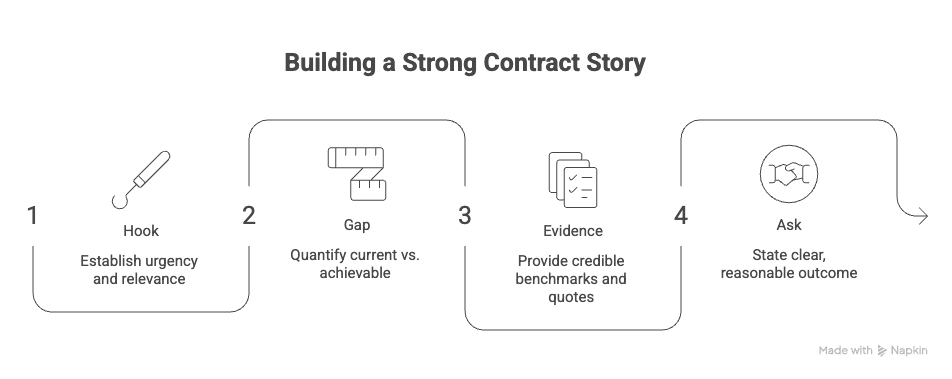
- The hook: Why this conversation must happen now — market movement, contract expiry, performance deterioration, or competitive alternative.
- The gap: What the current contract delivers versus what the market shows is achievable — quantified in financial or performance terms.
- The evidence: Benchmarks, quotes, or should-cost analysis that makes the gap credible and hard to dispute.
- The ask: The specific outcome procurement is seeking — stated clearly, framed as reasonable, and connected logically to the gap and evidence.
- The path forward: Practical next steps that move toward closure — a follow-up meeting, revised proposal request, or deadline that creates urgency without ultimatum.
KPIs of Contract Story Scripting
| Dimension | Sample KPIs |
| Preparation Quality | % of contract negotiations with completed story script, objection response coverage |
| Outcome Quality | Commercial outcome vs. target position, concession value vs. planned boundary |
| Cycle Time | Time from negotiation opening to heads of terms agreement |
| Capability | Team scripting completion rate, post-negotiation debrief and script improvement rate |
Key Terms in Contract Story Scripting
- Negotiation Script: A structured preparation document defining the narrative, evidence sequence, objection responses, and concession strategy for a contract negotiation.
- Concession Strategy: A pre-planned sequence of what procurement is willing to give up and in what order — ensuring concessions are deliberate gestures, not improvised capitulations.
- Opening Hook: The framing statement that establishes the context and stakes of a negotiation at the outset, before the counterparty has an opportunity to set the agenda.
- Objection Anticipation: The pre-identification of the counterparty’s likely challenges to the procurement position, with prepared responses ready to neutralize each.
- BATNA (Best Alternative to a Negotiated Agreement): The most favorable outcome procurement can achieve if the negotiation fails — the foundation of negotiating strength and the reference point for concession boundaries.
Technology Enablement
Contract management platforms support story scripting by providing access to historical contract performance data, market benchmarking integrations, and negotiation preparation templates. AI-powered contract analytics tools can automatically surface pricing variances, term deviations, and performance gaps — providing the evidence foundation that the contract story is built on, without requiring manual data assembly from multiple sources.
FAQs
Q1. What is contract story scripting?
The practice of structuring the narrative behind a contract negotiation — defining the commercial story, the evidence sequence, objection responses, and concession strategy before entering the room.
Q2. How is scripting different from negotiation preparation?
Standard preparation gathers data. Scripting organizes that data into a persuasive narrative — a logical sequence that moves the counterparty toward the desired outcome rather than presenting facts for them to interpret.
Q3. What is a concession strategy and why does it matter?
A pre-planned sequence of what procurement will give up and in what order. Without it, concessions are improvised under pressure and typically larger and more frequent than they need to be.
Q4. What is BATNA and why does it matter for contract scripting?
BATNA is procurement’s best alternative if the negotiation fails. It defines the minimum acceptable outcome and sets the concession boundary — below which walking away is better than agreeing.
Q5. When is contract story scripting most valuable?
In high-value renewals, complex multi-year agreements, sole-source negotiations, and any situation where commercial outcome depends as much on persuasion as on price competitiveness.
References
- Contract Automation: Transforming Procurement with Futuristic Process Analysis Techniques
- Whitepaper: The Why, What & How of Contract Management
- Solution: Next-Gen Contract Lifecycle Management (CLM) Software
- Leveraging Technology to Resolve Post-War Contract Management Challenges
- 5 Reasons Why You Need a Contract Management Software










