



A breach of contract occurs when one party to a legally binding agreement fails to fulfil its obligations without lawful justification. In procurement, this may involve a supplier failing to deliver goods on time, providing services below the agreed quality standard, charging prices outside contracted terms, or violating confidentiality obligations. It may also arise on the buyer’s side through failure to pay, refusal to accept delivery, or unilateral changes to agreed terms. Understanding breach of contract is essential for procurement professionals who manage supplier agreements and enforce contractual rights.
Why Breach of Contract Matters in Procurement
Contracts are the primary mechanism through which procurement holds suppliers accountable. When a breach is not addressed, it erodes contractual discipline across the supply base. Procurement teams that recognize breaches early, document them properly, and escalate correctly protect the organization’s legal position. Failure to act on a known breach can weaken the ability to enforce remedies later.
Read more: 5 Most Common Mistakes in Procurement and How to Solve Them
The Core Process of Breach Of Contract
Breach Identification: The process begins when procurement or the contract manager identifies a failure to perform against a specific contractual obligation — a missed delivery milestone, a quality non-conformance, an invoice above the contracted rate, or a failure to maintain required certifications. The obligation breached must be clearly identified and supported by evidence.
Documentation and Notice: The breach is documented with specificity: which clause was breached, when, the contracted requirement, and what actually occurred. A formal notice is then issued to the supplier per the contract’s prescribed form — describing the breach, referencing the relevant clause, stating the required remedy, and setting a cure timeline.
Cure Period and Escalation: The supplier is given the contractual timeframe to remedy the breach. If they do so, the matter may be resolved without further action. If they do not, procurement escalates to available remedies — financial penalties, contract suspension, or termination — depending on severity and what the contract permits.
Core Components of Breach of Contract
- Breach identification and evidence require clear documentation of the specific obligation, the contractual standard, and the deviation. Vague or undocumented breaches are difficult to enforce and weaken the organization’s legal position.
- Formal notice is the legal act of informing the supplier that a breach has occurred. Most contracts prescribe how notice must be served — typically in writing, to a named contact, within a defined timeframe. Failure to follow the notice procedure can invalidate the claim.
- The cure period and escalation define the timeline within which the supplier must remedy the breach and the consequences if they do not. These provisions must be tracked carefully to preserve the right to escalate.
- Remedies and enforcement are the contractual actions available to the buyer following an unresolved breach, including damages, service credits, step-in rights, and termination. Procurement must understand which remedies are available under each contract before deciding how to proceed.
Key Benefits of Breach of Contract
- Preserves the organization’s legal and commercial rights by ensuring breaches are formally documented and notified within contractual timeframes.
- Creates accountability in the supply base by demonstrating that contractual obligations are actively monitored and enforced.
- Enables recovery of damages or service credits that compensate for the financial impact of supplier non-performance.
- Supports termination for cause when a supplier’s failure to perform justifies ending the relationship, rather than being locked into a failing contract.
Common Pitfalls of Breach Of Contract
- Informally raising issues without formal notice: Addressing a breach through conversations or email without issuing formal notice as required by the contract may reset the clock or waive the right to enforce remedies later.
- Missing contractual notice deadlines: Many contracts specify that breach notices must be served within a defined period of the breach occurring. Delays beyond that window can extinguish the right to claim.
- Accepting partial performance without reserving rights: Accepting substandard delivery or below-spec services without explicitly reserving the right to claim for the breach can be construed as acceptance of the defective performance.
KPIs of Breach Of Contract
| Dimension | Sample KPIs |
| Breach Detection | # of breaches identified per period, average time from breach to identification |
| Notice Compliance | % of breaches formally notified within contract timeframe |
| Resolution Rate | % of breaches resolved within cure period, escalation rate |
| Financial Recovery | Damages or service credits recovered vs. loss incurred |
Key Terms in Breach Of Contract
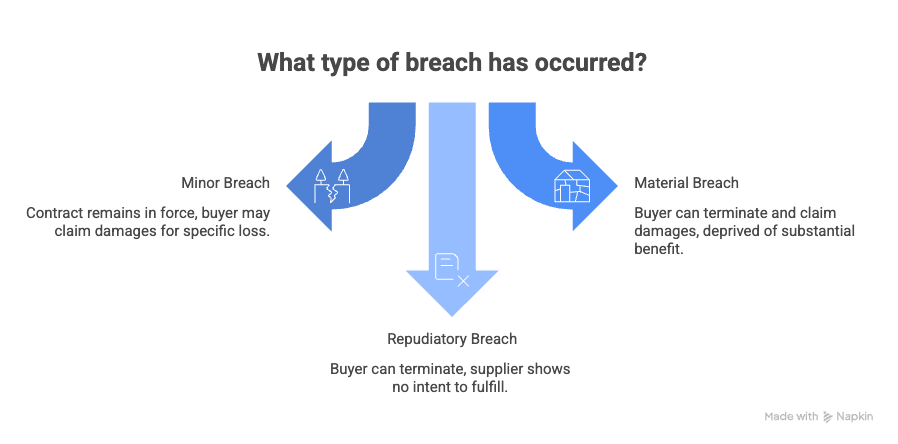
- Material Breach: A significant contractual failure that deprives the innocent party of the benefit they contracted for, typically triggering termination rights.
- Cure Period: The contractual timeframe within which a party in breach must remedy the failure before the other party can exercise further remedies.
- Notice of Breach: A formal written communication informing the breaching party of the specific failure, the relevant contract clause, and the required remedy.
- Damages: Financial compensation owed to the innocent party to put them in the position they would have been in had the breach not occurred.
- Termination for Cause: The right to end a contract on the basis of a material or persistent breach, as distinct from termination for convenience.
Technology Enablement
Contract management platforms support breach management through obligation tracking tools that flag missed milestones, performance monitoring dashboards that surface delivery and quality deviations, and document management systems that store notices, correspondence, and evidence in a structured audit trail. These capabilities help procurement identify and respond to breaches faster and with better-documented positions.
FAQs
Q1. What is a breach of contract?
A failure by one party to fulfil its contractual obligations without lawful justification.
Q2. What is the difference between a minor and a material breach?
A minor breach involves partial non-performance that can be remedied. A material breach is a fundamental failure that deprives the buyer of what they contracted for and typically triggers termination rights.
Q3. Can informal communication count as a breach notice?
Usually no. Most commercial contracts require written notice to a named contact within a defined period. Informal communication typically does not satisfy this requirement.
Q4. What remedies are available for breach of contract?
Damages, service credits, step-in rights, suspension of payment, and termination for cause are the most common remedies available to buyers.
Q5. When can a contract be terminated for breach?
When the breach is material or when a supplier fails to cure within the contractual remedy period, termination for cause is typically available under the contract’s termination provisions.
References
For further insights into these processes, explore the following Zycus resources related to Breach of Contract: