Acquisition cost is the total cost incurred by an organization to obtain a good, service, or asset, encompassing not just the **purchase price** but all associated costs required to bring it into use. This includes transportation, import duties, inspection fees, installation, onboarding, and any other expenses directly attributable to securing and activating the item. In procurement, acquisition cost provides a more complete picture of value than invoice price alone, supporting better sourcing decisions and more accurate total cost comparisons across suppliers.
Why Acquisition Cost Matters in Procurement
Procurement decisions based solely on unit price routinely underestimate the true cost of a purchase. A supplier offering a lower headline price may impose higher freight costs, longer lead times requiring larger safety stock, or higher inspection failure rates that generate rework expense. Acquisition cost thinking forces procurement to surface and quantify these factors before making sourcing decisions — particularly important in categories where ancillary costs can rival or exceed the purchase price itself.
Read more: Strategic Vendor Sourcing: Best Practices for Cost, Risk, and Sustainability
The Core Process of Acquisition Cost
The process begins with cost identification. Procurement defines all cost elements relevant to acquiring a specific good or service, going beyond the quoted price to include freight, customs, insurance, receiving and inspection, storage, and any costs associated with getting the item ready for use. The specific elements vary by category; a capital equipment purchase will have different cost drivers than a consumable supply.
Cost data is gathered from internal records, supplier quotes, and third-party sources. For new categories, some elements may need to be estimated based on comparable purchases or market rates, documented and refined once actual data becomes available.
Acquisition costs are aggregated and incorporated into sourcing decisions. When evaluating competing suppliers, total acquisition cost becomes the comparison basis, ensuring a lower-priced supplier with higher logistics or compliance costs does not win on headline price alone.
Post-purchase, actual acquisition costs are tracked against estimates. Variances improve future cost modeling and reveal where category cost structure can be improved through negotiation, logistics optimization, or process change.
Core Components of Acquisition Cost
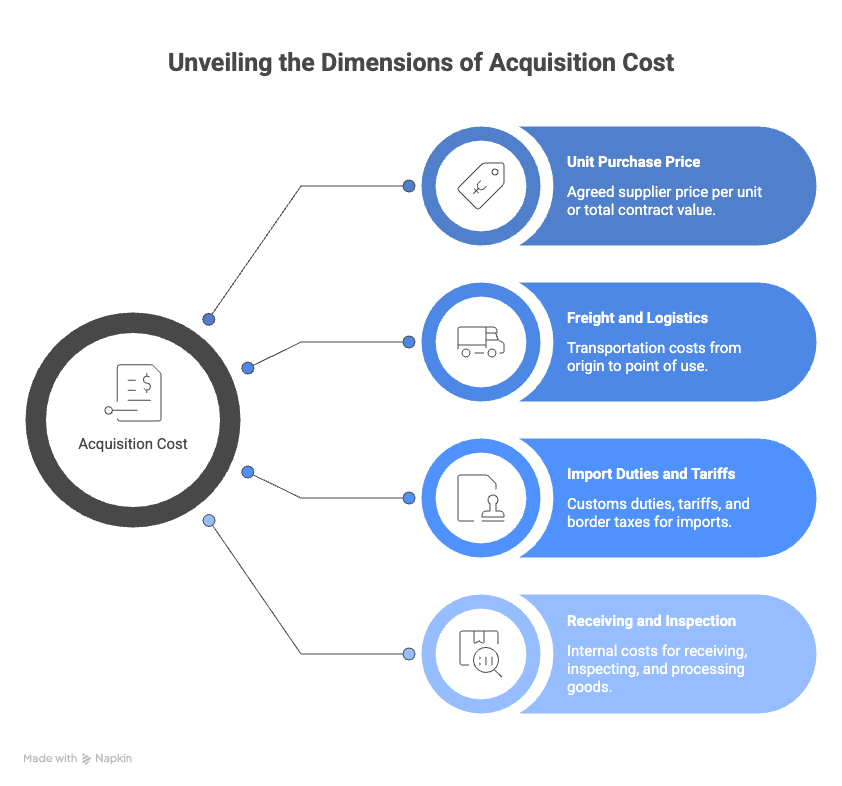
- Purchase price is the starting point but rarely the complete picture. It reflects the agreed unit or contract price and forms the largest component of acquisition cost in most categories.
- Logistics and transportation costs cover freight, insurance, and handling from the supplier’s facility to the buyer’s point of use. These can be substantial for international or bulky goods.
- Compliance and regulatory costs include import duties, customs brokerage, tariffs, and inspection fees applicable to specific goods or origin countries.
- Receiving and onboarding costs cover the internal labor, inspection, storage, and preparation required before the item is ready for use.
Key Benefits of Acquisition Cost
- Enables more accurate supplier comparisons by replacing headline price with a comprehensive cost view that reflects the true cost of sourcing from each option.
- Identifies hidden cost drivers that can be targeted for savings through logistics optimization, duty reduction, or supplier consolidation.
- Improves budget accuracy by ensuring procurement plans reflect what will actually be spent rather than the invoice value alone.
Common Pitfalls of Acquisition Cost
- Treating quoted price as total cost: Many sourcing decisions are made on invoice price without accounting for freight, duty, or receiving costs that can significantly alter the comparative picture.
- Failing to update cost models when conditions change: Freight rates, duty structures, and exchange rates fluctuate. Acquisition cost models built on historical data must be refreshed to remain accurate.
- Inconsistent cost element inclusion across supplier comparisons: If freight is included for one supplier but excluded for another, the comparison is invalid. Cost element definitions must be applied consistently across all options evaluated.
- Ignoring internal processing costs: The cost of receiving, inspecting, and onboarding a purchase is a real acquisition cost that many organizations omit, leading to underestimates for complex or high-volume categories.
KPIs of Acquisition Cost
| Dimension | Sample KPIs |
| Cost Accuracy | Variance between estimated and actual acquisition cost by category |
| Cost Composition | Ancillary costs as % of total acquisition cost (freight, duty, receiving) |
| Savings Identification | Savings achieved through acquisition cost reduction vs. price-only negotiation |
| Model Coverage | % of spend categories with documented acquisition cost models |
Key Terms in Acquisition Cost
- Total Cost of Ownership (TCO): A broader cost framework that extends beyond acquisition to include operating, maintenance, and disposal costs over the full life of an asset or relationship.
- Landed Cost: The total cost of a product once it has been delivered to a specified destination, including purchase price, freight, insurance, and import duties.
- Freight-on-Board (FOB): A shipping term that defines the point at which ownership and responsibility for freight costs transfer from seller to buyer.
- Cost Modeling: The process of building a structured representation of all cost elements associated with a purchase to support planning and decision-making.
- Invoice Price: The price stated on a supplier’s invoice, which represents only one component of total acquisition cost.
Technology Enablement
Source-to-Pay platforms support acquisition cost analysis through spend analytics that capture all cost elements, cost breakdown templates within RFx tools, and total cost comparison modules that aggregate acquisition cost components across competing bids
FAQs
Q1. What is acquisition cost?
The total cost of obtaining a good, service, or asset, including purchase price and all associated costs required to bring it into use.
Q2. How is acquisition cost different from purchase price?
Purchase price is the amount on the invoice. Acquisition cost adds freight, duties, inspection, storage, and other costs incurred in securing and activating the item.
Q3. How is acquisition cost different from total cost of ownership?
Acquisition cost covers the costs of obtaining an item. TCO extends further to include operating, maintenance, and end-of-life costs over the full usage period.
Q4. Which categories benefit most from acquisition cost analysis?
Categories with complex logistics, international sourcing, regulatory compliance requirements, or significant receiving and handling costs show the greatest benefit.
Q5. Can acquisition cost analysis change a sourcing decision?
Yes. When ancillary costs are material, a supplier with a higher unit price but lower total acquisition cost can represent better value than the cheapest-quoted option.
Q6. How often should acquisition cost models be updated?
At minimum annually, and whenever significant changes occur in freight rates, duty structures, exchange rates, or supplier logistics arrangements.
References
Here are 3 Zycus resources related to Acquisition Cost: