


WHAT IS THE PROCUREMENT ACT 2023?
The Procurement Act 2023 is the UK law that governs how public bodies buy goods, services and works. It replaced the earlier EU-derived procurement regulations for England, Wales and Northern Ireland from 24 February 2025. It sets the procedures, notices, award rules and transparency duties that contracting authorities and suppliers follow.
WHY IT MATTERS IN PROCUREMENT
For public sector buyers, the Act changes how procurements are planned, run and reported. For suppliers, it changes how opportunities are found and how awards can be challenged. Private companies that sell to the UK public sector need to understand it, because tender timelines, notices and evaluation rules follow its structure.
The Act aims to make procurement simpler, more flexible and more transparent. It consolidates the number of procedures, puts more emphasis on public benefit and small business access, and increases publication of notices and contract information. The Act also requires conflicts of interest to be assessed and sets 30-day payment terms that flow down public supply chains. Scotland has its own regime, and the Act sits alongside separate rules for some sectors. Confirm the rules for each procurement with legal advice.
THE CORE PROCESS / LIFECYCLE
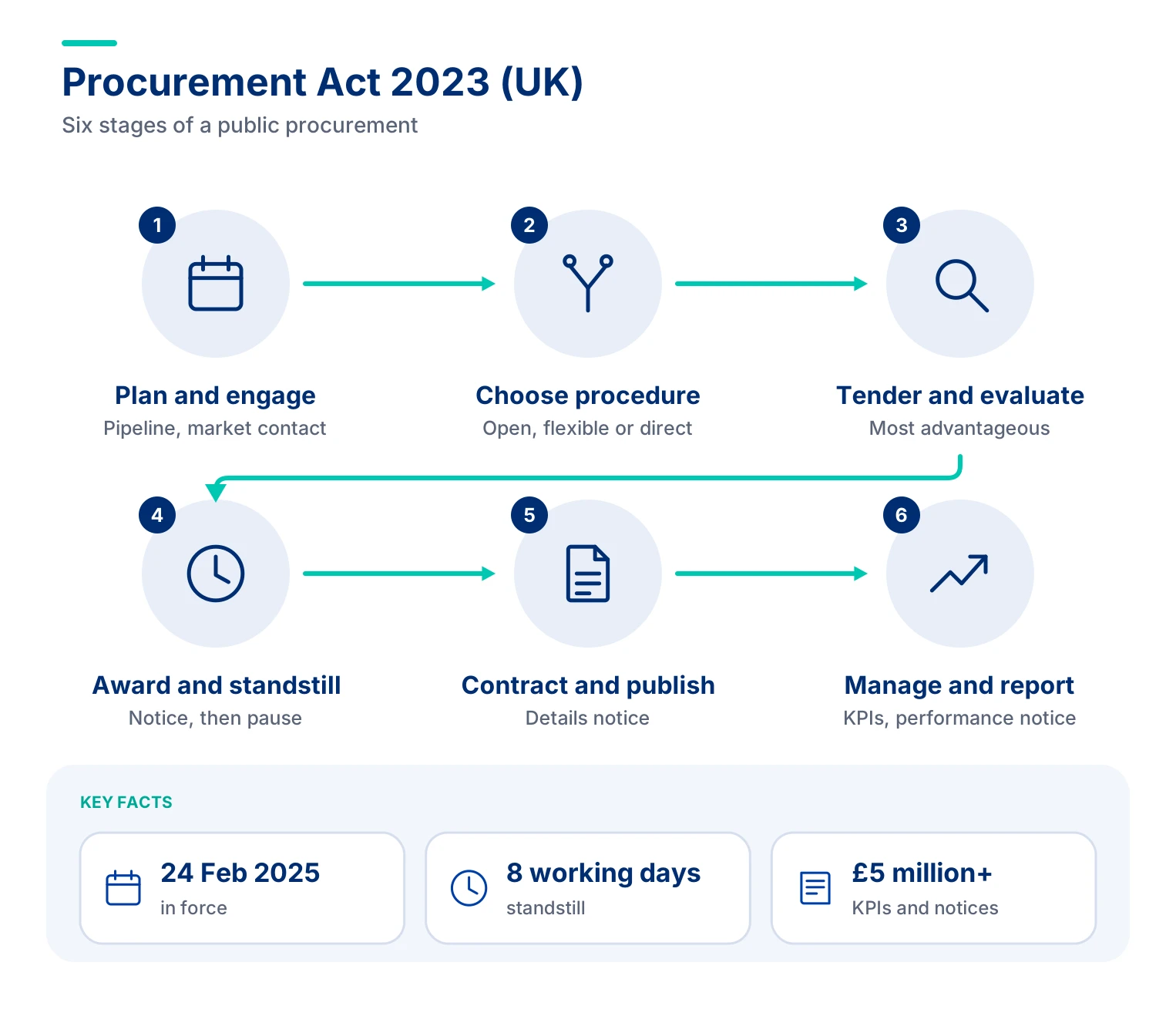
- Plan and Engage. The authority publishes its pipeline for larger spend, may run preliminary market engagement with a notice, and sets its requirements and award approach.
- Choose the Procedure. The authority picks the open procedure, the competitive flexible procedure, or, in limited cases, a direct award, with a framework or dynamic market where suitable.
- Tender and Evaluate. A tender notice invites bids. Tenders are assessed against published criteria to find the most advantageous tender.
- Award and Standstill. The authority sends assessment summaries and publishes a contract award notice. A mandatory standstill period of eight working days then applies before the contract is entered into.
- Contract and Publish. The contract is signed and a contract details notice is published. Contracts above £5 million are also published.
- Manage and Report. For contracts above £5 million, key performance indicators are set and an annual contract performance notice is published. Changes follow the modification rules.
CORE COMPONENTS
Procedures are the open procedure, the competitive flexible procedure and direct award. Most advantageous tender replaces the earlier most economically advantageous tender and allows a wider view of public benefit. Notices run through the lifecycle, from planned procurement to contract performance. Central digital platform is where suppliers register once and notices are published. Exclusion and debarment let authorities exclude suppliers on listed grounds, and a debarment list records them. Standstill and remedies give unsuccessful suppliers time to challenge before a contract is concluded.
KEY BENEFITS
A single framework with fewer procedures reduces complexity for authorities and suppliers. The competitive flexible procedure allows dialogue and negotiation for complex needs, which the old rules handled in several separate procedures.
Greater transparency helps suppliers, particularly smaller ones, to see opportunities earlier and understand why they won or lost. Published performance information gives authorities a stronger basis for managing suppliers. Wider award criteria let authorities consider social value and other public benefits, alongside price and quality. A central registration reduces repeated form filling.
COMMON PITFALLS
- Assuming the old rules still apply. Procurements started before 24 February 2025 continue under the earlier regime, so check which rules govern each one.
- Treating most advantageous tender as price only. The criteria must be published and can include quality and public benefit, so bids that ignore them lose points.
- Missing notices. Notices drive timelines and challenge rights, so missed publications can cause delay or challenge.
- Ignoring contract management duties. Performance notices for larger contracts need KPIs set at the start, and later changes follow the modification rules.
PROCEDURES AND WHEN EACH FITS
The Act groups competitive procurement into two main procedures, plus direct award in limited circumstances.
| Procedure | How it works | Typical use |
| Open procedure | One stage. Any interested supplier can bid, and all tenders are assessed. | Clear, stable requirements |
| Competitive flexible procedure | Authority designs its own process, with shortlisting, dialogue or negotiation as needed. | Complex or innovative needs |
| Direct award | Contract awarded without competition on allowed grounds. | Limited cases, such as urgency or a single possible supplier |
| Frameworks and dynamic markets | Arrangements that set terms or admit suppliers over time, with call-offs. | Repeat purchases over several years |
KPIS
| Dimension | Sample KPIs |
| Compliance | Notices published on time; procurements with a documented procedure choice |
| Competition | Bids per tender; share of spend awarded competitively |
| Access | Share of spend with small businesses; supplier registrations |
| Contract performance | Contracts above £5 million with KPIs; KPIs met |
KEY TERMS
Contracting Authority. A public body that buys goods, services or works under the Act.
Most Advantageous Tender. The tender that best meets the published award criteria, including public benefit.
Standstill Period. The pause between award notification and contract signing that lets suppliers challenge.
Contract Award Notice. The published notice that the authority intends to award a contract.
Contract Details Notice. The notice published after the contract is entered into.
Preliminary Market Engagement. Early contact with the market to shape requirements before tendering.
Debarment List. A published list of suppliers excluded from public contracts.
Dynamic Market. A list of qualified suppliers that can be joined over time.
FAQs
1. What is the Procurement Act 2023?
It is the UK law setting how public bodies buy goods, services and works, in force from 24 February 2025.
2. Which parts of the UK does it cover?
England, Wales and Northern Ireland. Scotland has its own procurement rules.
3. What replaced the most economically advantageous tender?
The most advantageous tender, which allows a wider view of public benefit alongside price and quality.
4. How long is the standstill period?
Eight working days under the Act, before the contract can be entered into.
5. What changed for frameworks?
Standard frameworks stay capped at four years, or eight for defence and utilities. New open frameworks can run up to eight years and reopen to new suppliers at set points.
6. Does it matter to private companies?
Yes, if they sell to or subcontract for the public sector, because tender timelines, notices and challenge rights follow the Act.
7. What are the contract management duties?
For contracts above £5 million, authorities set KPIs and publish annual performance notices.