


WHAT IS AN EVERGREEN CONTRACT?
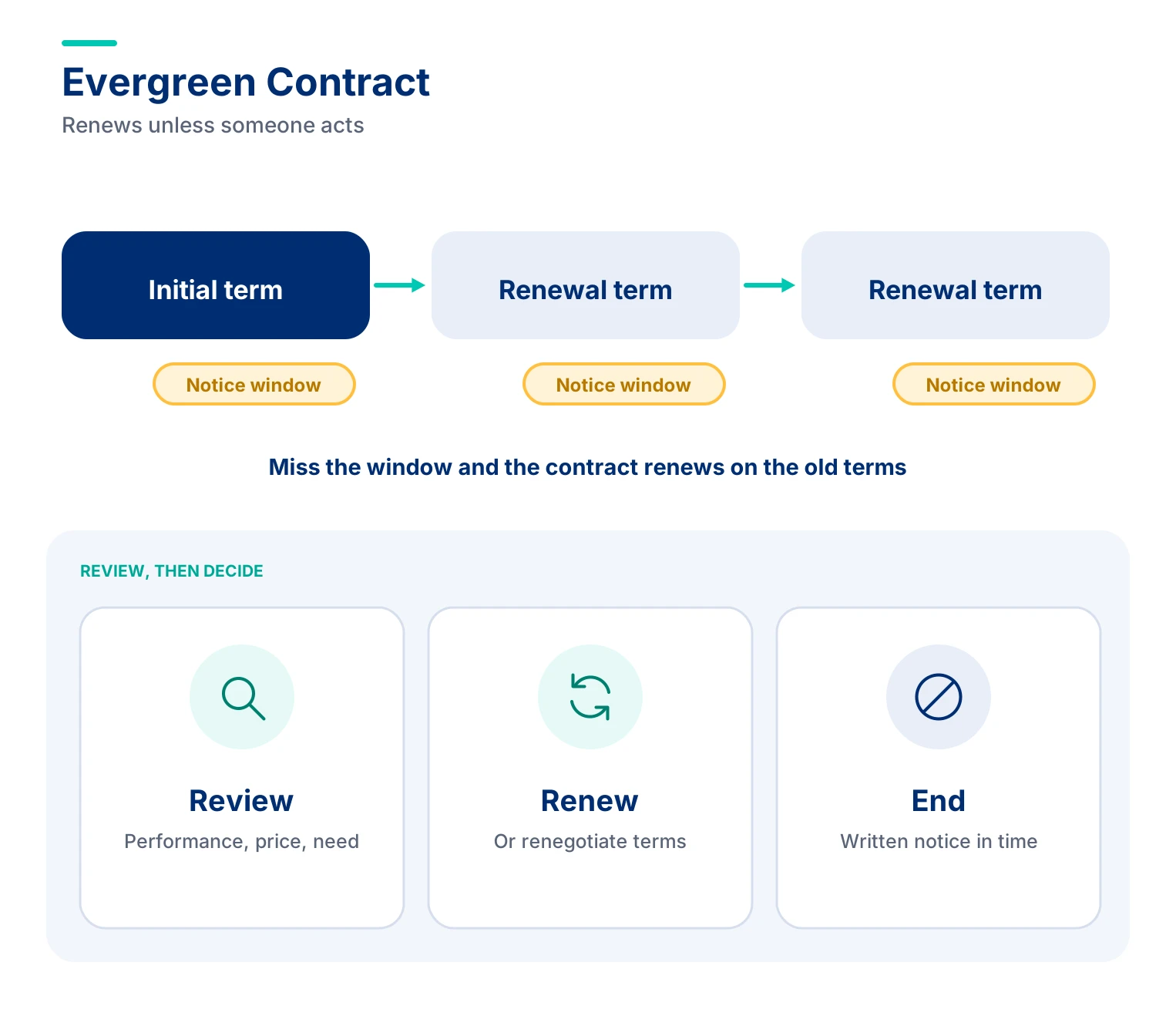
An evergreen contract is an agreement that renews automatically at the end of each term until one party gives notice to end it. It is also called an auto-renewing contract. The contract stays in force unless someone acts, so the notice window matters.
WHY IT MATTERS IN PROCUREMENT
Evergreen terms keep supply and service continuous. They save the effort of renegotiating every term, and give both sides stability, which suits stable, ongoing relationships such as software subscriptions, maintenance and routine services.
The risk is drift. If nobody tracks the notice date, the contract renews on old terms, and prices can rise, scope can shrink in value, or a supplier that no longer fits can stay in place for another term. Procurement needs to know which contracts renew automatically, when notice is due and who decides, so that renewal is a decision rather than an accident.
THE CORE PROCESS / LIFECYCLE
- Identify Evergreen Terms. The team finds renewal and term clauses in contracts and flags those that renew automatically or have no end date.
- Record Dates and Notice Rules. The renewal date, notice period and how notice must be given are entered in the contract system with reminders.
- Review Ahead of the Window. Well before the notice deadline, the owner reviews performance, price, need and alternatives.
- Decide. The owner decides to renew, renegotiate or end the contract, with procurement and legal support.
- Act Within the Notice Window. If the decision is to change or end the contract, written notice is sent in the form and time that the contract requires.
- Confirm and Record. The outcome, whether renewal on new terms, exit or an extension, is recorded and the register is updated.
CORE COMPONENTS
Initial term is the first fixed period. Renewal term is the length of each automatic extension. Notice period is how far ahead a party must give notice to stop renewal. Notice method states how notice must be sent, such as in writing to a named address. Price adjustment shows how prices may change on renewal, such as a fixed percentage or index-linked uplift. Termination rights cover when a party may end the contract early, for example for convenience or for breach.
KEY BENEFITS
Evergreen contracts reduce administration and avoid gaps in supply or service. A critical service does not lapse by accident, and buyers avoid the cost of re-tendering low-risk spend every term.
When managed well, they can also be a source of leverage. A buyer that tracks renewals can use the notice window to negotiate price or terms, with the credible option of leaving. Clear renewal and price rules give both sides predictability, and long relationships can build supplier knowledge and service quality.
COMMON PITFALLS
- Missing the notice window. The contract renews for another full term, locking in terms that may no longer suit.
- Accepting automatic price increases. Uplift clauses that apply on renewal can compound unless reviewed against the market.
- Burying renewal terms in the small print. Terms in schedules or order forms are easy to miss, so they should be extracted and tracked.
- Treating renewal as a default. Skipping the review means paying for services that are unused or underperforming.
RENEWAL MODELS COMPARED
Contracts end or continue in different ways. The table shows the common models and the main watch point for each.
| Model | How it works | Watch point |
| Fixed term | Ends on a set date unless the parties agree to extend | Plan renewal or re-sourcing before expiry |
| Evergreen (auto-renew) | Renews for set periods unless notice is given | Notice deadline and price uplift |
| Open-ended | No end date, continues until either side gives notice | Regular review and a clear termination right |
| Renewal by agreement | Extension only if both parties sign | Risk of a gap if renewal is late |
KPIs
| Dimension | Sample KPIs |
| Visibility | Contracts with renewal dates recorded; evergreen contracts identified |
| Timeliness | Renewal reviews started before the notice deadline; missed notice dates |
| Value | Savings from renewal negotiations; price uplifts challenged |
| Governance | Renewals with a documented decision; unintended renewals |
KEY TERMS
- Auto-Renewal. A clause that extends a contract automatically at the end of a term.
- Notice Period. The minimum time before a date, such as renewal or termination, by which notice must be given.
- Initial Term. The first fixed period of a contract.
- Renewal Term. The length of each extension after the initial term.
- Termination for Convenience. A right to end the contract without cause, on notice.
- Escalation Clause. A clause that raises prices on a schedule or by an index.
- Rolling Contract. A contract that continues from period to period until ended.
- Contract Register. A central list of contracts with key dates and terms.
FAQs
1. What is an evergreen contract in procurement?
An evergreen contract is an agreement that automatically renews at the end of its term unless either party provides notice to terminate or prevent renewal. Also called an auto-renewing contract, it is commonly used for software subscriptions, maintenance agreements, and recurring supplier services. Evergreen contracts support business continuity and reduce administrative work, but require careful monitoring of renewal dates, pricing terms, and termination conditions.
2. How does an evergreen contract work?
An evergreen contract automatically extends for an agreed renewal period when neither party provides termination or non-renewal notice within the specified timeframe. For example, a one-year supplier agreement may renew for another year unless written notice is submitted 60 days before expiration. Procurement teams must track renewal deadlines, review supplier performance, and evaluate contract pricing before automatic extensions take effect.
3. What is the difference between an evergreen contract and a fixed-term contract?
An evergreen contract renews automatically unless a party gives notice, while a fixed-term contract typically expires on a specified date unless both parties agree to extend it. Evergreen agreements provide continuity for recurring services, whereas fixed-term contracts create defined opportunities for renegotiation or supplier evaluation. Procurement teams should consider service criticality, pricing flexibility, and termination rights when choosing between these contract structures.
4. How can a company cancel or terminate an evergreen contract?
A company can prevent an evergreen contract from renewing by providing notice according to the agreement’s termination or non-renewal provisions. These typically specify a notice period, acceptable delivery method, and recipient. Missing the deadline may trigger another contractual term. Procurement teams should review termination clauses, submit notices within the required timeframe, retain delivery evidence, and confirm the contract’s expiration or termination date.
5. Can suppliers increase prices when an evergreen contract automatically renews?
Suppliers may increase prices during evergreen contract renewals if the agreement permits adjustments through escalation clauses, fixed percentage increases, or index-linked pricing. Automatic renewal does not necessarily authorize unrestricted price changes. Procurement teams should review pricing provisions, compare proposed increases against market benchmarks, and negotiate caps where appropriate. Tracking renewal dates provides opportunities to challenge unnecessary increases before the next contractual term begins.
6. Are evergreen contracts legally enforceable?
Evergreen contracts are generally enforceable when their automatic renewal provisions comply with applicable laws and contractual requirements. However, some jurisdictions impose additional rules on renewal disclosures, customer notifications, consent, and cancellation rights, particularly for consumer and certain small-business agreements. Procurement and legal teams should verify local requirements, ensure renewal clauses are clearly written, and confirm that notice periods and termination procedures are reasonable and legally compliant.
7. How can contract management software prevent unwanted evergreen renewals?
Contract management software helps prevent unwanted evergreen renewals by centralizing contract records, extracting renewal clauses, tracking notice deadlines, and sending automated reminders. Procurement teams can assign contract owners, review supplier performance, compare pricing, and initiate renegotiations before renewal windows close. Contract lifecycle management (CLM) systems also provide visibility into upcoming expirations, renewal decisions, and contractual obligations, helping organizations avoid unnecessary spending and maintain control over supplier agreements.