

WHAT IS RAG IN PROCUREMENT?
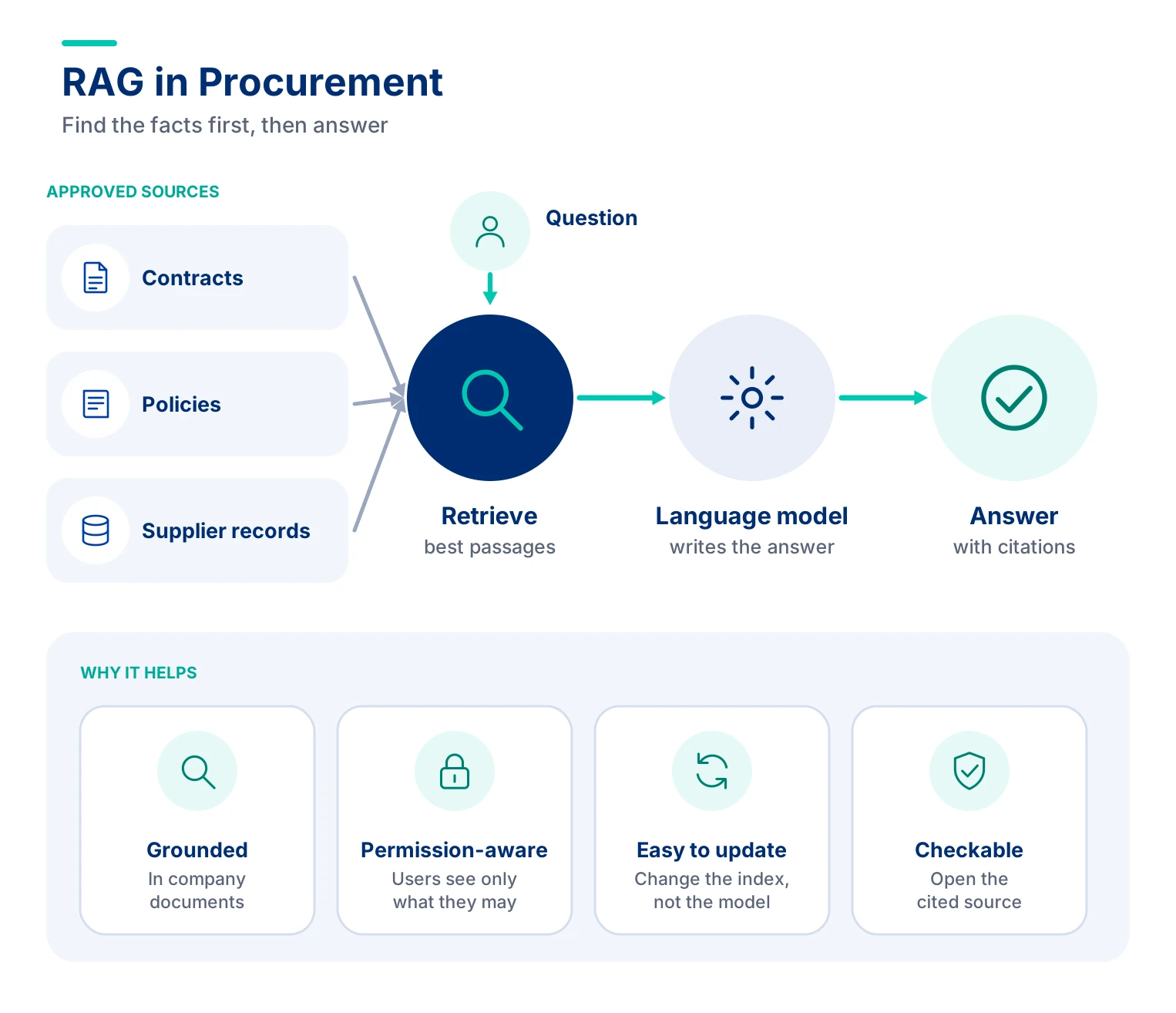
Retrieval-augmented generation (RAG) is an AI technique in which a language model first retrieves relevant passages from a trusted set of documents, then uses them to write its answer. In procurement, it lets people ask questions about contracts, policies and supplier records and get answers grounded in company sources, with references.
WHY IT MATTERS IN PROCUREMENT
A general language model knows nothing about a company’s own contracts, policies or supplier data, and it may answer with confidence even when it is wrong. RAG addresses this by giving the model the right passages at the time of the question. Answers reflect the company’s own documents, and users can check the source.
RAG is not the same as the model itself. A large language model is the engine that writes text. RAG is the design around it that finds and supplies the facts. It is also different from an AI agent, which can plan and act on a goal. RAG answers questions from documents, although an agent may use RAG as one of its tools. RAG reduces made-up answers but does not remove them, so source quality and review still matter.
THE CORE PROCESS / LIFECYCLE
- Select and Prepare Sources. The team chooses the documents the system may use, such as contracts, policies and supplier records, and cleans them and removes outdated versions.
- Split and Index. Documents are split into passages, converted into numerical representations called embeddings, and stored in a searchable index along with their access rights.
- Retrieve Relevant Passages. When a user asks a question, the system searches the index and returns the passages that best match, limited to what that user is allowed to see.
- Augment the Prompt. The retrieved passages are added to the question and sent to the language model with instructions to answer only from them.
- Generate and Cite. The model writes an answer and points to the passages it used, so the reader can open the source and check it.
- Evaluate and Refresh. The team tests answer quality, collects user feedback and updates the index as documents change.
CORE COMPONENTS
Knowledge sources are the approved documents and data, for example contracts, sourcing policies, supplier profiles and past RFP answers. Embeddings and index let the system find passages by meaning rather than exact keywords. Retriever selects the most relevant passages for each question, often combining keyword and meaning-based search, because contract numbers and clause IDs need exact matches. Language model writes the answer from those passages. Access control makes sure users only receive information they are permitted to see. Citations link each statement to its source. Evaluation measures whether answers are correct and complete.
KEY BENEFITS
RAG lets procurement teams ask questions in plain language and get answers in seconds, instead of searching through folders of contracts or policy documents. Answers come with sources, so users can verify them and trust grows.
Because the knowledge sits in the document index, not in the model, updating a policy or adding a contract does not mean retraining the model. It also keeps sensitive data under company control and permissions. Typical gains are faster contract queries, quicker responses to stakeholders’ policy questions, and faster drafting of RFP responses and supplier summaries.
COMMON PITFALLS
- Indexing poor or outdated documents. The system can only be as good as its sources, so superseded contracts and drafts lead to wrong answers.
- Ignoring permissions. If retrieval does not respect who may see what, confidential contract terms can reach the wrong user.
- Trusting answers without checking citations. RAG lowers the chance of invented answers but does not remove it, so important decisions need a source check.
- Never measuring quality. Without test questions and feedback, errors and gaps in the sources go unnoticed.
PROCUREMENT USE CASES FOR RAG
RAG fits any task that means finding and summarizing information held in documents.
| Use case | Source documents | Typical output |
| Contract questions | Executed contracts and amendments | Answer on terms, dates and obligations with clause references |
| Policy guidance | Sourcing policy, approval rules, templates | Answer on what a buyer should do in a given case |
| Supplier summaries | Supplier profiles, performance and risk records | Short briefing before a meeting or review |
| RFP response support | Past responses and product documents | Draft answers for a person to review |
KPIs
| Dimension | Sample KPIs |
| Quality | Answers rated correct by users; answers with a valid citation |
| Coverage | Documents indexed; questions the system could answer |
| Adoption | Active users; questions asked per month |
| Efficiency | Time to find a contract answer; requests diverted from legal and category teams |
KEY TERMS
- Large Language Model. An AI model trained on large amounts of text that can read and write language.
- Foundation Model. A broad model trained on large data that can be adapted for many tasks.
- Embedding. A numerical representation of text that captures its meaning for search.
- Vector Index. A store that finds passages whose embeddings are close to a question.
- Hallucination. An answer that sounds plausible but is not supported by facts.
- Grounding. Tying an answer to specific source material.
- Chunking. Splitting documents into passages for indexing.
- AI Agent. A system that plans and takes actions toward a goal, and may use RAG as one tool.
FAQs
1. What is Retrieval-Augmented Generation (RAG) in procurement?
Retrieval-Augmented Generation (RAG) is an AI technique that retrieves relevant information from trusted company documents before generating responses. In procurement, RAG enables teams to ask questions about supplier contracts, purchasing policies, sourcing records, and compliance requirements. By grounding AI-generated answers in verified internal sources, RAG improves information accuracy, reduces manual document searches, and helps procurement professionals make informed decisions with traceable references.
2. How does Retrieval-Augmented Generation (RAG) work in procurement?
RAG works by searching approved procurement documents, retrieving relevant information, and providing that context to a large language model (LLM). The model then generates an answer based on the retrieved content, ideally with source citations. Procurement teams can use RAG to locate contract clauses, verify purchasing policies, and summarize supplier information. Document indexing, semantic search, and access controls help ensure relevant information is retrieved securely.
3. What are the main use cases of RAG in procurement?
Common RAG use cases in procurement include contract analysis, supplier information retrieval, procurement policy assistance, and RFP response drafting. For example, procurement teams can ask questions about contract renewal dates, payment terms, or supplier compliance requirements and receive answers linked to relevant documents. RAG also supports supplier risk summaries and sourcing research by consolidating information from approved internal records, reducing manual research and improving decision-making efficiency.
4. What is the difference between RAG and traditional large language models?
A traditional large language model generates responses using patterns learned during training and any context provided in its prompt. RAG enhances this process by retrieving relevant information from external or internal knowledge sources before generating answers. Unlike relying solely on a model’s training knowledge, RAG can reference current procurement contracts, policies, and supplier records. This improves factual grounding and allows organizations to update knowledge without retraining the underlying model.
5. How is RAG different from AI agents in procurement?
RAG retrieves information from trusted documents to generate contextually relevant answers, while AI agents can plan and execute tasks toward defined objectives. For example, RAG can identify payment terms within a supplier contract, whereas an AI agent may use that information to support a procurement workflow. AI agents can incorporate RAG to access company knowledge before taking actions. RAG primarily supports knowledge retrieval, while agentic AI extends into task execution and automation.
6. Can RAG reduce AI hallucinations in procurement applications?
Yes, RAG can reduce AI hallucinations by grounding generated responses in relevant, trusted procurement documents. Instead of relying entirely on learned information, the model references retrieved contract clauses, supplier records, and purchasing policies. However, RAG cannot eliminate inaccurate answers, especially when source documents are outdated, incomplete, or incorrectly retrieved. Organizations should implement source citations, document validation, and regular accuracy testing to improve reliability.
7. How can organizations securely implement RAG for confidential procurement data?
Organizations can secure procurement RAG systems through role-based access controls, approved document repositories, encryption, and permission-aware information retrieval. Sensitive supplier contracts, pricing agreements, and financial records should only be accessible to authorized users. Procurement and IT teams should also maintain current document versions, monitor retrieval activity, and validate generated answers. These safeguards help protect confidential information while enabling AI-powered knowledge access across procurement workflows.