


WHAT IS DAYS PAYABLE OUTSTANDING (DPO)?
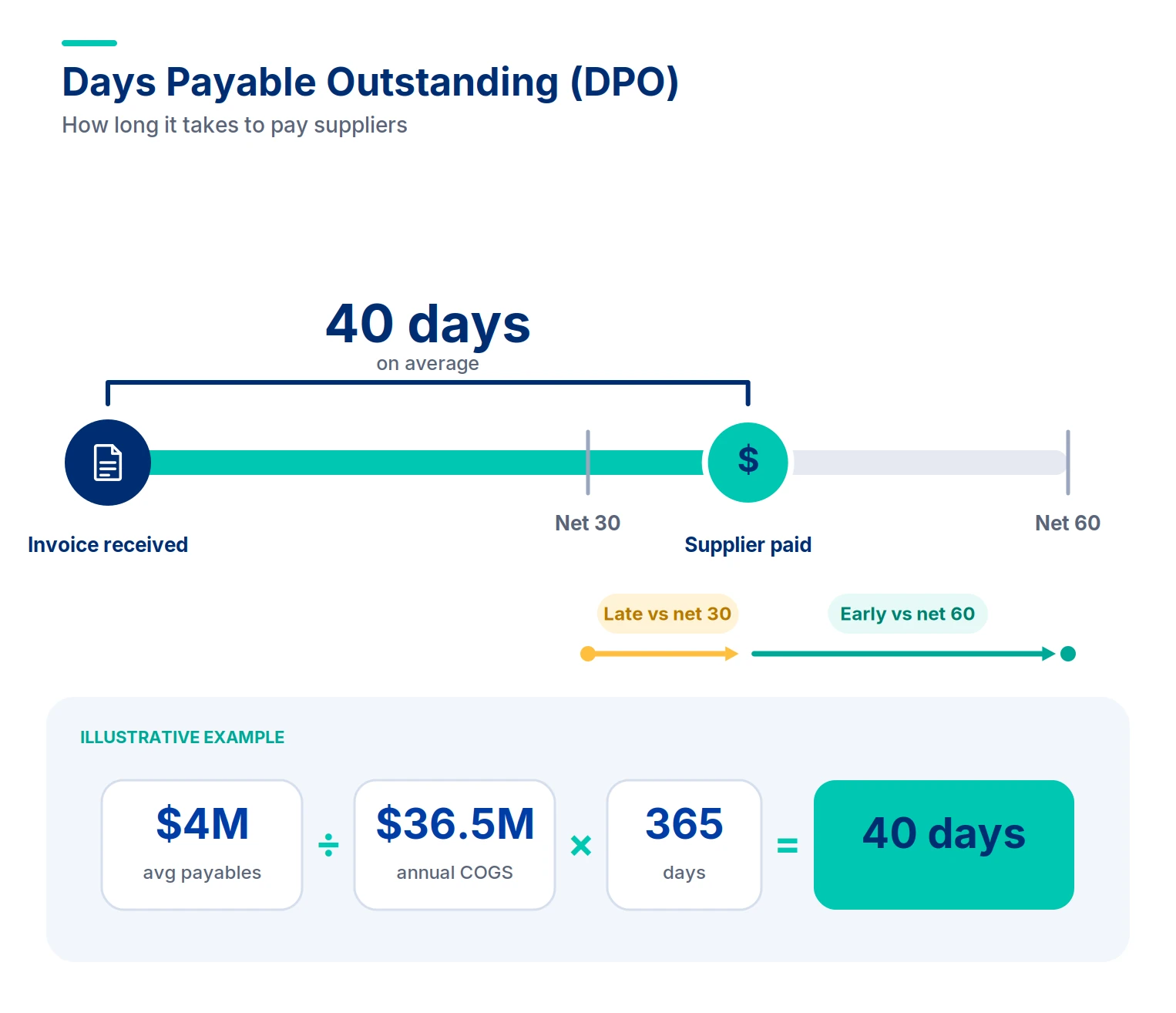
Days Payable Outstanding (DPO) measures the average number of days a company takes to pay its suppliers after receiving an invoice. A higher DPO means cash stays in the business longer. A lower DPO means suppliers are paid faster. Procurement and finance use it to manage working capital and supplier relationships together.
WHY IT MATTERS IN PROCUREMENT?
DPO links procurement decisions directly to cash. Every extra day of payment terms keeps cash in the business without borrowing. Across thousands of suppliers, small changes in terms add up to material working capital.
The number cuts both ways. Stretching payments too far strains suppliers, raises their prices and weakens supply continuity. DPO is useful only when read alongside supplier health, early payment discounts and the cost of capital.
THE CORE PROCESS / LIFECYCLE
- Data Collection. Finance pulls accounts payable balances and cost of goods sold for the period from the ERP. Accuracy depends on clean invoice dates and consistent payables recording.
- Calculation. DPO is calculated for the period, usually a quarter or a year, and tracked monthly. Teams also segment it by supplier, category and business unit.
- Benchmarking. The result is compared with prior periods and with industry peers. Averages hide a lot, so the useful view is by supplier group.
- Terms Review. Procurement reviews payment terms against the DPO target. This shows where terms are shorter than policy and where renegotiation would add value without hurting key suppliers.
- Payment Execution. Accounts payable aligns payment runs with agreed terms, so invoices are paid neither late nor needlessly early. Paying early with no discount gives away cash.
- Monitoring. DPO is reported alongside DSO and inventory days to show the full cash cycle, and reviewed whenever terms or supplier mix change.
CORE COMPONENTS
Accounts payable balance is the amount owed to suppliers, usually averaged over the period. Cost of goods sold (COGS) is the base the payables are measured against. Period length is the number of days in the period, commonly 365 for a year. Each input can be distorted by timing, so consistent definitions matter.
KEY BENEFITS
Tracking DPO gives finance and procurement a shared working capital metric. It shows whether payment terms are being negotiated or simply accepted. Terms that vary widely across similar suppliers point to negotiation opportunities. It also exposes late payment patterns that damage relationships, and it supports cash forecasting because payment timing becomes predictable.
COMMON PITFALLS
- Chasing a higher DPO at any cost. Pushing terms out shifts financing costs onto suppliers, who price it back into the next contract.
- Comparing against the wrong peers. DPO varies by industry and business model, so a cross-industry benchmark misleads.
- Ignoring supplier mix. A blended figure hides critical suppliers who are paid late and small ones who are paid early.
- Paying early without a return. Paying before the due date with no discount gives up cash for no benefit.
HOW TO CALCULATE DPO, WITH A WORKED EXAMPLE
- The formula. DPO = (Average accounts payable ÷ Cost of goods sold) × Number of days in the period. Some analysts use purchases instead of COGS.
- The AP turnover link. DPO also equals 365 ÷ accounts payable turnover, where turnover is COGS divided by average accounts payable. The two ratios describe the same behavior from opposite directions.
- A worked example. A company has average accounts payable of $4 million and annual COGS of $36.5 million. DPO = (4 ÷ 36.5) × 365 = 40 days. On average, it pays suppliers 40 days after invoicing.
- Reading the result. Compare the trend over time, not the absolute number, with payment terms. Payables include non-COGS spend and COGS is not the same as purchases, so use invoice-level days to pay to test terms compliance.
- Watching the inputs. Use average payables, not one month-end balance, because a single-day snapshot can swing the result.
KPIs
| Dimension | Sample KPIs |
| Working capital | DPO; DSO; cash conversion cycle |
| Terms | Average contractual payment terms; spend on standard terms |
| Payment performance | On-time payment rate; early payment rate without discount |
| Supplier impact | Late payment complaints; discount capture rate |
KEY TERMS
- Accounts Payable Turnover. How many times a company pays off its average payables in a period, calculated as COGS divided by average accounts payable.
- Days Sales Outstanding (DSO). The average number of days a company takes to collect payment from its customers.
- Cash Conversion Cycle. The days between paying for inventory and collecting from customers, calculated as inventory days plus DSO minus DPO.
- Working Capital. Current assets minus current liabilities, the funds available for day-to-day operations.
- Payment Terms. The agreed number of days and conditions for paying an invoice, such as net 30.
- Early Payment Discount. A price reduction offered for paying before the due date, such as 2/10 net 30.
- Dynamic Discounting. A discount that grows the earlier the buyer pays, funded from the buyer’s own cash.
- Supply Chain Finance. A program in which a funder pays suppliers early and the buyer pays later, a common way to extend DPO without hurting supplier cash flow.
FAQs
1. What is Days Payable Outstanding (DPO) in procurement?
Days Payable Outstanding (DPO) is a financial metric that estimates the average number of days a company takes to pay its suppliers. It measures payment efficiency and helps procurement and finance teams manage working capital. A higher DPO generally indicates longer payment cycles, while a lower DPO indicates faster supplier payments. Monitoring DPO helps organizations balance cash flow optimization with supplier relationship management.
2. How do you calculate Days Payable Outstanding (DPO)?
Days Payable Outstanding is calculated by dividing average accounts payable by cost of goods sold (COGS) and multiplying by the number of days in the period.
DPO Formula = (Average Accounts Payable ÷ COGS) × Number of Days
For example, if average accounts payable is $4 million and annual COGS is $36.5 million, DPO equals 40 days. Using average payables rather than a single closing balance improves calculation reliability.
3. What is a good DPO ratio for a business?
A good DPO ratio depends on industry benchmarks, supplier payment terms, business models, and working capital requirements. There is no universally ideal DPO. Companies should compare their DPO against industry peers and historical performance while monitoring supplier relationships. The goal is to optimize payment timing without violating agreed terms, losing valuable early payment discounts, or affecting supply chain stability.
4. Is a high Days Payable Outstanding (DPO) good or bad?
A high DPO can benefit businesses by preserving cash and improving short-term working capital. However, excessively long payment cycles may damage supplier relationships, increase procurement costs, or disrupt supply continuity. A low DPO indicates faster supplier payments but may reduce available cash. Companies should balance DPO performance with contractual payment terms, supplier financial health, and early payment discount opportunities.
5. What is the difference between DPO and DSO in working capital management?
Days Payable Outstanding (DPO) measures how long a company takes to pay suppliers, while Days Sales Outstanding (DSO) measures how long customers take to pay the company. DPO tracks outgoing payments, whereas DSO tracks incoming cash collections. Both influence the cash conversion cycle, calculated as inventory days plus DSO minus DPO. Monitoring these metrics helps businesses improve liquidity and working capital efficiency.
6. How can procurement teams improve Days Payable Outstanding without affecting suppliers?
Procurement teams can optimize DPO by negotiating appropriate payment terms, standardizing supplier contracts, and aligning payment schedules with agreed deadlines. Supply chain finance programs can enable suppliers to receive early payments while buyers retain extended payment terms. Organizations should also evaluate early payment discounts against financing costs and avoid unnecessary early payments. This approach improves working capital while maintaining healthy supplier relationships.
7. How is Days Payable Outstanding related to accounts payable turnover?
Days Payable Outstanding and accounts payable turnover measure supplier payment efficiency from different perspectives. Accounts payable turnover indicates how frequently a company pays its average supplier liabilities during a period, while DPO expresses payment timing in days.
DPO = 365 ÷ Accounts Payable Turnover
For example, an annual accounts payable turnover of 9.125 corresponds to a DPO of 40 days. Higher turnover generally means lower DPO and faster supplier payments.