



WHAT IS A SEALED BID?
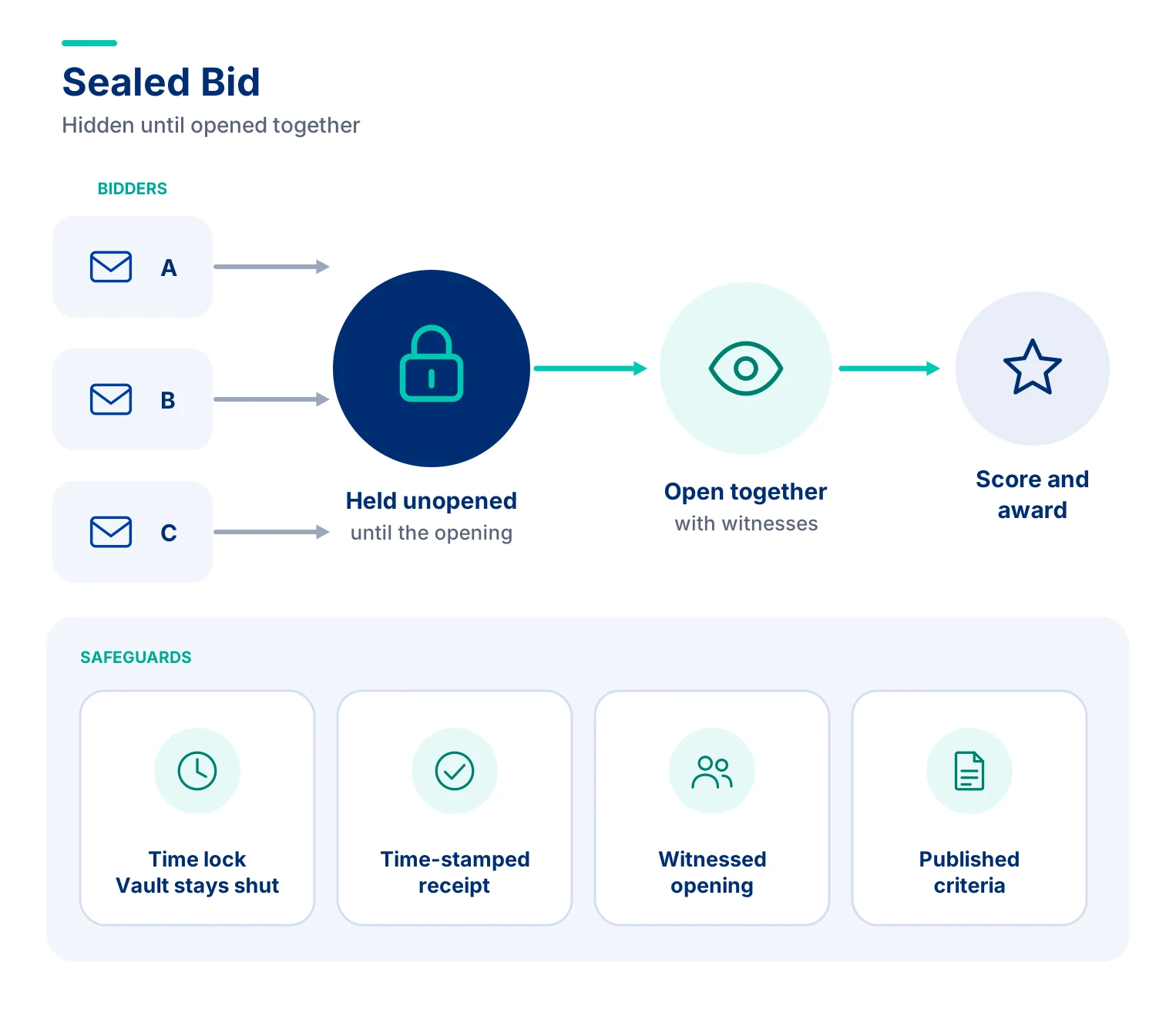
A sealed bid is a confidential offer that a supplier submits by a set deadline, kept unopened and unseen by anyone, competitors and the buyer alike, until a formal opening. All bids are then opened together and evaluated against stated criteria. It is a way of running competitive bidding, common in public sector and construction purchasing.
WHY IT MATTERS IN PROCUREMENT?
Sealed bidding protects fairness. Because no bidder can see another’s price before submitting, no one can adjust to a rival’s offer, and the buyer can show that every bid was received, held and opened under the same rules. That makes it a standard choice for public bodies that must show open and equal treatment.
It works well when requirements are precise and the buyer wants a clean comparison of offers. It is less suited to complex purchases that need dialogue or negotiation, because there is little room to clarify or improve bids after submission. Rules vary by jurisdiction, so the process should follow the buyer’s own policy and applicable law.
THE CORE PROCESS / LIFECYCLE
Issue the Invitation. The buyer publishes the requirements, evaluation criteria, submission instructions and deadline so every supplier gets the same information.
Prepare and Submit. Suppliers prepare complete bids and submit them through a secure channel before the deadline, in sealed envelopes or an electronic vault.
Secure the Bids. The buyer logs the time of receipt and keeps bids locked. Late bids are handled as the rules state, usually rejected.
Open Together. Bids are opened at a set time, often with witnesses, and key details such as bidder names and prices may be recorded or read out.
Evaluate. The evaluation team checks compliance and scores bids against the published criteria, which may be price alone or price and quality.
Award and Notify. The buyer awards the contract and notifies all bidders of the outcome, with any required feedback or standstill period.
CORE COMPONENTS
- Invitation documents set the specification, terms and criteria.
- Submission deadline is the fixed time after which bids are not accepted.
- Secure receipt is the sealed envelope or electronic vault that holds bids unopened.
- Bid opening is the formal event at which bids are revealed.
- Evaluation criteria decide the winner, whether lowest compliant price or best overall value.
- Bid validity is the period for which each bid stays open for acceptance.
KEY BENEFITS
Sealed bidding gives a clear, defensible record. Every bid is received under the same rules, and opening and scoring can be documented for audit or challenge. Suppliers know they are not competing against a live scoreboard, which encourages them to offer their best price at the outset.
It is also simple to run for well-specified purchases. There are no live events or multiple rounds, so it suits buyers with limited sourcing capacity. Electronic vaults add time-locks and logs, which remove the manual risks of envelope handling.
COMMON PITFALLS
- Vague specifications. Suppliers interpret the requirement differently, so the bids cannot be compared like for like.
- Opening bids early or unsupervised. Early access or a single handler undermines trust and can invalidate the process.
- Treating lowest price as the only test. If the criteria include quality, the buyer must score them as published, and cheap non-compliant bids still fail.
- Allowing changes after opening. Letting a bidder revise a price after seeing others breaks fairness, so negotiation should follow the rules.
SEALED BID RISKS AND SAFEGUARDS
Most sealed bid failures come from handling errors. The safeguards below keep the process defensible.
| Risk | Safeguard |
| Bid seen before opening | Electronic vault with time lock, or sealed and logged envelopes |
| Late or disputed submission | Time-stamped receipt and a clear late bid rule |
| Unfair opening | Opening with two or more witnesses and a recorded list of bidders |
| Non-comparable bids | Clear specification, standard price form and clarification window before the deadline |
| Challenge after award | Documented scoring against published criteria and recorded reasons |
KPIs
| Dimension | Sample KPIs |
| Competition | Bids received per invitation; share of invited suppliers responding |
| Compliance | Compliant bids as share of total; late or rejected bids |
| Process | Days from invitation to award; evaluation time |
| Defensibility | Awards challenged; challenges upheld |
KEY TERMS
- Competitive Bidding. The broader practice of inviting several suppliers to compete for a contract.
- Bid Opening. The formal moment sealed bids are revealed.
- Bid Validity. The period a bid stays open for acceptance.
- Invitation to Bid. The document that asks suppliers to submit sealed bids.
- Non-Compliant Bid. A bid that fails mandatory requirements and is rejected.
- Electronic Vault. A secure system that holds bids unopened until a set time.
- Bid Bond. A guarantee that a bidder will sign the contract if it wins.
- Clarification Window. The period when suppliers can ask questions before the deadline.
- Two-Envelope Bid. A sealed bid in two parts, technical and commercial, where price is opened only for bids that pass the technical review.
FAQs
1. What is a sealed bid in procurement?
A sealed bid is a confidential supplier offer submitted before a specified deadline and kept undisclosed until a formal bid opening. All submissions are opened together and evaluated against predetermined criteria. Sealed bidding is commonly used in government procurement, construction, and competitive sourcing to ensure fairness, pricing confidentiality, and transparent supplier selection. It prevents bidders from viewing competing offers before submission.
2. How does the sealed bidding process work?
The sealed bidding process begins when a buyer issues an invitation outlining requirements, evaluation criteria, and submission deadlines. Suppliers submit confidential bids through sealed envelopes or secure electronic platforms. After the deadline, bids are opened together, checked for compliance, and evaluated against published criteria. The buyer then selects the winning supplier and communicates the award decision. Documented procedures help maintain transparency and procurement accountability.
3. What is the difference between sealed bidding and an English auction?
Sealed bidding requires suppliers to submit confidential offers without knowing competing prices, while an English auction allows participants to see competing bids and increase their offers during live bidding. Sealed bids are typically submitted once and opened simultaneously, whereas English auctions involve successive bidding rounds. Procurement teams generally prefer sealed bidding when confidentiality and structured evaluation are important, while auctions support real-time price competition.
4. Does the lowest sealed bid always win a procurement contract?
No, the lowest sealed bid does not always win. Contract awards depend on the evaluation criteria published in the invitation to bid. Some procurement processes select the lowest-priced compliant offer, while others consider technical quality, delivery capabilities, supplier qualifications, and overall value. Bids that fail mandatory requirements may be rejected regardless of price. Buyers must apply the published criteria consistently to maintain fairness and transparency.
5. What is a two-envelope sealed bidding system?
A two-envelope bidding system separates supplier proposals into technical and financial submissions. The technical envelope is opened and evaluated first to determine whether the supplier meets predefined qualification and performance requirements. Only suppliers passing the technical evaluation have their financial bids opened. This method helps procurement teams assess technical suitability before considering price, supporting fair and structured supplier selection.
6. What happens if a sealed bid is submitted late or requires changes?
Late sealed bids are generally rejected unopened, depending on the procurement rules and applicable regulations. Suppliers must submit complete offers before the stated deadline. Changes or negotiations after bid opening are typically restricted because they can compromise fairness and equal treatment. Any permitted clarifications, corrections, or negotiations must follow the published bidding procedures and relevant procurement laws.
7. How does eProcurement software improve sealed bidding?
eProcurement software improves sealed bidding by providing secure electronic bid submission, time-stamped receipts, controlled access, and documented evaluation workflows. Electronic bid vaults prevent unauthorized access before the scheduled opening time, while audit logs record submission and opening activities. Automated processes can reduce manual handling errors, improve supplier communication, and support consistent evaluation against predefined criteria. These capabilities strengthen transparency, efficiency, and compliance in competitive sourcing.