


WHAT ARE DUPLICATE PAYMENTS?
A duplicate payment occurs when a company pays the same invoice, or the same obligation, more than once. It usually results from process errors rather than fraud, such as an invoice being entered twice or paid through two channels. The overpayment then has to be detected and recovered from the supplier.
WHY IT MATTERS IN PROCUREMENT?
Duplicate payments are a direct cash leak. Each one sends money out with nothing received in return. Because they are spread across thousands of invoices, they often go unnoticed until an audit or a supplier statement reconciliation surfaces them.
Recovery is possible but costly. It means finding the payment, contacting the supplier and waiting for a refund or credit note. Prevention at the point of entry is far cheaper than recovery after payment, and it avoids awkward conversations with suppliers.
THE CORE PROCESS / LIFECYCLE
- Invoice Capture. Invoices arrive by email, portal, EDI and paper. Each is logged with supplier, invoice number, date, amount and PO reference. Consistent capture of these fields is what makes duplicate checks possible.
- Duplicate Screening. The system compares each new invoice with existing ones on supplier, invoice number, amount and date. Fuzzy matching catches near-duplicates, such as an invoice number with an added prefix or a trailing character.
- Match and Approval. Invoices are matched to POs and receipts. A PO that has already been fully invoiced should block a second invoice against it.
- Payment Run Checks. Before payment is released, a final check looks for the same supplier and amount in recent runs, including payments made by card or manual transfer.
- Post-Payment Detection. Analytics scan paid invoices for duplicates that slipped through, including those that cross entities, currencies or ERPs.
- Recovery. Confirmed duplicates are raised with the supplier for a refund or a credit against future invoices. The root cause is logged and fixed.
- CORE COMPONENTS
Master data hygiene matters because duplicate supplier records let the same invoice through under two vendor IDs. Invoice data capture has to record the invoice number consistently. Matching rules decide what counts as a duplicate, from exact matches to fuzzy ones. Exception handling gives accounts payable a clear path to hold and review flagged items.
KEY BENEFITS
Preventing duplicate payments protects cash directly, with no new savings program required. It cuts the manual work of recovery, supplier calls and credit note tracking. It improves supplier trust, since refund requests are awkward for both sides. It gives auditors cleaner evidence of control over payables, and it exposes weaknesses in master data and invoice intake that cause other errors too.
COMMON PITFALLS
- Relying only on exact invoice number matches. A trailing space, a hyphen or an added prefix defeats exact matching, and the second payment goes through.
- Paying from statements or reminders. Paying a supplier’s chaser without checking it against paid items is a common route to double payment.
- Leaving duplicate vendor records in place. The same supplier under two IDs lets one invoice be paid under each.
- Checking only inside one system. Duplicates across entities, ERPs or payment channels are invisible to single-system checks.
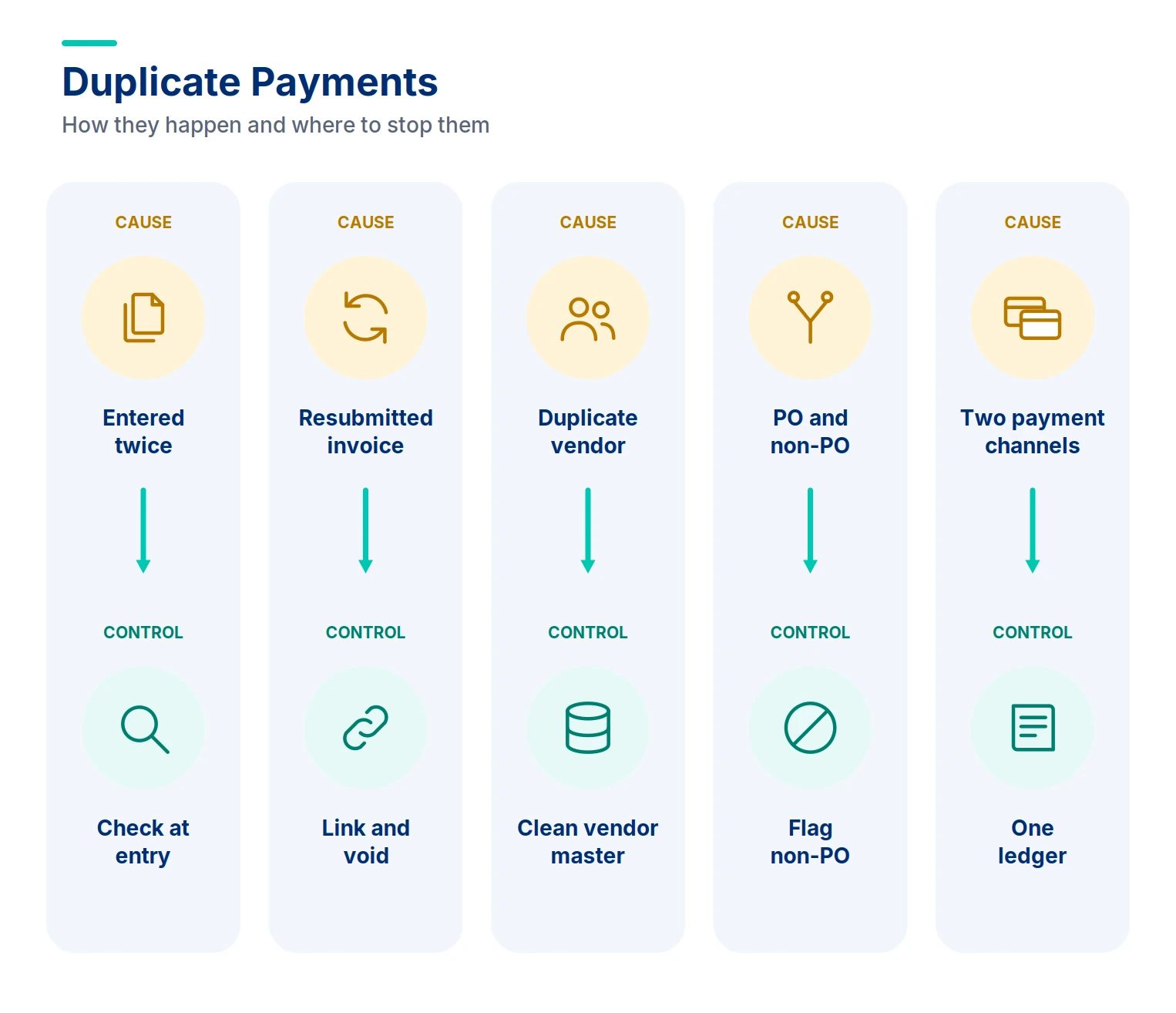
HOW DUPLICATE PAYMENTS HAPPEN AND WHERE TO STOP THEM
- Same invoice entered twice. An emailed invoice is keyed in, then the same invoice arrives by post. Control it with a duplicate check on supplier, number and amount at entry.
- Resubmission after a query. A supplier resends an invoice once a dispute is resolved, and both copies are paid. Link resubmissions to the original and void the first.
- Duplicate vendor records. The same supplier is set up twice under different spellings. Cleanse the vendor master and check new suppliers before approval.
- Overlap of PO and non-PO routes. An invoice is paid against a PO and again as a non-PO invoice. Flag non-PO invoices from suppliers with an open PO and route them to PO matching.
- Overlap of payment channels. A manual or card payment is made while the invoice also sits in the standard payment run. Record every payment in one ledger.
KPIs
| Dimension | Sample KPIs |
| Prevention | Duplicates blocked before payment; duplicate rate per thousand invoices |
| Detection | Post-payment duplicates found; time to detect |
| Recovery | Value recovered; recovery cycle time |
| Data quality | Duplicate vendor records; invoice capture accuracy |
KEY TERMS
- Duplicate Invoice. A second copy of an invoice already received or paid, sometimes with a slightly different number.
- Fuzzy Matching. A method that finds near-identical records despite small differences in spelling or format.
- Vendor Master. The record of approved suppliers and their payment details.
- Payment Run. A scheduled batch in which approved invoices are paid.
- Credit Note. A supplier document that reduces the amount owed, often used to settle an overpayment.
- Recovery Audit. A retrospective review of paid transactions to find and reclaim overpayments.
- Supplier Statement Reconciliation. A comparison of a supplier’s statement of account with the buyer’s ledger to find differences.
FAQs
1. What are duplicate payments in accounts payable?
Duplicate payments occur when a business pays the same supplier invoice or financial obligation more than once. These overpayments typically result from invoice processing errors, duplicate entries, or overlapping payment channels. Duplicate payments create unnecessary cash outflows, increase reconciliation workloads, and require recovery from suppliers. Effective accounts payable controls, invoice validation, and automated duplicate detection help organizations prevent financial losses and maintain accurate payment records.
2. What are the most common causes of duplicate payments?
Common causes of duplicate payments include invoices entered multiple times, duplicate supplier records, invoice resubmissions, and payments processed through different channels. For example, an invoice received by email and later through a supplier portal may be processed twice. Inconsistent invoice numbers, overlapping purchase order and non-PO workflows, and poor supplier master data management also increase duplicate payment risks.
3. How can companies detect duplicate invoice payments?
Companies can detect duplicate payments by comparing supplier names, invoice numbers, payment amounts, invoice dates, and purchase order references. Automated accounts payable systems use exact matching and fuzzy matching to identify duplicate invoices with minor formatting differences. Organizations should also analyze completed payments across different ERP systems, business entities, and payment channels. Regular supplier statement reconciliation helps identify duplicate payments that bypass initial validation controls.
4. What is the difference between duplicate payments and invoice fraud?
Duplicate payments typically result from accidental processing errors, while invoice fraud involves deliberate attempts to obtain unauthorized payments. For example, paying a resubmitted invoice twice is usually an error, whereas submitting fabricated invoices or creating fictitious suppliers constitutes fraud. Both can cause financial losses and exploit weak accounts payable controls. Invoice verification, supplier validation, approval workflows, and transaction monitoring help organizations detect and prevent both risks.
5. How can businesses prevent duplicate payments in procurement?
Businesses can prevent duplicate payments by implementing invoice validation, automated duplicate checks, accurate supplier master data, and purchase order matching. Procurement and finance teams should verify supplier records, link invoice resubmissions to original entries, and maintain centralized payment visibility. Additional controls include three-way matching, approval workflows, and pre-payment screening across payment channels. Regular audits help identify process gaps before they result in financial losses.
6. Can duplicate payments be recovered from suppliers?
Yes, duplicate payments can often be recovered through supplier refunds or credit notes against future invoices. Accounts payable teams should first confirm the duplicate transaction using payment records, invoice details, and supplier statements. Once verified, they should contact the supplier, request repayment or credit, and track the recovery until completion. Investigating the original processing error helps prevent similar overpayments. Recovery can be time-consuming, making preventive controls more cost-effective.
7. How does accounts payable automation help reduce duplicate payments?
Accounts payable automation reduces duplicate payments by detecting repeated invoices, validating supplier information, and checking transactions before payment authorization. Advanced matching capabilities identify near-duplicate invoices even when invoice numbers contain formatting differences. Automated workflows can flag suspicious transactions for review and prevent duplicate payment processing. However, automation requires accurate supplier master data, consistent invoice capture, and visibility across payment systems to maintain effective controls.