


WHAT IS GOODS RECEIVED NOT INVOICED (GRNI)?
Goods Received Not Invoiced (GRNI) is an accounting accrual for goods or services the buyer has received but the supplier has not yet invoiced. It records the cost and the liability in the period of receipt, so the financial statements show what the company owes.
WHY IT MATTERS IN PROCUREMENT
Without GRNI, costs appear only when invoices arrive, which can be weeks after delivery. Expenses and liabilities are understated, and period-end results look better than they are. Managers then see cost they did not expect when late invoices land in a later month.
A GRNI balance that keeps growing is also a warning. It can point to unmatched receipts, missing invoices or disputes that nobody is chasing. Procurement and accounts payable both own the cleanup, because the causes sit on both sides.
THE CORE PROCESS / LIFECYCLE
- Goods Receipt. The warehouse or requester confirms delivery against the PO. The receipt records quantity and PO price and triggers the accrual.
- Accrual Entry. The system debits inventory or expense and credits the GRNI account for the PO value. The liability is now on the books even without an invoice.
- Invoice Chase. Accounts payable tracks receipts with no invoice and contacts suppliers whose invoices are late. Procurement helps where the relationship is the issue.
- Invoice Matching. When the invoice arrives, it is matched to the PO and receipt. The GRNI accrual is cleared against the amount invoiced.
- Variance Handling. Differences between the accrued and invoiced amounts are posted as price or quantity variances and investigated if material.
- Period-End Review. Finance reviews the GRNI balance, ages open items and reverses accruals that will never be invoiced.
CORE COMPONENTS
The GRNI account is the liability account that holds the accrual until the invoice arrives. The goods receipt record supplies the quantity and date, and the PO price supplies the value. An ageing report shows how long each receipt has gone uninvoiced. A clearing process matches invoices to open accruals.
KEY BENEFITS
GRNI gives a truer picture of liabilities at period end. It matches cost to the period in which the goods arrived. It surfaces suppliers that are slow to invoice and receipts that were never matched. It improves month-end close because finance can explain the balance. It gives auditors a clear trail from receipt to invoice. And it gives procurement a list of open items to resolve with suppliers.
COMMON PITFALLS
- Letting old items sit. Accruals that never clear overstate liabilities and hide missing invoices or duplicate receipts.
- Receiving without a PO price. An accrual with no agreed price is a guess that creates variances later.
- Treating GRNI as only a finance problem. Many uncleared items come from late receipts, supplier delays and PO errors outside finance.
- Clearing by writing off. Reversing accruals without investigation can hide real liabilities or leave suppliers unpaid.
JOURNAL ENTRIES FOR GRNI, FROM RECEIPT TO INVOICE
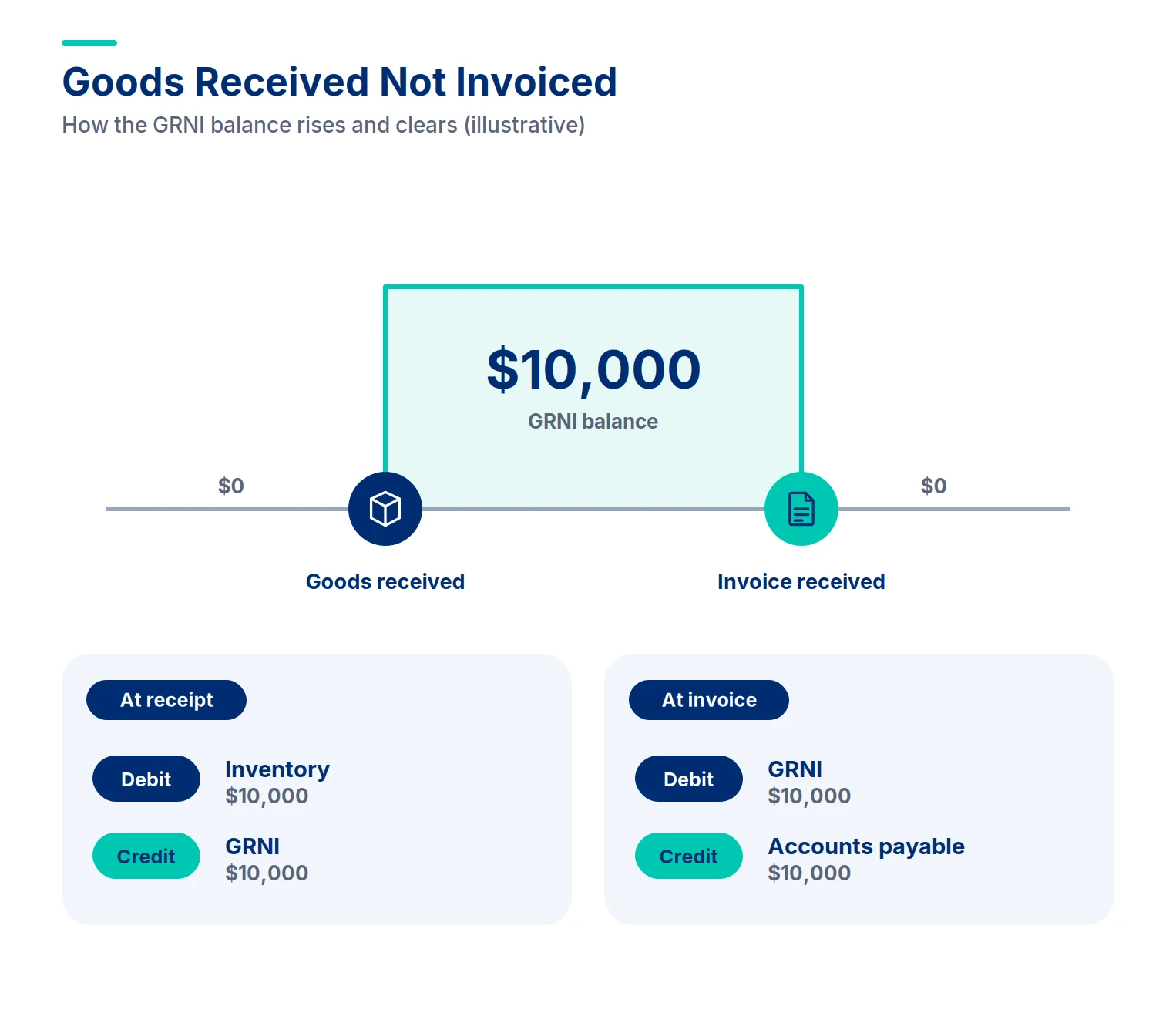
Treatment depends on the accounting framework and costing method. The amounts below are illustrative.
- The scenario. A company receives goods worth $10,000 on a PO. The supplier invoices two weeks later.
- At receipt. Debit inventory $10,000 and credit GRNI $10,000. The goods and the liability are recorded, with no accounts payable yet.
- At invoice. Debit GRNI $10,000 and credit accounts payable $10,000. The accrual clears and the liability moves to payables.
- If the invoice differs. If the invoice is $10,400, the extra $400 is posted as an invoice price variance under standard costing (under moving-average costing it is usually added to inventory if the goods are still on hand), the GRNI clears and accounts payable records $10,400.
- At period end. Any GRNI still open is reviewed, and items that will not be invoiced are reversed.
KPIs
| Dimension | Sample KPIs |
| Balance | GRNI balance; GRNI as a share of monthly spend |
| Ageing | Items open over 30 and 90 days; oldest open item |
| Clearing | Invoice to receipt match rate; items cleared per month |
| Causes | Receipts with no PO price; uninvoiced receipts by supplier |
KEY TERMS
- Accrual. An expense or liability recorded when it is incurred, not when it is paid.
- Goods Receipt Note (GRN). The document that proves goods were delivered and accepted.
- Accounts Payable (AP). The amounts owed to suppliers for invoices already received.
- Three-Way Match. A check of the PO, goods receipt and invoice before payment.
- Invoice Price Variance. The difference between the PO price and the price actually invoiced.
- Month-End Close. The finance process that finalizes the books for the period.
- Uninvoiced Receipts. A name some systems use for receipts that have no matching invoice yet.
FAQs
1. What is Goods Received Not Invoiced (GRNI) in accounting?
Goods Received Not Invoiced (GRNI) is an accounting accrual that records goods or services received by a company before the supplier submits an invoice. It ensures expenses, inventory, and outstanding liabilities are recognized in the correct accounting period. GRNI helps procurement and finance teams maintain accurate financial statements, track uninvoiced receipts, and prevent understated liabilities during month-end closing.
2. How is GRNI recorded in accounting journal entries?
GRNI is recorded when goods are received but the supplier invoice is outstanding. The company debits inventory or expenses and credits the GRNI liability account. For example, receiving goods worth $10,000 creates a $10,000 GRNI accrual. When the invoice arrives, GRNI is debited and accounts payable is credited, clearing the accrual. This process follows accrual accounting principles and supports accurate financial reporting.
3. What is the difference between GRNI and accounts payable?
GRNI represents liabilities for goods or services already received but not yet invoiced, while accounts payable (AP) records amounts owed against supplier invoices received. For example, a delivery awaiting an invoice remains in GRNI until billing occurs. Once the invoice is matched and recorded, the GRNI balance is cleared and transferred to accounts payable. Both help organizations track supplier liabilities at different stages of the procure-to-pay process.
4. What causes a high GRNI balance in procurement?
A high GRNI balance commonly results from delayed supplier invoices, unmatched goods receipts, incorrect purchase order prices, duplicate receipt entries, or unresolved invoice discrepancies. These issues leave accruals open longer than expected and may overstate outstanding liabilities. Procurement and accounts payable teams should regularly review GRNI ageing reports, investigate overdue receipts, and coordinate with suppliers to resolve missing invoices and transaction mismatches.
5. How does the GRNI reconciliation and clearing process work?
GRNI reconciliation involves comparing open goods receipts against purchase orders, supplier invoices, and accounting records. When a matching invoice arrives, the corresponding GRNI accrual is cleared and transferred to accounts payable. Price or quantity differences are investigated and adjusted according to accounting policies. Finance teams review ageing balances during month-end close, while procurement helps resolve supplier disputes, incorrect receipts, and missing invoices.
6. How can procurement teams reduce outstanding GRNI balances?
Procurement teams can reduce outstanding GRNI balances by ensuring accurate purchase orders, timely goods receipt posting, and prompt supplier invoicing. Regular reviews of uninvoiced receipts help identify missing invoices, duplicate entries, and pricing discrepancies. Collaboration between procurement, accounts payable, and suppliers accelerates issue resolution. Automated three-way matching and GRNI ageing reports can further improve reconciliation accuracy, reduce manual follow-ups, and prevent unnecessary accrual backlogs.
7. What are the most important KPIs for monitoring GRNI?
Important GRNI KPIs include total outstanding GRNI balance, GRNI as a percentage of monthly spend, ageing of uninvoiced receipts, and invoice-to-receipt matching rates. Organizations should also monitor items outstanding beyond 30 or 90 days, monthly accrual clearing rates, and suppliers with recurring missing invoices. These metrics help finance and procurement teams identify reconciliation delays, improve month-end close accuracy, and strengthen control over supplier liabilities.