


What is the difference between a purchase order and an invoice?
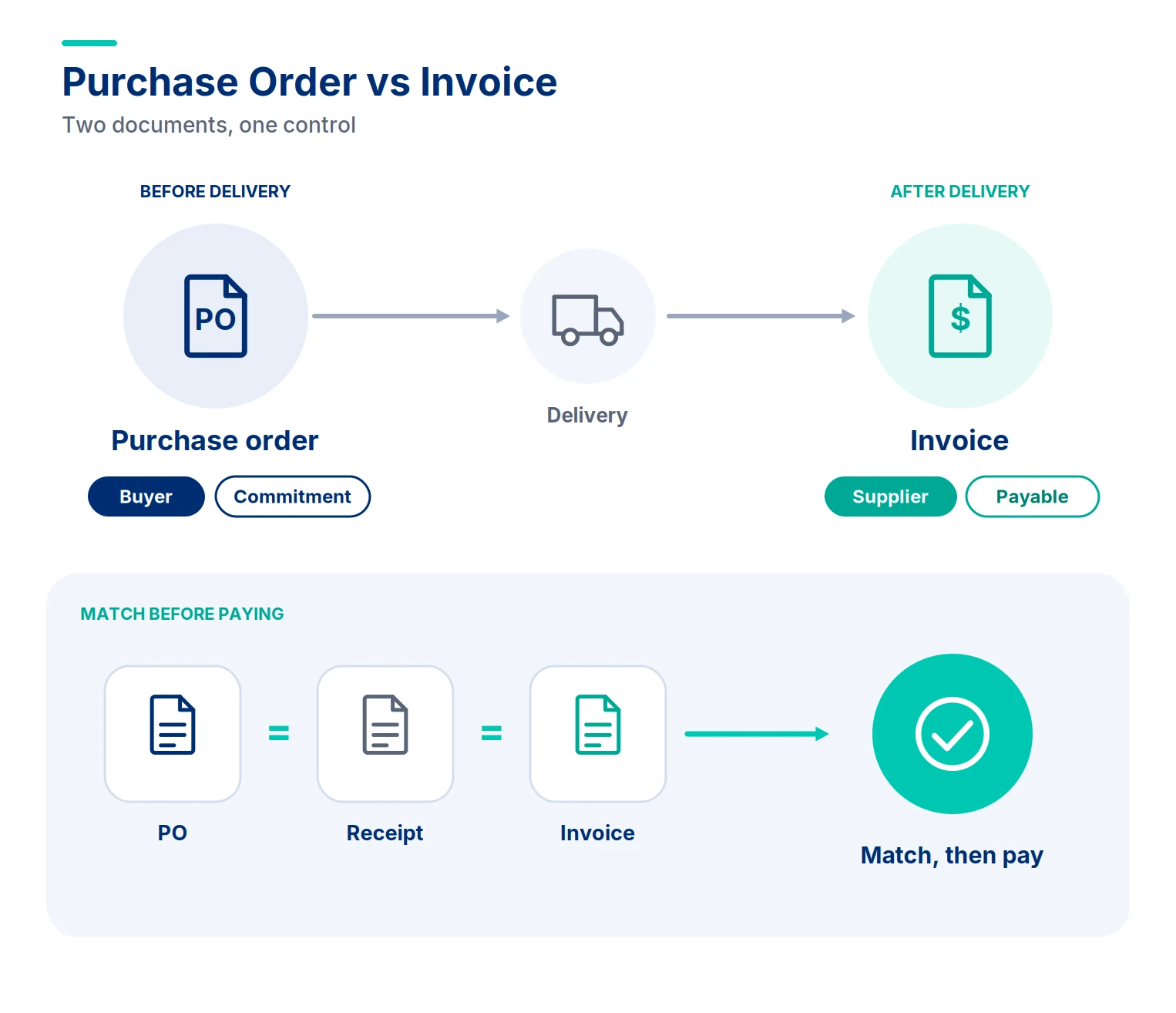
A purchase order (PO) is a document a buyer sends to a supplier to authorize a purchase before delivery. An invoice is the supplier’s request for payment, usually after goods or services are delivered. The PO sets the agreed terms. The invoice claims payment against them.
Why it matters in procurement?
Confusing the two creates payment risk. A PO is a commitment the buyer makes. An invoice is a demand the supplier makes. If finance pays an invoice with no matching PO, nobody has verified that the purchase was approved, priced correctly or received. Spend leaks through that gap.
The pairing is also the basis of control. Matching an invoice against its PO is how accounts payable catches price changes, quantity differences and duplicate billing before cash leaves the business. Teams that skip the PO step lose visibility and bargaining power, because spend is recorded only after it has happened.
The core process / lifecycle
- Requisition and Approval. A business user raises a requisition describing what is needed. It is approved against budget and authority limits before any commitment is made to a supplier.
- Purchase Order Issue. Procurement converts the approved requisition into a PO stating items, quantities, agreed prices, delivery dates and payment terms. The supplier receives it as the instruction to supply.
- Supplier Acknowledgement and Delivery. The supplier confirms the order and ships the goods or performs the service. Any change to price or date should be agreed against the PO, not introduced on the invoice.
- Receipt Confirmation. The buyer records what was actually delivered, usually as a goods receipt or service confirmation. This is the evidence that supports payment later.
- Invoice Submission. The supplier issues an invoice that references the PO number. It lists what was supplied, the amount due and the payment due date.
- Matching and Payment. Accounts payable compares the invoice with the PO and the receipt. A clean match is approved for payment. A mismatch goes to an exception queue and is resolved before any money moves.
Core components
- A purchase order carries the buyer’s commitment: PO number, supplier, line items, unit prices, quantities, delivery location and payment terms.
- An invoice carries the supplier’s claim: invoice number, referenced PO number, billed quantities and prices, tax and payment details.
- The match between them is the control point, because every field on the invoice should trace back to something the PO or receipt has already confirmed.
Key benefits
Keeping the two documents distinct and matched gives spend visibility before commitments become liabilities, since POs record intent while invoices record what the supplier says is owed. Price and quantity errors surface at matching, not in a supplier audit months later. Approval happens before the purchase, which reduces maverick buying. Commitment reporting improves because open POs show committed spend that has not yet been invoiced. Payment disputes also shrink, because the PO is the agreed reference both sides can point to.
Common pitfalls
- Paying invoices without a PO. Spend bypasses approval and pricing checks, and nobody can confirm the goods arrived.
- Treating the invoice as the commitment. Recording spend only when invoices arrive hides liabilities and distorts budget tracking.
- Letting prices change on the invoice. An unagreed price that is paid without challenge quietly becomes the price on the next order.
- Raising POs after the invoice arrives. A retroactive PO approves spend that has already happened and makes the control meaningless.
Purchase order and invoice compared field by field
| Dimension | Purchase Order | Invoice |
| Issued by | Buyer | Supplier |
| Issued when | Before delivery | Usually after delivery |
| Purpose | Authorizes and commits spend | Requests payment |
| Accounting effect | A commitment, not yet a liability | Moves the amount from a receipt accrual into accounts payable |
| Reference trail | Traces back to the requisition and contract | Traces back to the PO number and receipt |
KPIs
| Dimension | Sample KPIs |
| Control | PO compliance rate; non-PO invoice share |
| Accuracy | Invoice match rate; price mismatch rate |
| Efficiency | Touchless invoice rate; invoice cycle time |
| Risk | Retroactive PO rate; exception queue ageing |
Key Terms
- Purchase Requisition. An internal request to buy, raised and approved before a PO is issued.
- Goods Receipt. A record that ordered items arrived, used to support invoice payment.
- Two-Way Match. A check that the invoice agrees with the PO on price and quantity.
- Three-Way Match. A check across the PO, goods receipt and invoice before payment is released.
- Non-PO Invoice. An invoice received with no matching purchase order, which needs extra approval.
- Payment Terms. The agreed timing and conditions for paying an invoice, such as net 30.
- Pro Forma Invoice. A preliminary supplier statement of expected charges, sent before delivery and not a final demand for payment.
FAQs
1. What is the difference between a purchase order and an invoice?
A purchase order (PO) is issued by a buyer to authorize a purchase, while an invoice is issued by a supplier to request payment. A purchase order specifies agreed quantities, prices, delivery dates, and payment terms before goods or services are delivered. An invoice confirms the amount billed after delivery. Both documents support procurement transparency, spend control, and accurate payment processing.
2. Which comes first, a purchase order or an invoice?
A purchase order typically comes before an invoice in the procurement process. After a purchase requisition is approved, the buyer issues a PO outlining the purchase requirements. The supplier then delivers the goods or services and submits an invoice requesting payment. Accounts payable verifies the invoice against the purchase order and applicable receipt records before approving payment. This sequence helps prevent unauthorized purchases and billing errors.
3. Is a purchase order legally binding like an invoice?
A purchase order can become a legally binding contract once the supplier accepts its terms, depending on applicable laws and existing agreements. It establishes the buyer’s commitment to purchase specified goods or services. An invoice, however, is a supplier’s request for payment rather than a purchase authorization. Procurement teams should ensure purchase orders clearly define pricing, quantities, delivery conditions, and payment obligations to minimize contractual disputes.
4. Can a company process and pay an invoice without a purchase order?
Yes, companies can process non-PO invoices, but these transactions require additional approval and verification controls. Without a purchase order, accounts payable cannot perform standard PO matching to confirm agreed pricing and purchasing authorization. Organizations should validate the invoice, confirm receipt of goods or services, and obtain appropriate approvals before payment. Monitoring non-PO spending helps improve procurement compliance and reduce unauthorized purchases.
5. What is the difference between two-way and three-way invoice matching?
Two-way invoice matching compares an invoice against its purchase order to verify quantities and prices. Three-way matching adds a goods receipt to confirm that the ordered items were actually delivered. Three-way matching provides stronger payment controls and is particularly useful for material goods purchases. Two-way matching may be appropriate for certain low-value transactions or recurring services, depending on organizational policies.
6. What happens when an invoice does not match its purchase order?
When an invoice does not match its purchase order, accounts payable typically flags the discrepancy and temporarily holds payment. Common mismatches include incorrect prices, quantities, taxes, or missing purchase order references. The procurement or finance team contacts the supplier or responsible buyer to investigate and resolve the issue. Automated invoice matching helps identify discrepancies earlier, reduce payment errors, and prevent duplicate or unauthorized payments.
7. What is the difference between a purchase order and a pro forma invoice?
A purchase order is a buyer-issued document authorizing a purchase, while a pro forma invoice is a preliminary billing document provided by the supplier before delivery. A pro forma invoice outlines estimated costs, product details, and proposed transaction terms but is not a final payment demand. The purchase order confirms the buyer’s purchasing commitment, whereas the pro forma invoice helps both parties review expected charges before completing the transaction.