


WHAT IS SUPPLIER ENABLEMENT?
Supplier enablement is the process of getting approved suppliers set up to transact electronically with a buyer, for example by receiving POs, sending invoices and catalogs, and updating their own data through a portal, network or integration. It differs from supplier onboarding, which vets and approves a supplier. Enablement makes an approved supplier able to work digitally.
WHY IT MATTERS IN PROCUREMENT
Electronic ordering and invoicing only pay off when suppliers actually use them. If suppliers keep emailing PDFs and taking orders by phone, the buyer’s procure-to-pay system still depends on manual work, and spend keeps flowing outside the process.
Enablement is also becoming a compliance matter. E-invoicing mandates in several countries require structured invoices, so supplier readiness decides whether accounts payable can stay compliant. Strong enablement also reduces the cost of each transaction, which is the usual business case behind a supplier adoption program.
THE CORE PROCESS / LIFECYCLE
- Segment Suppliers. Procurement ranks suppliers by spend, transaction volume and strategic importance, so effort goes where it returns the most.
- Choose Channels. For each segment, the team picks a channel: a supplier portal, EDI or cXML integration, punchout catalog or e-invoicing network. Smaller suppliers usually need a low-effort option.
- Communicate and Train. Suppliers get a clear explanation of what changes, what it costs them and how to start, with guides and named support contacts.
- Connect and Test. Suppliers register, load catalogs or set up integrations, and test sample orders and invoices before going live.
- Go Live and Support. Transactions move to the electronic channel. A support team resolves errors and answers supplier questions in the first weeks.
- Monitor and Expand. Adoption is tracked by supplier and channel, non-adopters are followed up, and further document types are added over time.
CORE COMPONENTS
- Supplier channels include portals, EDI and e-invoicing networks.
- Catalogs and punchout let suppliers present products and prices inside the buyer’s system.
- Supplier master data holds the routing and tax details each channel needs.
- Training and support reduce errors and drop-off.
- Adoption targets set the share of spend or invoices that should flow electronically.
KEY BENEFITS
Enabled suppliers mean more spend through the system, which gives better visibility and control. Orders and invoices arrive structured, so there is less keying and fewer matching errors. Payment is faster and more predictable, which suppliers value, and that is often the strongest reason for them to adopt. Compliance with e-invoicing rules becomes easier to manage. And accounts payable teams spend less time on exceptions and chasing missing documents.
COMMON PITFALLS
- Treating all suppliers the same. A system integration suits a high-volume supplier but is too heavy for one that bills twice a year.
- Running it as a buyer-only project. Suppliers adopt when they see a benefit, such as faster payment, so the benefit needs to be explained.
- Offering no low-effort option. Small suppliers with no IT resources drop out and return to email.
- Stopping at go-live. Without support and monitoring, suppliers slip back to old habits and adoption stalls.
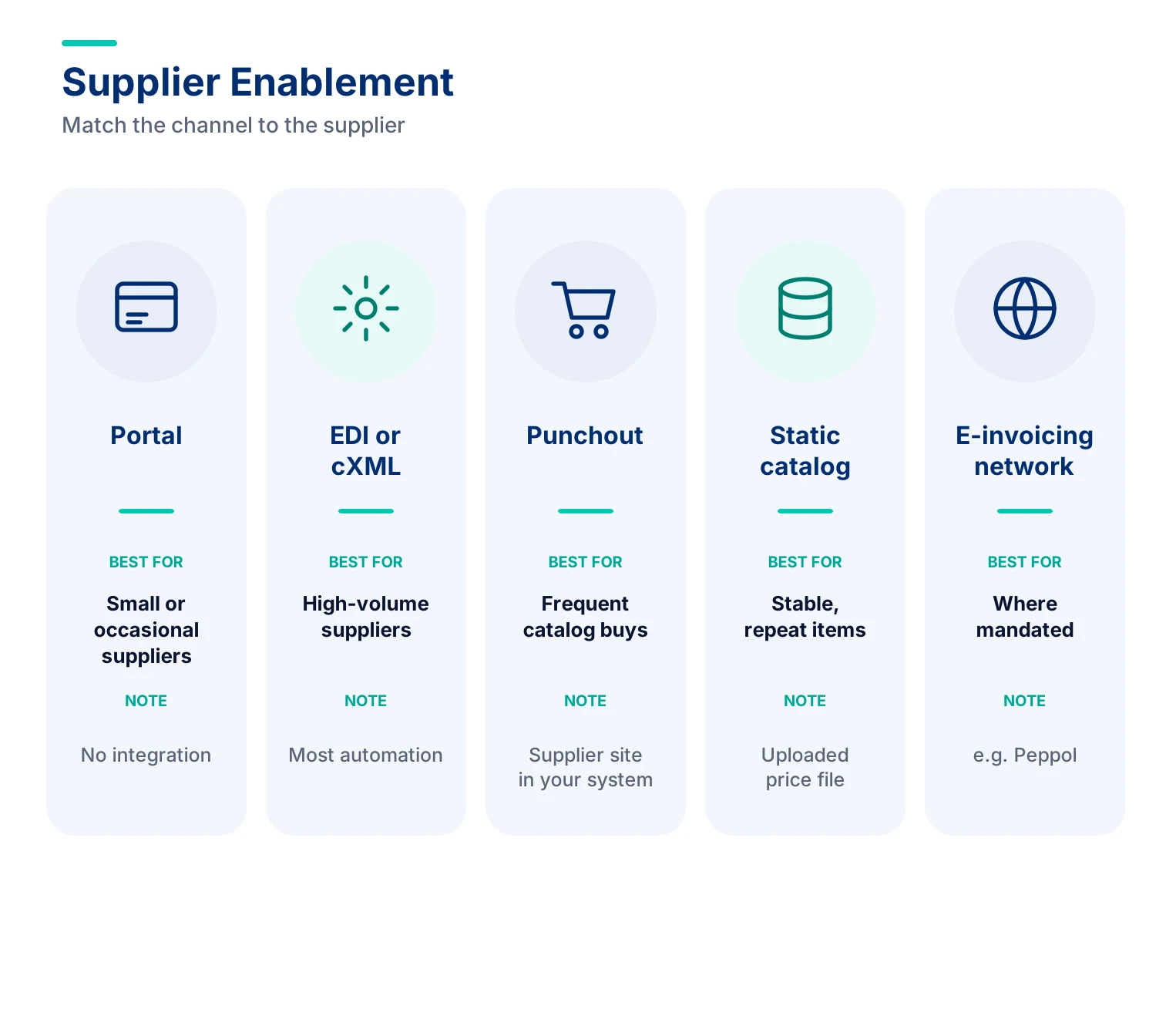
ENABLEMENT METHODS AND WHICH SUPPLIERS THEY SUIT
- Supplier portal. Web access that lets small or occasional suppliers view POs and submit invoices with no integration.
- EDI or cXML integration. System-to-system exchange for high-volume suppliers, with more set-up effort and the most automation.
- Punchout catalogs. The supplier’s own catalog site opens inside the buyer’s procurement system, which suits frequent catalog purchases.
- Static catalogs. Uploaded item and price files, suited to stable, repeat items.
- E-invoicing networks. Structured invoices sent through a network such as Peppol, where mandated or preferred.
KPIs
| Dimension | Sample KPIs |
| Adoption | Suppliers enabled; share of spend through enabled suppliers |
| Channel mix | Orders by channel; invoices received electronically |
| Quality | Invoices matched without touch; document error rate |
| Support | Time to first transaction; support tickets per supplier |
KEY TERMS
- Supplier Onboarding. The process of vetting, registering and approving a new supplier.
- Supplier Portal. A web application where suppliers view orders, submit invoices and update their data.
- EDI. Electronic data interchange, a standard way to exchange business documents between systems.
- cXML. A web-based format for exchanging procurement documents such as orders and invoices.
- Punchout Catalog. A supplier-hosted catalog that opens inside the buyer’s system and returns the selected items.
- Static Catalog. A file of items and prices loaded into the buyer’s system.
- Non-PO Spend. Spend that happens without a purchase order, sometimes linked to suppliers that are not enabled.
FAQS
1. What is supplier enablement in procurement?
Supplier enablement is the process of connecting approved suppliers to a buyer’s digital procurement systems so they can exchange purchase orders, invoices, catalogs, and business information electronically. It typically involves supplier portals, electronic data interchange (EDI), or procurement networks. Effective supplier enablement reduces manual transactions, improves purchase order accuracy, accelerates invoice processing, and increases supplier participation in procure-to-pay (P2P) workflows.
2. What is the difference between supplier onboarding and supplier enablement?
Supplier onboarding focuses on registering, verifying, and approving new suppliers before establishing a business relationship. Supplier enablement begins after approval and ensures suppliers can transact electronically through procurement platforms. For example, onboarding involves collecting tax information, banking details, and compliance documents, while enablement involves configuring supplier portals, electronic invoicing, and purchase order integrations. Both processes support efficient supplier management but serve different purposes in the procurement lifecycle.
3. How does the supplier enablement process work?
The supplier enablement process involves segmenting suppliers, selecting appropriate digital transaction channels, providing training, configuring integrations, and testing electronic transactions. Procurement teams typically prioritize suppliers based on spending, transaction volume, and strategic importance. After successful testing, suppliers begin exchanging purchase orders and invoices electronically. Continuous monitoring, technical support, and adoption tracking help organizations resolve transaction errors and improve supplier participation.
4. What are the different methods of supplier enablement?
Common supplier enablement methods include supplier portals, EDI integrations, cXML connections, punchout catalogs, static catalogs, and e-invoicing networks. Supplier portals suit smaller businesses with limited technical resources, while EDI and cXML support high-volume automated transactions. Punchout catalogs enable purchasing directly from supplier-hosted catalogs, and e-invoicing networks facilitate structured invoice exchange. Procurement teams should select methods based on supplier capabilities, transaction volumes, and integration requirements.
5. Which suppliers should organizations prioritize for digital enablement?
Organizations should prioritize suppliers based on purchasing spend, transaction frequency, strategic importance, and potential automation benefits. High-volume suppliers often provide the greatest opportunity to reduce manual processing costs through EDI or system integrations. Smaller suppliers can be enabled through simpler self-service portals. A segmented supplier enablement strategy helps procurement teams allocate resources efficiently, accelerate digital adoption, and improve transaction coverage across the supplier network.
6. How does supplier enablement support electronic invoicing compliance?
Supplier enablement supports electronic invoicing compliance by helping suppliers generate and exchange structured invoices through approved digital channels. Procurement and accounts payable teams can configure supplier portals, e-invoicing networks, and integrations to meet applicable regulatory requirements. Accurate supplier master data, including tax identification and invoice routing details, helps reduce validation errors. Effective enablement also improves invoice matching, reduces manual processing, and supports compliance with country-specific e-invoicing mandates.
7. How can companies measure supplier enablement success?
Companies can measure supplier enablement success using key performance indicators such as supplier adoption rates, electronically processed purchase orders, digital invoice volumes, and spend coverage. Additional metrics include invoice matching accuracy, transaction error rates, time to first electronic transaction, and supplier support requests. Monitoring these KPIs helps procurement teams identify adoption gaps, reduce manual processing costs, and continuously improve supplier participation in digital procurement workflows.