



WHAT IS A MOST FAVORED NATION CLAUSE?
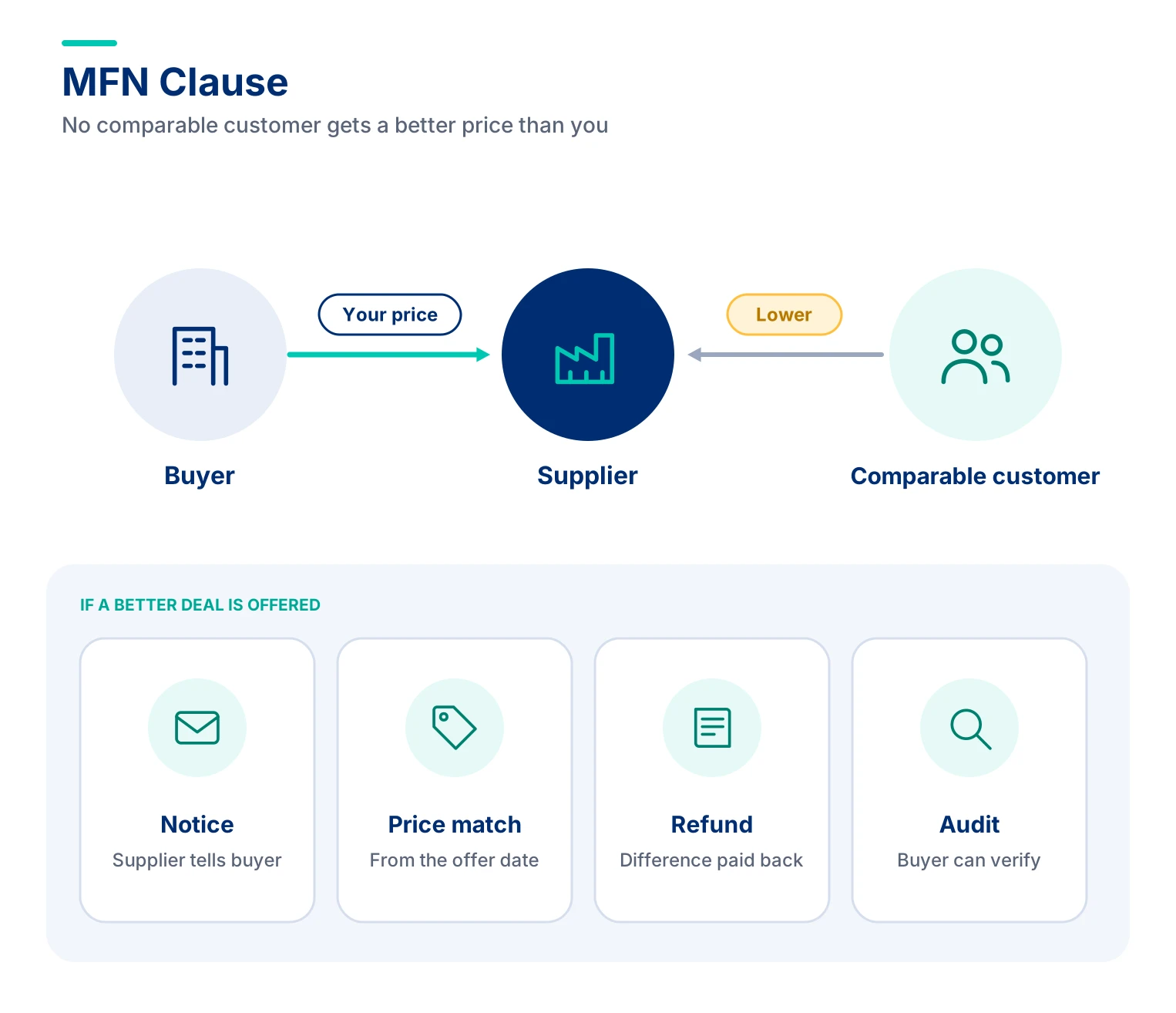
A most favored nation (MFN) clause is a contract term in which a supplier promises that the buyer will get prices or terms at least as good as those it gives to any other comparable customer. If the supplier offers a better deal elsewhere, the same deal must be offered to the buyer. It is also called a most favored customer clause.
WHY IT MATTERS IN PROCUREMENT
Buyers cannot see what suppliers charge others, and prices agreed today can look poor after a supplier cuts a deal with a competitor. An MFN clause protects against that gap. It keeps the buyer’s price in line with the market over the life of the contract, and it reduces the need to renegotiate or benchmark the price all the time.
MFN clauses are only as strong as their wording and enforcement. Suppliers resist broad clauses because they limit pricing freedom, so the scope is often negotiated. Some jurisdictions also treat MFN clauses with care under competition law, especially where the party using them has strong market power, so legal review matters.
THE CORE PROCESS / LIFECYCLE
- Decide Where an MFN Fits. The team identifies contracts where price transparency is weak and the supplier has other comparable customers, such as stable, repeat purchases.
- Define the Comparison. The clause states which customers, products, volumes and terms count as comparable, so the test is clear.
- Draft the Obligation. The supplier agrees to offer the buyer the better price or terms if it gives them to a comparable customer.
- Set Notice and Audit Rights. The clause requires the supplier to notify the buyer of triggering offers and allows verification, often through an independent auditor.
- Agree the Remedy. The clause sets the remedy, such as an automatic price match from the date of the better offer, a refund of the difference or a right to terminate.
- Monitor and Enforce. The buyer reviews supplier certifications, runs audits as agreed and applies the remedy when the clause is triggered.
CORE COMPONENTS
Scope states whether the clause covers price only or also terms such as payment, warranty or service levels. Comparable customers define who counts, usually by volume, geography and purchase terms. Equivalent products limit the comparison to the same or very similar goods or services. Lookback and look-forward set whether the clause covers past sales, future offers or both. Verification gives the buyer a way to check compliance. Remedy sets what the supplier must do when the clause is triggered.
KEY BENEFITS
An MFN clause gives the buyer ongoing price protection without constant renegotiation. It assures leadership that the company is not paying more than comparable customers, and reduces the risk of overpaying after the contract is signed.
It can also support longer contracts, because the buyer has less need to hedge against falling market prices through short terms. The clause creates an incentive for the supplier to price fairly from the start. In some categories, such as software or services with few price references, it is one of the few ways to keep the price aligned with the market.
COMMON PITFALLS
- Vague comparison rules. If comparable customer and equivalent product are undefined, the clause is easy to avoid and hard to enforce.
- No verification right. Without notice duties or audit rights, the buyer cannot tell whether the clause was triggered.
- Ignoring legal limits. In some markets and situations, MFN clauses raise competition law concerns, so legal review is needed.
- Looking at list price only. Rebates, free services and other terms can give other customers a better net deal, so the clause should define price to include them.
SAMPLE CLAUSE AND THE TERMS TO DEFINE
Illustrative wording only, for legal review: “Supplier represents that the prices charged to Buyer for the Products will not exceed the lowest price charged by Supplier to any other customer purchasing comparable quantities of equivalent products on similar terms. If Supplier offers a lower price to such a customer, Supplier will apply that price to Buyer from the date of the offer and refund any difference paid.”
| Term to define | Why it matters |
| Comparable customer | Sets who the buyer is compared with, by volume, region and terms |
| Equivalent product | Keeps the test to like-for-like goods or services |
| Effective date | States when the better price applies |
| Audit right | Lets the buyer or a third party verify compliance |
| Remedy | Sets price match, refund or termination right |
KPIs
| Dimension | Sample KPIs |
| Coverage | Contracts with an MFN clause; spend covered by MFN terms |
| Compliance | Supplier certifications received on time; audits completed |
| Value | Price adjustments or refunds triggered; value recovered |
| Quality of terms | Clauses with defined comparison rules and audit rights |
KEY TERMS
- Most Favored Customer. Another name for an MFN clause.
- Price Parity. A promise that a buyer’s price matches that of other buyers.
- Comparable Customer. A customer similar enough to the buyer, by volume and terms, to be used for comparison.
- Price Match. A remedy in which the supplier lowers the price to the better level.
- Audit Right. The right to check a supplier’s records to verify compliance.
- Benchmarking. Comparing prices with market data to judge whether they are competitive.
- Price Protection. Contract terms that guard the buyer against price increases or unfavorable pricing.
- Retroactive Adjustment. A change that applies from an earlier date.
FAQs
1. What is a Most Favored Nation (MFN) clause in procurement?
A Most Favored Nation (MFN) clause is a contractual provision requiring suppliers to offer buyers pricing or terms at least as favorable as those provided to comparable customers. Also called a Most Favored Customer clause, it protects organizations from paying higher prices for equivalent products or services. Procurement teams use MFN clauses to maintain competitive supplier pricing, improve contract value, and reduce the need for frequent price renegotiations.
2. How does an MFN clause work in supplier contracts?
An MFN clause requires suppliers to extend better pricing or contractual terms to an existing buyer when comparable customers receive more favorable offers. For example, if a supplier offers a similar customer a lower price for equivalent products and purchase volumes, the buyer may qualify for the same price. Depending on the contract, adjustments can include automatic price matching, retroactive refunds, or revised commercial terms.
3. What should be included in a Most Favored Nation clause?
An effective MFN clause should define comparable customers, eligible products or services, pricing conditions, effective dates, and verification rights. It should also specify whether discounts, rebates, payment terms, and service benefits are included in price comparisons. Procurement teams should establish supplier notification requirements, audit provisions, and remedies for non-compliance. Clear definitions reduce contractual ambiguity and make MFN provisions easier to monitor and enforce.
4. Do MFN clauses apply only to pricing or other contract terms?
MFN clauses can cover both pricing and non-price contractual terms, depending on their wording. Beyond product prices, they may include volume discounts, rebates, payment terms, warranties, and service levels. For example, if a supplier offers longer payment periods or additional services to a comparable customer, an appropriately drafted MFN clause may require equivalent benefits. Procurement teams should explicitly define which commercial terms qualify for comparison.
5. How can procurement teams monitor and enforce MFN clause compliance?
Procurement teams can monitor MFN compliance through supplier certifications, contractual notification requirements, periodic reviews, and agreed audit rights. Suppliers may be required to disclose when comparable customers receive more favorable pricing or terms. If a violation is identified, buyers can pursue contractual remedies such as price adjustments, refunds, or termination where permitted. Maintaining clear comparison criteria and verification procedures improves accountability and protects negotiated contract value.
6. Are Most Favored Nation clauses legal, and what are their risks?
MFN clauses are not automatically unlawful, but they can raise competition law concerns depending on market conditions, contractual scope, and the parties’ market power. Broad clauses may restrict supplier pricing flexibility or discourage competitive discounting. Procurement teams should assess potential antitrust implications, define reasonable comparison criteria, and obtain legal review before implementation. Poorly drafted MFN clauses can also create disputes over customer comparability, pricing calculations, and enforcement.
7. What is the difference between an MFN clause and price benchmarking?
An MFN clause protects buyers by comparing their contractual pricing or terms with those offered by the same supplier to comparable customers. Price benchmarking evaluates whether supplier pricing is competitive against broader market rates, industry data, or alternative vendors. While MFN clauses create contractual price protection, benchmarking provides market-based pricing insights. Procurement teams can use both approaches to identify overpayments, support supplier negotiations, and maintain competitive purchasing costs.