


What is a clause library?
A clause library is a managed collection of pre-approved contract clauses, each with standard wording, approved fallback versions and guidance on when to use them. Drafters pick clauses from the library instead of writing from scratch, which keeps contracts consistent and legally sound.
Why it matters in procurement?
Without a shared library, each buyer or lawyer drafts clauses in their own way, or copies them from old contracts. The result is a mix of wording, uneven risk protection and extra legal review. A clause library gives teams approved language they can use with confidence, and it brings consistent terms across suppliers.
A library also speeds up contracting. Drafters assemble contracts from tested building blocks, and legal reviews only what departs from the standard. The library is not the same as a contract playbook. The library holds the approved wording, while the playbook tells negotiators how far they can move on each term.
Read More About Enhancing Contract Management with Automated Clause Addition
The core process / lifecycle
- Collect Existing Clauses. Legal and procurement gather clauses from current templates and signed contracts, and note which ones work and which cause disputes.
- Standardize the Wording. For each topic, such as payment, liability or data protection, the team selects one preferred clause and writes it in clear language.
- Add Fallback Options. Legal drafts approved alternatives for common negotiation outcomes and defines who must approve each fallback.
- Add Usage Guidance. Each entry carries notes on when to use it, which contract types it fits and what risks it covers.
- Publish and Connect. The library goes into the contract authoring or management system, so drafters can insert approved clauses directly.
- Review and Update. Legal reviews clauses on a set schedule and when laws, risks or business needs change, and records the version history.
Core components
- Preferred clause is the standard wording used by default.
- Fallback clauses are pre-approved alternatives for common pushback.
- Metadata tags each clause by topic, contract type, jurisdiction and risk level.
- Usage guidance explains when and how to use the clause.
- Approval rules state who must approve a non-standard version.
- Version control records changes and keeps old versions available for contracts already signed.
- Ownership names the legal or procurement owner who maintains each clause.
Key benefits
A clause library reduces drafting time and legal review, because approved wording is ready to use. It raises consistency, so similar suppliers get similar terms and risk positions. New team members produce sound drafts sooner, since the approved language is in front of them.
It also lowers risk. Clauses reflect current law and company policy, and updates reach all drafters at once. When a dispute arises, the company knows what standard it intended to use. Over time, data on which fallbacks are used shows where standards are out of step with the market.
Check out
Common pitfalls
- Building it once and leaving it. Laws, risks and business needs change, so stale clauses create exposure.
- Too many options per clause. A long list of variants makes selection hard and defeats the purpose of standardization.
- No guidance on use. Without notes on when to use each clause, drafters pick the wrong one.
- Library disconnected from the drafting tool. If drafters must copy from a separate file, they revert to old habits.
Read More About Contract Management: A Complete Guide to Managing Contracts Effectively
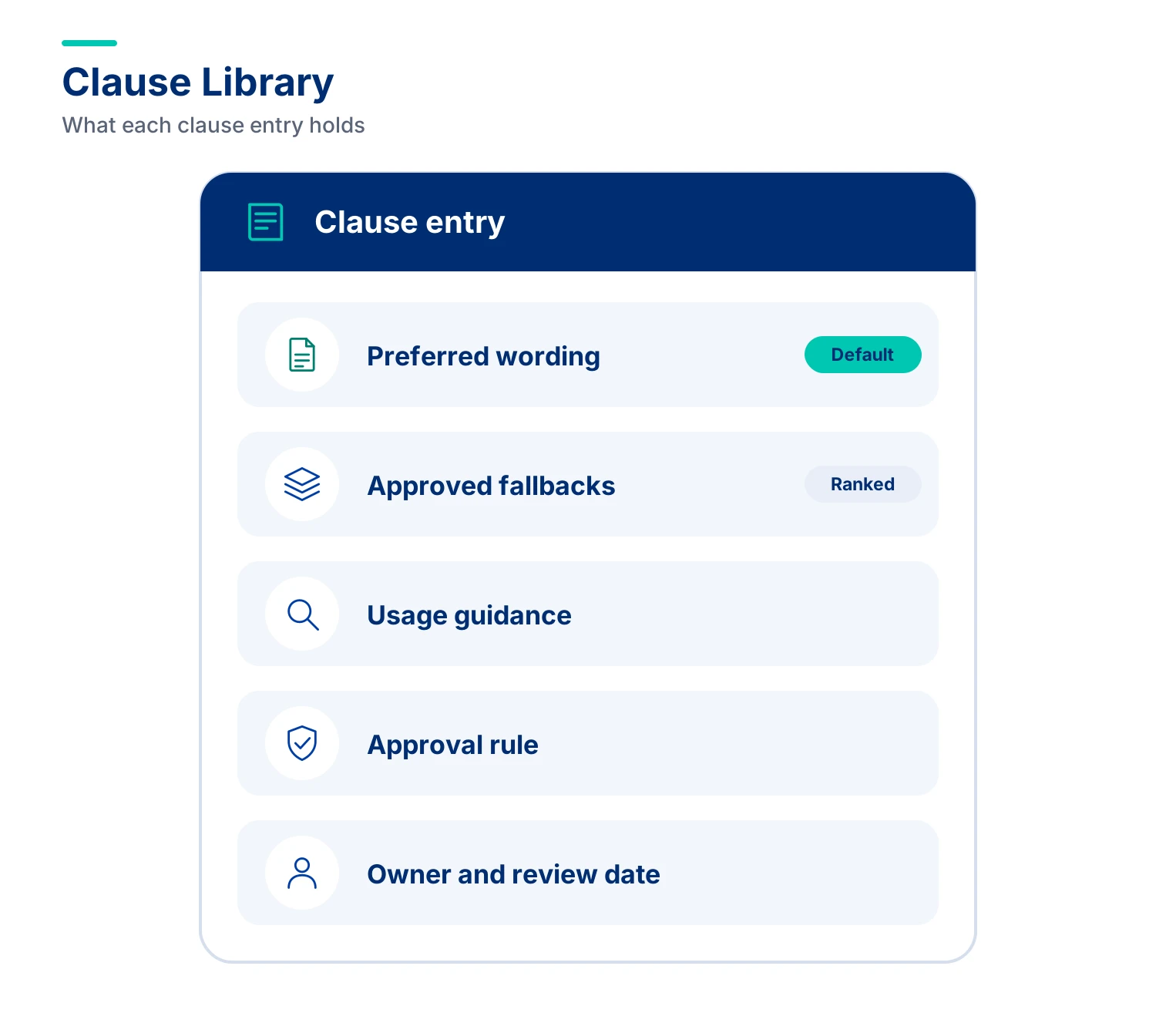
What each clause entry should contain?
A consistent entry structure makes the library easy to search and use.
| Field | Content |
| Clause name and topic | For example limitation of liability, data protection or termination |
| Preferred wording | Standard text used by default |
| Approved fallbacks | Alternative wording that can be used without escalation, in order |
| Usage guidance | When to use it, contract types it fits and what risk it covers |
| Approval rule | Who must approve changes that go beyond the approved fallbacks |
| Owner and review date | Person responsible and date of the next review |
KPIs
| Dimension | Sample KPIs |
| Adoption | Contracts drafted from library clauses; share of contracts using the standard template |
| Speed | Drafting time per contract; legal review time |
| Consistency | Non-standard clauses per contract; fallback use by clause |
| Currency | Clauses reviewed in the last 12 months; clauses with an owner |
Key terms
- Standard Clause. Approved wording used by default for a contract topic.
- Fallback Clause. An approved alternative that may be used in negotiation.
- Boilerplate. Standard contract terms that appear in most agreements.
- Contract Template. A pre-built contract that combines standard clauses.
- Contract Playbook. A guide to negotiating each term, with preferred, fallback and escalation positions.
- Metadata. Tags that describe a clause so it can be searched and filtered.
- Version History. A record of changes to a clause over time.
- Non-Standard Clause. Wording that departs from the approved library and needs review.
Checkout Zycus Contract Management Software
Related Reads
FAQs
1. What is a clause library in contract management?
A clause library is a centralized collection of pre-approved contract clauses used to standardize contract drafting and negotiation. It contains preferred legal wording, approved fallback clauses, usage guidelines, and approval requirements. Procurement and legal teams use clause libraries to create consistent supplier agreements, reduce drafting errors, and accelerate contract reviews. When integrated with contract lifecycle management (CLM) software, a clause library helps organizations maintain compliance and improve contracting efficiency.
2. What types of clauses should be included in a contract clause library?
A contract clause library should include frequently used and high-risk legal clauses such as payment terms, limitation of liability, confidentiality, data protection, indemnification, termination, and dispute resolution. Each entry should contain standard wording, approved alternatives, usage instructions, and approval requirements. Organizations should also maintain clause ownership, version history, and review dates to ensure contractual language remains accurate, consistent, and aligned with business policies.
3. What is the difference between a clause library and a contract template?
A clause library stores individual, pre-approved legal provisions that can be reused across different contracts, while a contract template provides a predefined structure for an entire agreement. For example, a clause library may contain several approved confidentiality provisions, whereas a supplier agreement template combines confidentiality, payment, liability, and termination clauses into one document. Both support contract standardization, but clause libraries provide greater flexibility when drafting customized agreements.
4. How does a clause library differ from a contract playbook?
A clause library contains standardized contractual language and approved alternative clauses, while a contract playbook provides guidance on negotiating those terms. The library defines what wording can be used, whereas the playbook explains acceptable negotiation positions, fallback options, and escalation requirements. Legal and procurement teams often use both together to maintain consistent contract terms, accelerate negotiations, and manage contractual risks without requiring legal approval for every routine change.
5. How does a clause library improve procurement and contract management?
A clause library improves procurement and contract management by standardizing legal language, reducing repetitive drafting, and accelerating contract approvals. It allows procurement teams to reuse approved contract terms instead of creating clauses from scratch. This reduces inconsistencies across supplier agreements, limits unnecessary legal reviews, and improves compliance with organizational policies. Centralized clause management also makes it easier to track deviations, manage contractual risks, and maintain consistency throughout the contract lifecycle.
6. Who should manage a clause library, and how often should it be updated?
The legal department typically manages a clause library in collaboration with procurement and contract management teams. Each clause should have a designated owner responsible for maintaining approved wording, fallback options, and usage guidelines. Organizations should review their clause libraries at least annually and whenever regulations, business requirements, or risk policies change. Regular reviews, version control, and clearly defined approval workflows help prevent outdated contract language and maintain consistency across agreements.
7. How can AI and contract management software automate clause library management?
AI-powered contract management software can automate clause library management by recommending approved clauses, identifying non-standard wording, and flagging deviations from contractual policies. During contract drafting and review, AI tools can help users select relevant clauses based on agreement type, risk level, and predefined guidelines. Integration with contract lifecycle management software enables centralized access, version tracking, and faster review workflows. Human oversight remains essential for approving contractual changes and validating legally sensitive provisions.