


What is index-based pricing?
Index-based pricing is a contract pricing method in which the price of a good or service moves up or down in line with a published market index, such as a commodity, energy or labor cost index. The contract sets a base price, the index to follow, and the rules for when and how the price is adjusted.
Why it matters in procurement?
For categories where input costs swing, such as metals, plastics, fuel, freight or electricity, fixed prices force suppliers to add a risk premium or to ask for renegotiation when markets move. Linking price to an agreed index makes changes transparent and rule-based, so neither side needs to guess the future or argue about cost claims.
Index-based pricing shares market risk between buyer and supplier. It does not remove it. If the index rises, the buyer pays more, and if it falls, the buyer pays less. Procurement therefore needs to choose the right index, set clear weights and limits, and understand how much of the price is truly driven by the input.
The core process / lifecycle
- Choose the Index. The team selects a published, independent index that matches the actual input cost, such as a metal price for a metal part.
- Set Base Price and Base Index. The contract fixes the starting price and the index value at the date it applies, so changes can be measured from a clear point.
- Define the Weight. The parties agree what share of the price depends on the index. A part with 60 percent material cost may link only 60 percent of its price.
- Set Adjustment Rules. The contract states how often the price is reset, which index reading is used, and any lag between the index date and the new price.
- Add Limits. Caps, floors or collars limit how far the price can move in each period or over the term.
- Review and Audit. Both sides check calculations each period and review whether the index still fits the cost.
Core components
Index is the published reference, such as a metals exchange price, a producer price index, a fuel index or a labor cost series. Base price and base index anchor the formula. Weighting limits the adjustment to the share of price that follows the index. Adjustment interval sets how often the price changes. Lag is the delay between an index reading and the price it affects. Collars and caps limit movement. Fixed element is the part of the price that does not move, such as the supplier’s margin and conversion cost.
Key benefits
Index-based pricing removes much of the risk premium suppliers add to fixed prices, and gives both sides a clear formula for changes. It cuts the time spent on price renegotiation and on arguments over cost claims, because the rule is agreed in advance.
It supports longer contracts in volatile categories, since prices stay in line with the market. It also lets buyers forecast cost with a formula and run what-if scenarios on budgets. Used well, it protects supplier margins in rising markets and passes savings to buyers in falling ones.
Common pitfalls
- Choosing an index that does not match the cost. If the index moves differently from the supplier’s real input cost, one side gains or loses unfairly.
- Linking the whole price to the index. Labor, overhead and margin do not follow the index, so only the index-driven share should adjust.
- No caps or collars. Without limits, a sharp market swing can break the buyer’s budget or the supplier’s viability.
- Leaving the reset rule unclear. Ambiguity about which reading and date apply leads to disputes on every adjustment.
The formula and a worked example
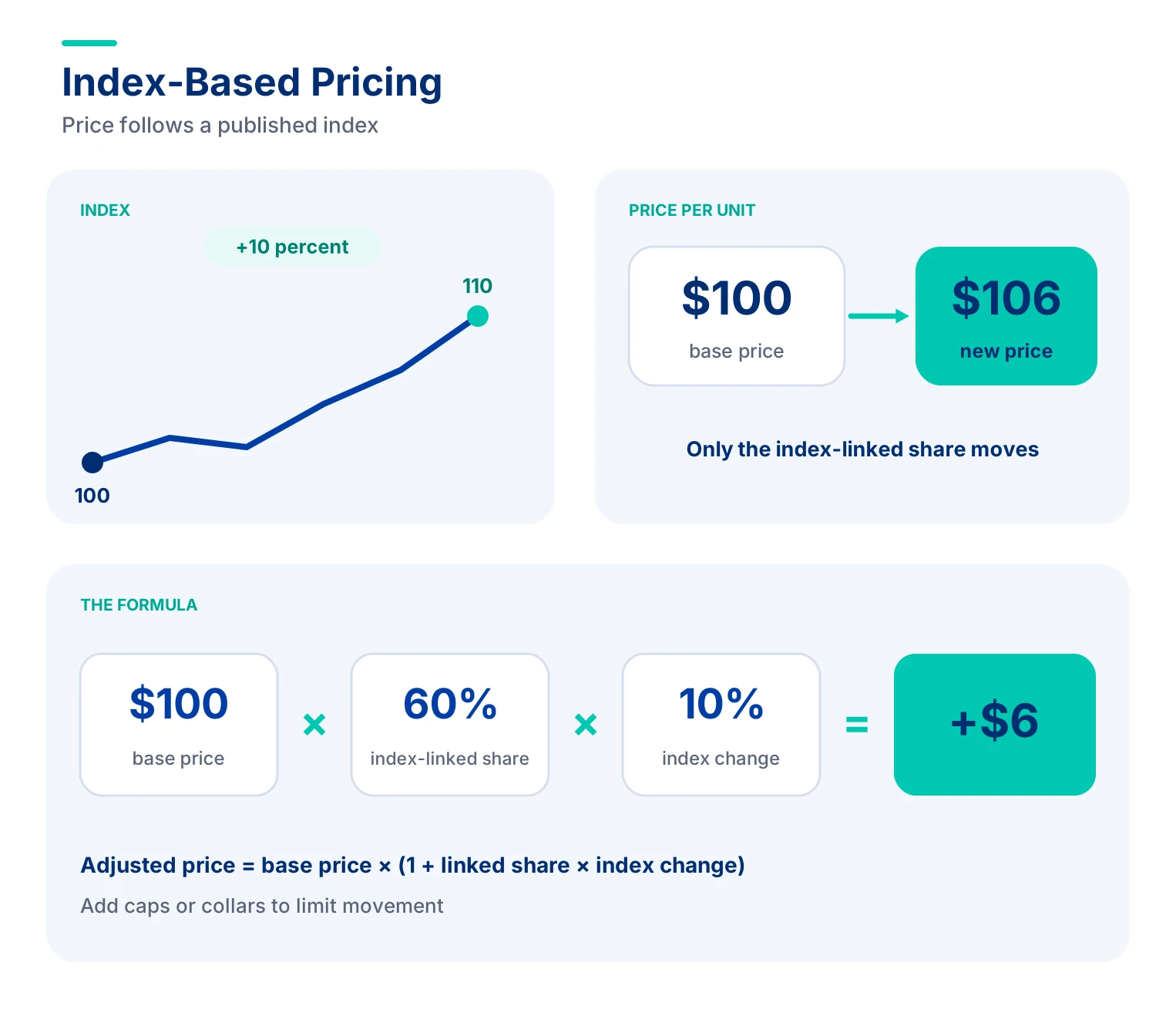
The adjusted price is the base price multiplied by one plus the index-linked share times the percentage change in the index. The example is illustrative.
| Item | Value |
| Base price | $100 per unit |
| Base index and current index | 100 and 110, a 10 percent rise |
| Share of price linked to the index | 60 percent |
| Adjustment | 60 percent × 10 percent = 6 percent |
| New price | $100 × 1.06 = $106 per unit |
KPIs
| Dimension | Sample KPIs |
| Coverage | Spend under index-linked contracts; categories with an agreed index |
| Accuracy | Price adjustments applied on time; adjustment disputes |
| Exposure | Budget variance caused by index movement; spend within caps |
| Fit | Correlation between index and supplier cost; indexes reviewed in the last year |
Key terms
- Price Index. A published series that tracks the price of a commodity, input or basket over time.
- Base Index. The index value on the date the base price applies.
- Price Adjustment Clause. A contract term that sets how prices change with an index.
- Collar. A limit that sets both a floor and a cap on price movement.
- Lag. The delay between an index reading and the date it changes the price.
- Pass-Through. Moving a change in input cost on to the buyer through the price.
- Cost-Plus Pricing. Pricing based on the supplier’s cost plus an agreed margin.
- Escalation Clause. A term that lets prices rise under stated conditions.
FAQs
1. What is index-based pricing in procurement?
Index-based pricing is a procurement pricing strategy where contract prices automatically adjust based on changes in a published market index. Common benchmarks include commodity prices, fuel costs, and labor indices. Instead of negotiating fixed prices, buyers and suppliers agree on a pricing formula linked to market movements. This approach improves pricing transparency, reduces frequent renegotiations, and helps organizations manage cost fluctuations in long-term supplier contracts.
2. How is index-based pricing calculated?
Index-based pricing is calculated using a base price, the percentage change in a market index, and the proportion of the price linked to that index.
**Formula: Adjusted Price = Base Price × [1 + (Index-Linked Share × Index Change %)]**
For example, if a product costs $100, its index rises by 10%, and 60% of its cost is index-linked, the adjusted price becomes $106. This method ensures that only the relevant cost component changes with market conditions.
3. When should companies use index-based pricing?
Companies should use index-based pricing when purchasing goods or services affected by significant market price fluctuations. It is particularly useful for procurement categories such as metals, plastics, fuel, freight, and energy. Index-linked contracts help organizations manage commodity price volatility, establish transparent supplier agreements, and reduce repeated price negotiations. They are especially valuable in long-term contracts where input costs are difficult to predict.
4. Which indices are commonly used in index-based pricing?
Common indices used in index-based pricing include commodity price indices, producer price indices, energy price indices, fuel benchmarks, and labor cost indices. Procurement teams should select an independent, publicly available index that closely reflects the supplier’s actual input costs. The choice depends on the product category, geographic market, and cost structure. Selecting the right benchmark helps ensure accurate contract price adjustments and reduces pricing disputes.
5. What are the benefits of index-based pricing in procurement?
Index-based pricing improves procurement cost transparency, reduces supplier pricing disputes, and simplifies contract negotiations. It allows buyers to benefit from declining market prices while helping suppliers recover legitimate cost increases. Additional benefits include improved spend forecasting, reduced supplier risk premiums, and greater stability in long-term sourcing agreements. By linking price adjustments to measurable market benchmarks, procurement teams can make more informed purchasing and budgeting decisions.
6. What are the risks of index-based pricing, and how can procurement teams manage them?
The main risks of index-based pricing include choosing an unsuitable market index, applying adjustments to the entire contract price, and experiencing unexpected cost increases. Procurement teams can manage these risks by selecting relevant benchmarks, defining index-linked cost percentages, and establishing price adjustment caps, floors, or collars. Contracts should also specify adjustment frequency, index reference dates, and audit procedures. Regular monitoring helps prevent pricing errors and ensures fair supplier agreements.
7. What is the difference between index-based pricing, fixed pricing, and cost-plus pricing?
Index-based pricing adjusts contract prices according to changes in an agreed market benchmark. Fixed pricing maintains a predetermined price throughout a specified contract period, regardless of market fluctuations. Cost-plus pricing calculates the final price using the supplier’s actual costs plus an agreed profit margin. Index-based pricing offers a balance between market responsiveness and pricing transparency, making it useful for procurement categories exposed to volatile input costs.