


Contract renewal automation is the use of technology to monitor contract expiration dates, trigger auto-renewal alerts, and manage renewal workflows without manual calendar tracking or email reminders. It ensures that procurement teams are notified well in advance of renewal windows, giving them time to renegotiate terms, benchmark pricing, or exit agreements that no longer serve the organization.
Read more: The Evolving Role of Contract Manager in Procurement
Why Contract Renewal Automation Matters in Procurement
Missed renewal deadlines are one of the most common and costly contract management failures. When a contract auto-renews without review, the organization may be locked into unfavorable pricing, outdated terms, or suppliers that no longer meet performance expectations. Renewal tracking through automated contract notifications eliminates this risk by ensuring every expiring contract receives timely attention. For procurement teams managing hundreds or thousands of contracts, manual tracking is simply not sustainable.
The Core Process of Contract Renewal Automation
The process begins when a contract is executed and stored in the contract management system. Key dates — effective date, expiration date, auto-renewal date, and notice period — are captured as metadata. The system uses these dates to build a renewal calendar and schedule contract notifications at predefined intervals.
As a renewal window approaches, auto-renewal alerts are triggered and sent to the responsible contract owner, category manager, or procurement lead. These alerts are typically staged — for example, 120 days, 90 days, and 30 days before the renewal or termination deadline — giving stakeholders adequate time to act.
Download Whitepaper: AI-Powered Contract Lifecycle Management for Legal and Procurement
Once alerted, the contract owner initiates the renewal workflow. This may involve reviewing supplier performance, benchmarking current pricing against market rates, assessing whether the scope of services still aligns with business needs, and deciding whether to renew, renegotiate, or terminate.
If renewal is approved, updated terms are negotiated and the contract is either amended or replaced. If the decision is to terminate, the team issues the required notice within the contractual window. Throughout this process, the system logs every action, notification, and decision for audit and compliance purposes across the full contract lifecycle.
Core Components of Contract Renewal Automation
Date and Milestone Tracking. Captures and indexes all critical contract dates — expiration, auto-renewal triggers, notice periods, and option exercise deadlines — as structured metadata.
Auto-Renewal Alerts. Automated, staged contract notifications sent to responsible stakeholders at predefined intervals before renewal or expiration deadlines.
Renewal Workflows. Structured task sequences that guide the renewal decision from performance review and market benchmarking through approval and execution.
Performance and Spend Context. Integrates supplier performance data and spend history into the renewal decision, so contract owners have the facts they need to negotiate effectively.
Audit Trail. Logs every notification, decision, and action taken during the renewal process, supporting compliance and governance requirements across the contract lifecycle.
Key Benefits of Contract Renewal Automation
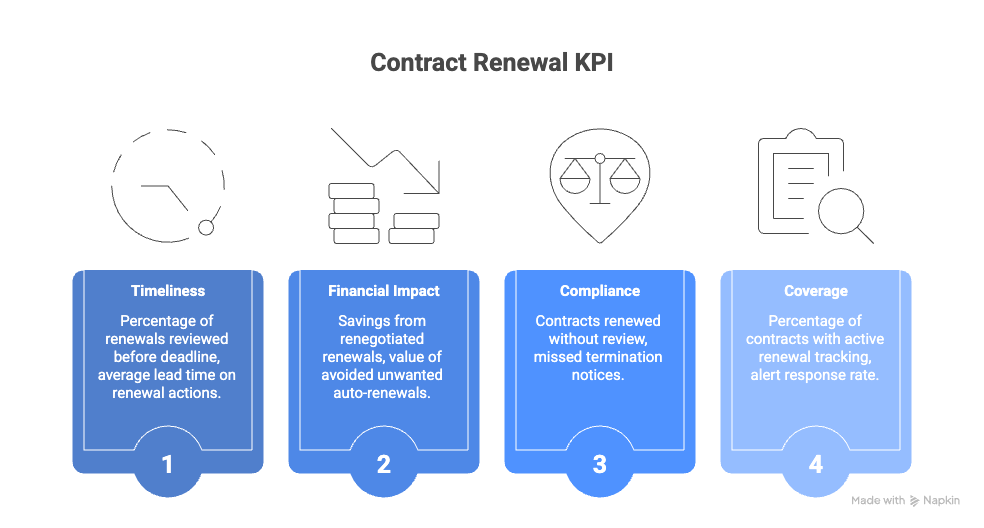
- Prevents unwanted auto-renewals by ensuring every expiring contract is flagged and reviewed before the notice deadline passes.
- Creates renegotiation opportunities by giving procurement teams enough lead time to benchmark pricing and reassess supplier performance.
- Reduces contract value leakage caused by rolling over outdated terms, unfavorable pricing, or underperforming suppliers.
- Eliminates reliance on manual calendar tracking and spreadsheet-based renewal tracking that is error-prone and difficult to scale.
- Strengthens compliance by maintaining a documented record of every renewal decision across the contract lifecycle.
Key Terms in Contract Renewal Automation
- Auto-Renewal Clause: A contract provision that automatically extends the agreement for an additional term unless one party provides notice of termination within a specified window.
- Notice Period: The required advance timeframe within which a party must notify the other of its intent to terminate or not renew a contract.
- Contract Lifecycle: The full span of a contract from creation and negotiation through execution, performance management, and renewal or termination.
- Renewal Window: The period before a contract’s expiration or auto-renewal date during which renewal decisions must be made.
- Contract Leakage: Financial loss resulting from contracts that auto-renew on unfavorable terms or continue without active management.
- Evergreen Contract: A contract with no fixed end date that continues indefinitely until one party provides termination notice.
- Termination for Convenience: A clause allowing either party to end the contract without cause, typically with advance written notice.
FAQs
Q1. What is contract renewal automation?
It is the use of automated alerts, workflows, and tracking to ensure contracts are reviewed, renegotiated, or terminated before renewal deadlines pass.
Q2. Why do missed renewals matter?
Missed renewals can lock an organization into unfavorable pricing, outdated scope, or underperforming suppliers for an additional contract term.
Q3. What are auto-renewal alerts?
Staged contract notifications sent automatically at predefined intervals before a contract’s renewal or expiration date, prompting stakeholders to take action.
Q4. How far in advance should renewal alerts be triggered?
Best practice is to stage alerts at 120, 90, and 30 days before the deadline, though timing varies based on contract complexity and negotiation lead time.
Q5. What is the difference between renewal and extension?
A renewal typically involves reviewing and potentially renegotiating terms for a new contract period. An extension continues the existing terms for an additional period without renegotiation.
Q6. Can renewal automation handle evergreen contracts?
Yes. Renewal workflows can be configured to flag evergreen contracts for periodic review even when no fixed expiration date exists.
Q7. How does renewal automation fit into the contract lifecycle?
It sits at the end of the active contract phase, connecting performance management back to sourcing and negotiation for the next term.