



Savings realization is the process of verifying that cost savings negotiated during sourcing actually flow through to the organization’s bottom line. It bridges the gap between projected sourcing savings and confirmed financial impact by tracking whether negotiated terms are adopted, contracts are complied with, and value capture is reflected in actual spend data.
Read more: Savings Target Management – An essential guide for procurement savings
Why Savings Realization in Procurement?
Procurement teams frequently negotiate favorable pricing, but without disciplined savings tracking, a significant portion of those gains never materialize. Contracts may not be adopted, buying behavior may drift to non-preferred suppliers, or volume commitments may fall short. Savings realization closes this accountability gap. It gives procurement leaders a defensible way to demonstrate procurement ROI, align with finance on what counts as real savings, and maintain credibility with executive stakeholders.
Try out the Procurement Savings Calculator
The Core Process in Saving Realization
The process begins during sourcing, when procurement establishes a savings baseline. This baseline represents the current cost of goods or services before any negotiation or supplier change. It is the reference point against which all future cost savings are measured.
Once a sourcing event concludes and new terms are agreed, the projected savings are calculated — the difference between the baseline cost and the newly negotiated price. At this stage, the savings exist only on paper as sourcing savings.
Savings tracking begins as purchases are made under the new contract. Procurement monitors actual spend against the negotiated terms to verify that the organization is buying at the agreed price, from the agreed supplier, and at the expected volume. Any deviation — contract leakage, maverick buying, or demand changes — reduces the realized value.
Periodically, procurement and finance jointly review realized savings against projections. This reconciliation confirms the portion of cost savings that has genuinely impacted the budget or P&L. Only validated, finance-approved savings are reported as realized, completing the value capture cycle.
Core Components of Savings Realization
Baseline Definition. Establishes the pre-negotiation cost benchmark. A credible baseline is essential — without it, savings claims lack a defensible reference point.
Savings Classification. Categorizes savings by type: hard savings (direct cost reductions reflected in budgets), soft savings (cost avoidance, efficiency gains), and value improvements (quality, risk, or service enhancements). Clear classification aligns procurement and finance on what gets reported.
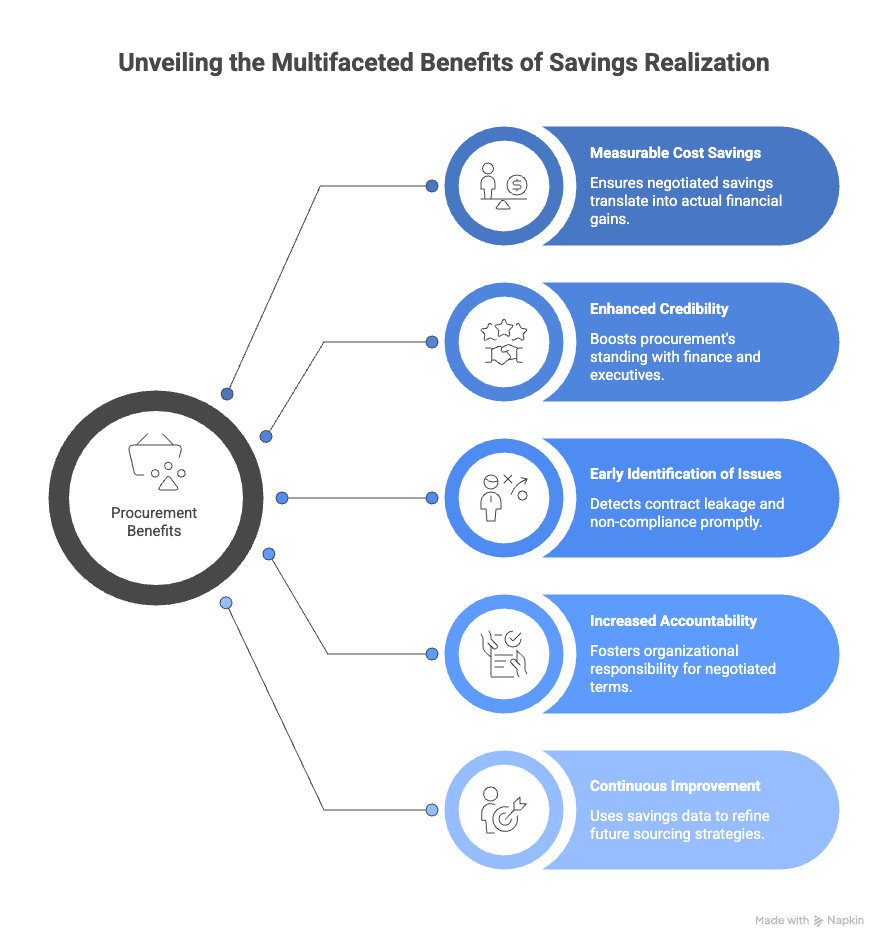
Savings Tracking. Monitors actual purchasing behavior against negotiated terms over time. Tracks contract adoption, supplier compliance, and volume adherence to identify leakage early.
Finance Validation. Requires finance sign-off on realized savings before they are formally reported. This step ensures procurement ROI figures are credible and tied to measurable financial outcomes.
Reporting and Governance. Provides dashboards and periodic reports showing projected vs. realized savings by category, business unit, or supplier. Supports executive reviews and continuous improvement.
Savings Realization KPIs
| Dimension | Sample KPIs |
| Value Capture | Realized savings vs. projected savings, savings realization rate |
| Compliance | Contract adoption rate, maverick spend percentage |
| Financial Impact | Hard savings as percentage of addressable spend, cost avoidance reported |
| Governance | Finance-validated savings rate, savings disputes resolved |
Key Terms in Savings Realization
- Hard Savings: Direct, measurable cost reductions that impact the budget or P&L, such as lower unit prices or reduced supplier rates.
- Soft Savings: Indirect benefits like cost avoidance, process efficiencies, or improved payment terms that do not directly reduce a budget line.
- Baseline: The pre-negotiation cost reference point against which savings are calculated.
- Contract Leakage: Spend that occurs outside negotiated contract terms, reducing the realized value of sourcing savings.
- Value Capture: The process of converting negotiated savings into confirmed financial outcomes through disciplined execution and tracking.
- Cost Avoidance: Preventing a future cost increase rather than reducing an existing cost — often categorized separately from hard savings.
- Procurement ROI: The return on procurement investment, measured by comparing realized savings and value delivered against procurement operating costs.
Technology Enablement
Modern Source-to-Pay platforms connect sourcing outcomes directly to spend and contract data, enabling automated savings tracking from negotiation through realization. This integration gives procurement and finance a shared view of value capture without relying on manual spreadsheets or disconnected reporting.
FAQs
Q1. What is savings realization?
It is the process of verifying that negotiated sourcing savings are actually captured in the organization’s spend and reflected in financial results.
Q2. Why do negotiated savings often fail to materialize?
Common causes include contract non-adoption, maverick buying, demand changes, supplier non-compliance, and lack of savings tracking discipline.
Q3. What is the difference between hard savings and soft savings?
Hard savings are direct cost reductions visible in the budget. Soft savings include cost avoidance and efficiency gains that do not reduce a specific budget line.
Q4. How is procurement ROI measured?
By comparing the total realized savings and value delivered by procurement against its operating costs, including team resources, technology, and sourcing expenses.
Q5. Who validates realized savings?
Finance typically validates savings to ensure they are credible, measurable, and reflected in actual financial performance before they are formally reported.
Q6. What is contract leakage?
Spend that occurs outside the negotiated contract terms — either through off-contract purchases or non-compliant buying — reducing the value of sourcing savings.
Q7. How often should savings be tracked?
Savings tracking should be continuous, with formal reconciliation between procurement and finance on a monthly or quarterly basis.
References
- A Guide to Effective Cost Reduction Strategies in Procurement
- eBook: 5 Proven Procurement Cost Savings Strategies
- Everything You Need To Know About Procurement Savings Tracking
- Solution: Zycus Financial Savings Management Software
- Podcast: AI in Procurement’s Dirty Little Secret: Is it Really Saving You Money Or Just Shifting the Workload?
- A Guide to Effective Cost Reduction Strategies in Procurement
- Savings Target Management – An essential guide for procurement savings










