



AI-Driven Tender Management Solutions are procurement systems that help organizations manage the full tendering cycle — from creating RFx events to supplier evaluation, negotiation, and award.
They modernize tendering by replacing manual spreadsheets and document-heavy sourcing with structured workflows, faster supplier engagement, and data-backed award decisions.
Instead of only collecting bids, modern platforms ensure tenders deliver compliant, defensible, and value-driven sourcing outcomes.
Why it Matters in Modern Procurement
Tendering is where sourcing strategy becomes commercial execution.
It determines supplier selection, pricing leverage, compliance alignment, and long-term performance.
Traditional tendering often struggles with slow cycles, inconsistent bid quality, evaluation overload, and weak risk visibility.
AI-driven tender management solves this by making sourcing events faster, governed, and intelligence-led — tightly connected to the Source-to-Contract process.
The Core Tender Management Flow
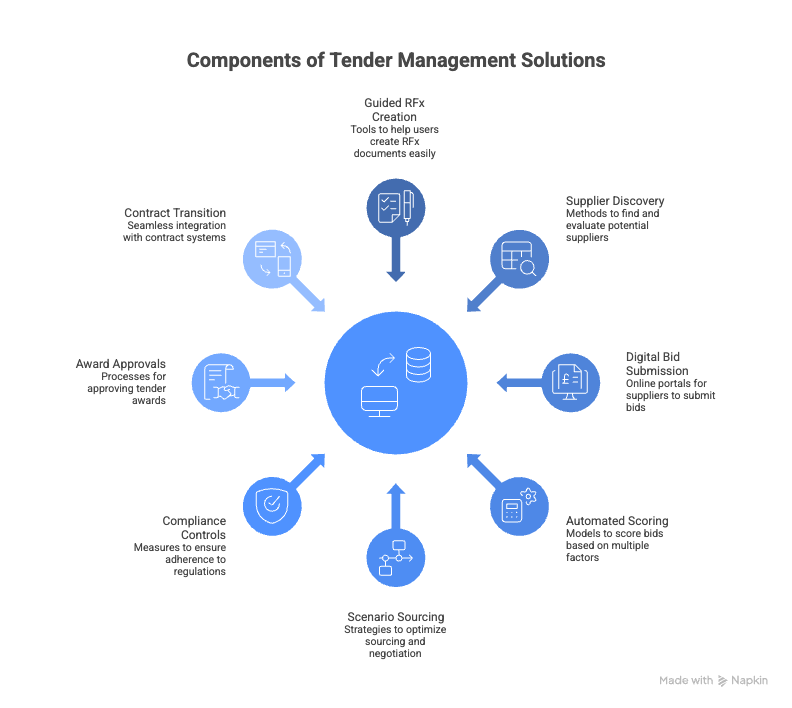
1. Tender Creation and Requirement Structuring
Tender events begin with defining scope, timelines, pricing formats, and evaluation criteria.
Modern systems apply intelligence through category templates, guided requirements, and policy-aligned event setup.
This ensures tenders start with clean specifications and fewer downstream corrections.
2. Supplier Discovery and Shortlisting
Strong tenders depend on the right supplier universe.
AI-supported platforms help shortlist suppliers based on category fit, performance history, compliance readiness, geographic feasibility, and diversity goals.
This expands sourcing reach while maintaining governance at entry.
3. RFx Execution and Supplier Participation
Once launched, tenders require structured supplier collaboration.
Digital tendering platforms provide supplier portals, response validation, clarification workflows, and real-time tracking.
This improves bid completeness, reduces confusion, and accelerates supplier response cycles.
4. Bid Evaluation and Scoring Automation
Bid analysis is the intelligence core of tender management.
AI enables automated comparisons across suppliers, pricing normalization, outlier detection, and weighted scoring across cost, risk, ESG, and capability.
This ensures evaluation remains consistent, defensible, and scalable even in complex events.
5. Negotiation and Scenario Optimization
Tendering is rarely about lowest price alone.
Modern platforms support negotiation by modeling award scenarios, identifying savings levers, and balancing resilience with supplier constraints.
Scenario sourcing strengthens both commercial outcomes and supply continuity.
6. Embedded Compliance and Risk Governance
Effective tenders embed governance upfront — not after award.
Systems integrate sanctions checks, ESG validations, clause alignment rules, and supplier documentation requirements before decisions are finalized.
This reduces downstream compliance failures and strengthens award accountability.
7. Award Decisions and Contract Handoff
The final stage converts sourcing into execution.
Award recommendations route through approvals, suppliers are activated with required controls, and outcomes are handed off directly into contracting workflows.
This prevents value leakage between tender award and contract execution.
KPIs for Tender Performance
| KPI Area | Key Metrics |
| Efficiency | Tender cycle time, events automated per quarter |
| Supplier Participation | Response rate, bid completeness % |
| Savings Outcomes | Cost reduction %, negotiation uplift |
| Decision Quality | Time-to-award, evaluation consistency |
| Compliance | % policy-aligned tenders, audit documentation coverage |
| Risk Control | % suppliers screened before award |
Key Terms in AI-Driven Tender Management Solutions
- RFx — RFI/RFP/RFQ tender event formats
- Bid Normalization — Standardizing supplier bids for fair comparison
- Scenario Sourcing — Modeling award combinations across constraints
- Weighted Scoring — Evaluation beyond price across multiple criteria
- Tender Governance — Approval, compliance, and audit enforcement
- Award Leakage — Value lost between sourcing award and contract execution
Examples of Tender Management Solutions
- Zycus iSource — Tender orchestration with sourcing intelligence and governance
- SAP Ariba Sourcing — Enterprise sourcing workflows with supplier networks
- Coupa Strategic Sourcing — Guided tendering connected to spend controls
- Jaggaer Advanced Sourcing Optimizer — Scenario-heavy sourcing optimization
- Ivalua Sourcing — Configurable tender execution with compliance integration
- GEP SMART Sourcing — AI-enabled RFx analytics and negotiation support
FAQs
Q1. What is AI-driven tender management?
It is the use of automation and intelligence to run tenders faster, score bids accurately, and award suppliers with governance.
Q2. How does AI improve tender evaluation?
AI normalizes bids, detects pricing outliers, applies weighted scoring, and accelerates decision-making.
Q3. What is the difference between tendering and sourcing software?
Tendering is one RFx phase, while sourcing platforms cover discovery, evaluation, negotiation, and contract conversion.
Q4. Why is tender governance important?
Because award decisions must be compliant, auditable, risk-cleared, and aligned to procurement policy.
Q5. How do modern platforms support tender-to-contract execution?
They connect award workflows directly into contracting systems, preventing leakage between sourcing and execution.
References
- 10 Game-Changing Use Cases of AI-Powered Intake Management You Need to Leverage Now
- Mastering Open Tendering: A Comprehensive Guide to Public Procurement Success
- Guide to Public Procurement: Strategies, Compliance & Digital Transformation
- Modern eProcurement in 2026: Process, Benefits, and Strategy
- Optimizing Your Services Procurement Process: A Guide to Efficiency










