



eProcurement solutions (Electronic Procurement solutions) are digital platforms that automate and manage the end-to-end purchasing process, from requisition to purchase order, supplier collaboration, and payment.
These solutions help organizations streamline buying operations, enforce policy compliance, and gain real-time visibility into spend and supplier performance.
In the broader Source-to-Pay (S2P) ecosystem, eProcurement solutions connect sourcing, contracting, supplier management, and invoicing, ensuring every purchase is compliant, efficient, and strategically aligned.
Read more: Your Guide to eProcurement
Why Organizations Need eProcurement Solutions
Procurement teams today operate across distributed business units, global suppliers, and complex regulatory frameworks. Without automation, inefficiency, off-contract spend, and visibility gaps become inevitable.
Modern eProcurement platforms solve these issues by embedding control, intelligence, and collaboration into every step of the buying process. They enable organizations to:
- Improve efficiency: Automate requisition, approval, and PO creation.
- Ensure compliance: Enforce category rules, contract pricing, and budget limits.
- Enhance visibility: Deliver real-time spend and supplier tracking.
- Drive savings: Reduce maverick buying and improve contract utilization.
- Improve experience: Make purchasing as intuitive as consumer eCommerce.
In short, eProcurement transforms tactical buying into strategic, policy-driven spend management.
Key Features of eProcurement Solutions
1. Requisitioning & Guided Buying
The process begins when users create purchase requests through guided-buying interfaces that automatically recommend preferred suppliers and approved items.
AI validates each requisition against budget thresholds, category rules, and contracts — ensuring policy adherence from the start.
Within Zycus Buyer Desk, guided buying and policy validation simplify purchasing while eliminating unauthorized spend.
2. Catalog Management
Centralized digital catalogs bring structure to enterprise buying.
They consolidate items, pricing, and contract terms from approved suppliers — ensuring employees purchase the right goods at the right price.
Hosted catalogs handle internal listings, while PunchOut catalogs connect directly to supplier eCommerce sites for live pricing.
Zycus Catalog Management automates synchronization, removing duplication and ensuring catalog accuracy across regions.
3. Approval Workflow Automation
Every request passes through a dynamic approval workflow based on spend, department, or risk.
Approvers receive contextual insights — budgets, supplier data, and contract linkage — to make fast, informed decisions.
The Zycus Approval Flow Engine applies adaptive routing and AI-assisted validations, balancing control with speed and ensuring frictionless approvals for compliant purchases.
4. Purchase Order (PO) Automation
Once approved, requisitions automatically convert into purchase orders.
POs are sent electronically to suppliers and tracked for acknowledgment, ensuring transparency in order acceptance and fulfillment.
Zycus eProcurement links POs directly to sourcing events or contracts, maintaining consistency and compliance throughout the process.
5. Receiving and Acknowledgment
Upon delivery, buyers record receipts electronically — generating Goods Receipt Notes (GRN) that validate delivery quantity and quality.
These confirmations trigger 3-way match readiness with invoices and POs.
Through integration with Zycus eInvoicing, organizations achieve faster, touchless invoice processing and accurate payment readiness.
6. Budget and Compliance Validation
Every requisition undergoes embedded budget and compliance checks to prevent overspending or policy violations.
Merlin AI proactively alerts approvers about potential risks or budget overruns before purchase, making compliance preventive rather than corrective.
How eProcurement Solutions Work
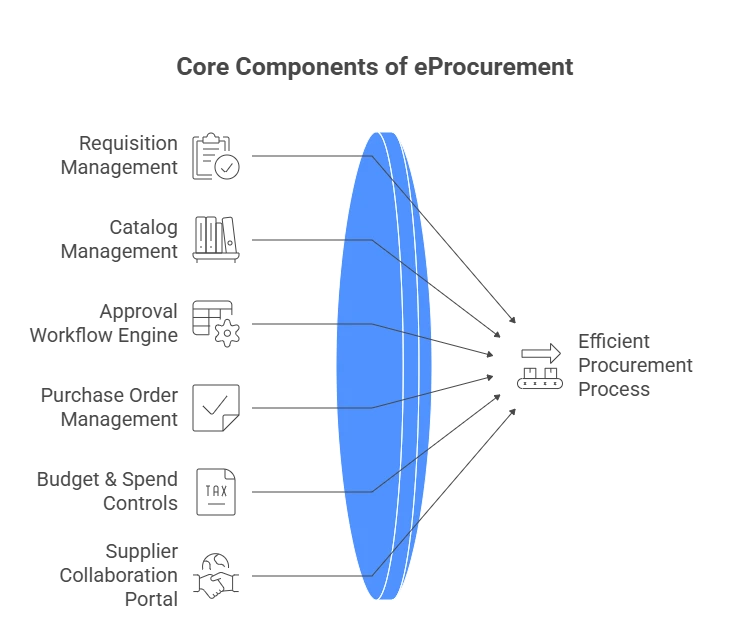
- Requisition Management: Digitized demand capture with guided buying and AI validation.
- Catalog Management: Centralized catalogs and punchout integrations for standardized purchases.
- Approval Workflow Engine: Policy-driven, multi-level routing for rapid approvals.
- Purchase Order Management: Automated PO creation, dispatch, and acknowledgment tracking.
- Budget & Spend Controls: Real-time budget enforcement and spend visibility.
- Supplier Collaboration Portal: Two-way communication for PO acceptance, fulfillment, and updates.
Together, these components create a connected, compliant, and insight-driven buying process.
Benefits of eProcurement Solutions
- Streamlined processes and reduced cycle times.
- Improved on-contract and policy compliance.
- Greater spend visibility and reporting accuracy.
- Lower procurement costs through automation and control.
- Enhanced user and supplier experience.
Integration Across Source-to-Pay
eProcurement acts as the operational bridge across the S2P chain:
- Sourcing: Pulls supplier and contract data for compliant requisitions.
- Contract Management: Enforces negotiated pricing and terms automatically.
- Supplier Management: Syncs supplier data, risk profiles, and compliance credentials.
- Invoice Automation: Enables 3-way match validation and payment readiness.
- Analytics: Feeds purchase and compliance data into dashboards for strategic insights.
With Zycus’ unified platform, these integrations occur seamlessly, maintaining data continuity from requisition to payment.
KPIs and Performance Metrics
| Category | Sample KPIs |
| Efficiency | Requisition-to-PO cycle time, automation rate |
| Compliance | On-contract spend %, policy adherence rate |
| Savings | Maverick spend reduction %, supplier consolidation ratio |
| Experience | Guided buying adoption %, user satisfaction score |
| Accuracy | PO acknowledgment %, duplicate requisition rate |
These metrics ensure automation translates into measurable procurement impact.
Advanced Capabilities in Modern eProcurement
| Capability | Description |
| Guided Buying | AI-driven recommendations ensure compliant and quick purchases. |
| Dynamic Policy Validation | Real-time enforcement of budget and category rules. |
| PunchOut Integration | Live supplier catalog access for accurate pricing. |
| Agentic AI Assistants | Intelligent agents automate validation, routing, and exception handling. |
| Predictive Budget Alerts | Flags potential overruns before approvals. |
| Supplier Collaboration Hub | Digital PO confirmation, fulfillment updates, and feedback exchange. |
Examples of eProcurement Solutions
Zycus eProcurement Suite — Unified, AI-driven procurement platform that streamlines requisitioning, catalog management, approvals, and PO automation. Guided buying ensures compliance from the start, while embedded Merlin AI monitors budgets, detects anomalies, and recommends corrective actions in real time — delivering visibility, speed, and control across the full procure-to-pay cycle.
SAP Ariba Buying and Invoicing — Cloud-based solution enabling guided buying, supplier collaboration, and seamless integration with the Ariba Network. Known for global supplier connectivity and spend visibility through powerful analytics.
Coupa Procurement — Intuitive platform within the Coupa BSM suite that uses AI to optimize approvals, detect off-contract spend, and drive savings. Emphasizes user-friendly guided buying and real-time budget control.
JAGGAER ONE Procurement — End-to-end automation for complex supply chains, combining catalog management, smart workflows, and AI-based spend analysis to reduce maverick spending and enhance compliance.
GEP SMART Procurement — Unified, AI-native platform integrating sourcing, contracting, and P2P. Predictive insights from GEP MINERVA™ forecast spend trends and recommend suppliers for smarter buying decisions.
Oracle Procurement Cloud — Enterprise-grade eProcurement with built-in AI for requisition accuracy, duplicate detection, and spend optimization. Strong ERP integration ensures smooth data and process flow.
Basware P2P — Automation-focused solution emphasizing touchless purchasing and AP integration. Machine learning enhances PO accuracy and invoice matching for high straight-through processing rates.
Workday Procurement — Simplifies enterprise purchasing with guided requisitioning, real-time budget visibility, and seamless integration with Workday Financials for unified spend control.
Ivalua Procurement — Configurable, modular eProcurement suite offering deep analytics, catalog automation, and AI-driven compliance enforcement across industries.
Key Terms in eProcurement
- Requisition Management: The process of creating and approving internal purchase requests before converting them into purchase orders. It ensures every purchase is validated against budgets and policies.
- AI in Procurement: An AI-enabled interface that helps employees select approved suppliers and items while automatically enforcing compliance with company policies and negotiated contracts.
- Catalog Management: Centralized digital management of product and service listings from approved suppliers. It ensures accuracy, up-to-date pricing, and easy item search for buyers.
- Purchase Order (PO) Automation: The automatic creation, dispatch, and acknowledgment of purchase orders once requisitions are approved—reducing manual effort and improving process speed.
- Approval Workflow: A predefined routing mechanism that ensures requisitions and POs are reviewed and approved by authorized stakeholders based on spend, category, or risk.
The Future of eProcurement Solutions
- Agentic AI Orchestration: Autonomous requisition creation and approval management.
- Predictive Spend Planning: Demand forecasting and spend optimization using AI.
- ESG-Linked Buying: Prioritizing sustainable and diverse suppliers automatically.
- Voice-Activated Procurement: Conversational interfaces for seamless request creation.
- Composable Platforms: Modular, API-driven design for scalable S2P integration.
FAQs
Q1. What is eProcurement and how does it work?
eProcurement refers to the use of digital platforms to automate the purchasing process—from creating requisitions to generating purchase orders and managing supplier interactions. It ensures compliance, efficiency, and transparency in procurement.
Q2. What are the key features of an eProcurement solution?
Features include guided buying, digital catalog management, approval workflows, PO automation, budget validation, and supplier collaboration tools.
Q3. Why should organizations adopt eProcurement solutions?
eProcurement helps reduce procurement cycle times, enforce policy compliance, lower costs, and enhance the user and supplier experience across distributed teams.
Q4. How is eProcurement different from traditional procurement?
Traditional procurement relies on manual processes and paperwork, while eProcurement automates workflows, improves visibility, and ensures real-time compliance using AI and digital tools.
Q5. What are the benefits of AI in eProcurement?
AI helps with predictive budget alerts, smart routing, anomaly detection, and intelligent guided buying—enhancing both control and agility in procurement operations.
Q6. Can eProcurement integrate with other procurement tools?
Yes, modern eProcurement platforms like Zycus integrate seamlessly with sourcing, contract management, invoicing, and supplier management systems within the S2P suite.
Q7. What is guided buying in eProcurement?
Guided buying uses AI to recommend approved suppliers and products, ensuring employees make compliant, cost-effective purchases with minimal training.
Q8. Which industries benefit the most from eProcurement?
Industries with complex supply chains—like manufacturing, healthcare, finance, and government—benefit significantly from the control and visibility offered by eProcurement platforms.
Q9. How does Zycus support eProcurement?
Zycus offers an AI-powered eProcurement suite with guided buying, catalog management, smart approvals, and PO automation—backed by Merlin AI for intelligent decision-making.
References
For further insights into these processes, explore Zycus’ dedicated resources related to eProcurement Solutions:










