Supplier statement reconciliation is the process of comparing a supplier’s account statement against the buyer’s internal records to identify and resolve discrepancies. It involves matching invoices, credit notes, and payments recorded by the supplier with corresponding entries in the buyer’s accounts payable system. The goal is to confirm that both parties agree on outstanding balances and that no amounts are missed, duplicated, or incorrectly applied.
Why Supplier Statement Reconciliation Matters in Procurement
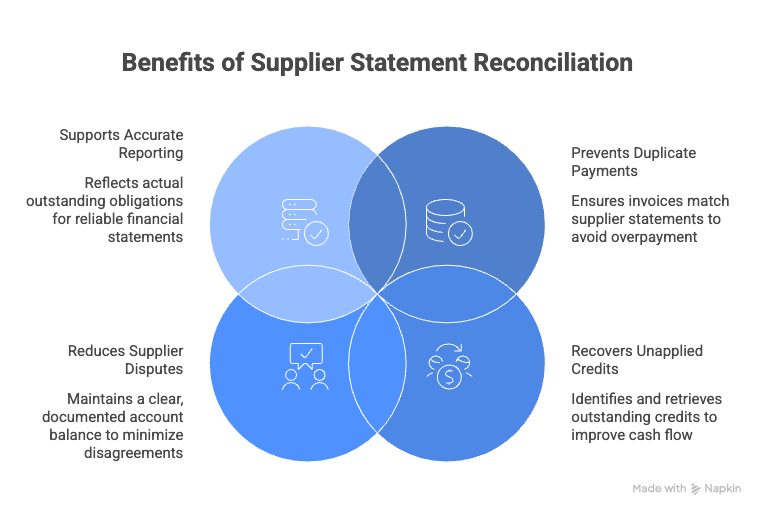
Discrepancies between supplier statements and internal records are common and can result in duplicate payments, missed credits, unrecorded liabilities, or disputed balances. Regular reconciliation provides assurance that the organization’s financial commitments are accurately reflected in its books, supports cash flow management by surfacing unapplied credits, and identifies overdue items before they escalate. In high-volume purchasing environments, unreconciled statements accumulate quickly and become expensive to resolve.
Read more: Everything You Need To Know About Procurement Savings Tracking
The Core Process of Supplier Statement Reconciliation
The process begins when the supplier issues a periodic account statement, typically monthly, listing all open invoices, credit notes, and unapplied payments. The accounts payable team requests or downloads this statement and begins the matching exercise against the internal ledger.
Each line on the supplier statement is cross-referenced with the corresponding entry in the buyer’s system. Matches are confirmed and marked as reconciled. Items that appear on the supplier statement but not in the internal records are investigated as potential unrecorded invoices or posting errors. Items in the internal records not reflected on the supplier statement may indicate payments not yet acknowledged or credits not yet issued.
Identified discrepancies are categorized and assigned for resolution. Some are resolved through internal correction, such as reposting a misapplied payment; others require supplier communication to issue a missing credit note or confirm a payment receipt. Once cleared, a reconciled closing balance is agreed and documented for audit purposes.
Core Components of Supplier Statement Reconciliation
Accounts payable ledger accuracy is the internal foundation. Posting errors, duplicate entries, or misapplied payments must be corrected before meaningful comparison with the supplier statement can occur. Supplier statement completeness matters equally — statements that omit recent transactions or carry forward unresolved items create additional reconciliation complexity. Discrepancy classification helps prioritize resolution effort; items above materiality thresholds should be escalated promptly while minor timing differences may be deferred to the next cycle. Documentation and audit trail capture ensures reconciled balances and resolutions are recorded to support internal and external audit.
Common Pitfalls of Supplier Statement Reconciliation
- Reconciling too infrequently: Monthly reconciliation is the standard minimum. Allowing statements to accumulate over multiple periods makes discrepancy resolution exponentially more time-consuming.
- Treating timing differences as resolved without follow-up: Items dismissed as timing differences should be tracked to confirm they clear in the next period. Persistent timing differences often indicate a systemic posting issue.
- Relying on manual matching for high-volume suppliers: Manual reconciliation for suppliers with hundreds of monthly transactions is error-prone and inefficient. Automated matching tools significantly reduce risk and effort.
- Failing to document agreed balance: Verbal agreement with a supplier on a closing balance without written confirmation creates ambiguity if the same items appear on the next statement.
Discrepancy Types and How to Resolve Them
- Invoice on supplier statement, not in internal records: Investigate whether the invoice was received and not posted, or whether it relates to goods not yet confirmed as received. Request a copy of the invoice from the supplier if needed.
- Payment in internal records, not acknowledged by supplier: Confirm payment details, including bank reference and value date. Share remittance advice with the supplier and request confirmation of receipt.
- Credit note expected but not issued: Follow up with the supplier to confirm the credit has been raised and request the credit note document for internal posting.
- Duplicate invoice entries: Review internal records for double-posting and reverse the duplicate entry. Confirm with the supplier that only one invoice is outstanding.
KPIs of Supplier Statement Reconciliation
| Dimension | Sample KPIs |
| Reconciliation Coverage | % of supplier accounts reconciled within period, reconciliation cycle time |
| Discrepancy Rate | # of discrepancies per reconciliation, average value of discrepancies |
| Resolution Efficiency | % of discrepancies resolved within defined SLA, aged discrepancy count |
| Financial Accuracy | Duplicate payments detected, credits recovered through reconciliation |
Key Terms in Supplier Statement Reconciliation
- Accounts Payable (AP): The function responsible for managing and processing amounts owed by the organization to its suppliers.
- Credit Note: A document issued by a supplier to reduce the amount owed by the buyer, typically following a return, overpayment, or pricing correction.
- Remittance Advice: A document sent by the buyer to the supplier that details which invoices a payment covers.
- Unapplied Payment: A payment received by the supplier that has not been matched to a specific invoice in their system.
- Three-Way Match: A control that verifies alignment between a purchase order, goods receipt, and supplier invoice before payment is approved.
- Aged Payables: A report showing outstanding supplier balances grouped by how long they have been outstanding.
- Materiality Threshold: A defined value below which discrepancies may be deferred or managed differently from higher-value items.
Technology Enablement
Modern Source-to-Pay and accounts payable platforms support supplier statement reconciliation through automated invoice matching, supplier portal integrations that allow real-time statement access, and exception management workflows that route discrepancies to the right team for resolution. These capabilities reduce cycle time and improve accuracy across high-volume supplier accounts.
FAQs
Q1. What is supplier statement reconciliation?
It is the process of comparing a supplier’s account statement with the buyer’s internal records to identify and resolve discrepancies in invoices, credits, and payments.
Q2. How often should supplier statement reconciliation be performed?
Monthly is the standard frequency. High-value or high-volume supplier accounts may warrant more frequent review.
Q3. Who is responsible for supplier statement reconciliation?
Typically the accounts payable team, often in collaboration with procurement for supplier communication and dispute resolution.
Q4. What is the difference between reconciliation and three-way match?
Three-way match is a pre-payment control that verifies invoice accuracy. Reconciliation is a periodic review of the overall account balance between buyer and supplier.
Q5. Can reconciliation be automated?
Yes. AP automation tools can match statement lines to internal records at scale, flagging exceptions for manual review rather than requiring line-by-line manual comparison.
Q6. How does reconciliation support audit readiness?
It creates a documented, agreed record of account balances at regular intervals, providing evidence that payable balances are accurate and that financial controls are operating effectively.
References
Explore Zycus resources to learn more about Supplier Statement Reconciliation: