



A procurement bid is a formal submission from a supplier in response to a buyer’s invitation to tender, request for proposal, or request for quotation. It sets out the supplier’s proposed solution, pricing, terms, and qualifications for a defined requirement. Procurement bids are the mechanism through which competitive markets are accessed — the structured responses from which buyers evaluate alternatives, compare commercial offers, and select the best-value supplier for a contract. Managing the bid process effectively, from invitation through evaluation to award, is a core procurement competence that directly determines the quality and defensibility of sourcing outcomes.
Why Procurement Bids Matter
The quality of a bid process determines the quality of the commercial outcome. A well-run process maximizes competitive tension, produces comparable submissions, and enables defensible award decisions. A poorly run process generates non-comparable responses, reduces supplier participation, and produces outcomes that are difficult to justify. For public sector procurement, process compliance is a regulatory requirement. For all organizations, how bids are invited, evaluated, and awarded reflects procurement’s professionalism and influences whether the best suppliers choose to engage.
The Core Process of Procurement Bids
- Invitation to Bid: The bid process begins with a clear, complete invitation document — ITT, RFP, or RFQ — that defines the requirement, evaluation criteria and weightings, submission requirements, timeline, and contractual terms. The quality of the invitation determines the quality of the responses received. Vague or incomplete invitations produce responses that cannot be meaningfully compared.
- Supplier Clarifications: Suppliers submit clarification questions during the bid period. All questions and answers are shared with all participating suppliers to maintain fairness — responses that provide material information must be issued to the full bidder group, not just the questioner.
- Bid Submission and Receipt: Bids are submitted by the deadline through the agreed channel — typically a secure e-sourcing portal. Late submissions are handled according to documented policy. All submitted bids are receipted and logged to create an audit trail.
- Evaluation and Award: Received bids are evaluated against the published criteria by a structured panel. Scores are documented. References are checked for shortlisted suppliers. The evaluation output supports an award recommendation that is traceable to published criteria. Unsuccessful bidders are notified and given feedback.
Core Components of Procurement Bids
- Bid documentation is the package of documents issued to prospective suppliers — specification, evaluation criteria and weightings, pricing schedules, terms and conditions, submission instructions, and timeline. Completeness and clarity of bid documentation is the single most important driver of submission quality.
- Evaluation methodology defines how bids will be scored — the dimensions of assessment, the weighting of each, and the scoring scale. Publishing the methodology in the bid documents creates a fair, transparent process and makes the award decision defensible.
- Bid evaluation panel is the structured group of procurement and business stakeholders who collectively assess submissions. Panel composition, evaluation training, and documented scoring prevent the subjectivity and inconsistency that undermine bid evaluation integrity.
- Standstill period is the defined time between notification of award intent and contract signature, during which unsuccessful bidders can request feedback and, in regulated environments, raise a formal challenge. It is mandatory in EU public procurement and best practice in all significant commercial sourcing.
Key Benefits of Procurement Bids
- Creates competitive tension that produces better pricing and terms than sole-source or negotiated approaches.
- Produces a documented, defensible award record that supports governance requirements and responds to supplier or stakeholder challenges.
- Provides market intelligence about supplier capabilities and pricing structures that procurement cannot access without competitive engagement.
Common Pitfalls of Procurement Bids
- Unclear or incomplete bid documentation. Vague specifications, ambiguous evaluation criteria, or unclear submission instructions generate non-comparable bids that are difficult to evaluate and easy to challenge.
- Inconsistent evaluation scoring. Evaluators who interpret criteria differently, or score without adequate training, produce scores reflecting individual judgment rather than published criteria — undermining award defensibility.
- Communicating with individual bidders outside the formal clarification process. One-to-one communications providing material information to one bidder but not others constitute a fairness breach. All substantive communication must go through the formal clarification channel.
KPIs of Procurement Bids
| Dimension | Sample KPIs |
| Process Quality | Supplier response rate, % of compliant bids received, clarification request volume |
| Evaluation Integrity | % of evaluations with documented scoring, inter-evaluator score variance |
| Outcome | Savings vs. baseline, contract performance vs. bid commitments |
| Compliance | % of awards with complete evaluation records, standstill period adherence |
Key Terms in Procurement Bids
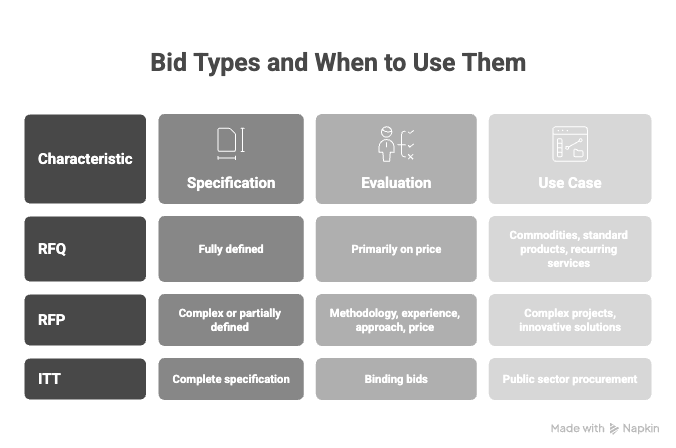
- Invitation to Tender (ITT): A formal bid document that invites binding submissions on a complete specification — the standard instrument for public sector procurement above threshold.
- Evaluation Criteria: The published dimensions against which bids are scored, including their relative weighting — the foundation of a fair and defensible award process.
- Standstill Period: The defined period between award notification and contract signature, during which unsuccessful bidders can seek feedback or raise a formal challenge.
- Bid Evaluation Panel: The structured group of procurement and business stakeholders responsible for scoring submitted bids against published evaluation criteria.
- Clarification: A formal question raised by a bidder during the bid period — answered and shared with all participants to maintain process fairness.
Technology Enablement
e-Sourcing platforms manage the full bid process — issuing bid documents through secure supplier portals, managing clarification Q&A, receiving and timestamping submissions, providing structured evaluation scorecards, and generating award notification and audit trail documentation. These capabilities reduce bid process administration, improve consistency, and create the documented evidence base needed to defend award decisions.
FAQs
Q1. What is a procurement bid?
A formal supplier submission in response to a buyer’s invitation — setting out the proposed solution, pricing, and terms for a defined requirement.
Q2. What is the difference between an ITT and an RFP?
An ITT invites binding bids on a fixed specification. An RFP invites suppliers to propose solutions to a defined need, evaluating quality and methodology alongside price.
Q3. Why must clarification responses be shared with all bidders?
Because information that helps one bidder understand the requirement or evaluation criteria must be available to all participants equally — one-to-one communication on material points is a fairness breach.
Q4. What is a standstill period?
A mandatory gap between award notification and contract signature, giving unsuccessful bidders the opportunity to seek feedback and raise challenges before the contract becomes legally binding.
Q5. How many suppliers should be invited to bid?
Enough to generate genuine competitive tension — typically three to six. Too few reduces competition; too many increases evaluation burden and may deter quality suppliers from investing in a response.
Q6. How should unsuccessful bidders be notified?
Promptly after award decision, with an offer of feedback. In regulated environments, notification must respect standstill period requirements. Constructive debriefs improve future submission quality and maintain market relationships.
References
Explore Zycus resources to learn more about Procurement Bids:










