



AI in ethical sourcing is the application of artificial intelligence to identify, assess, and mitigate ethical, social, and environmental risks across the supply base. It extends traditional ethical sourcing — which depends on supplier self-declarations, audits, and certifications — by continuously analysing supplier behaviour, public disclosures, news, and trade records to surface risks that manual review cannot catch at scale. AI does not replace ethical judgement; it expands the procurement team’s ability to apply that judgement across a wider, deeper supplier base than human capacity alone can cover.
Why AI in Ethical Sourcing Matters in Procurement
Ethical sourcing obligations have expanded faster than procurement headcount. Modern slavery laws, forced-labour regulations, ESG disclosure rules, and customer scrutiny require enterprises to demonstrate active monitoring of supplier conduct across the full supply chain — including sub-tier suppliers procurement has limited visibility into. AI closes the visibility gap at a scale traditional methods cannot match, monitoring tens of thousands of suppliers continuously rather than sampling a handful annually. For procurement leaders, AI converts ethical sourcing from a periodic compliance exercise into a continuous risk discipline.
Read more: The Imperative of Responsible Sourcing for Sustainable Business
The Core Process of AI in Ethical Sourcing
- Ethical Risk Framework Definition: The process begins by defining which ethical risks matter — labour practices, environmental impact, anti-corruption, sanctions exposure, sub-tier transparency — weighted by category and geography. These form the lens through which AI assesses every supplier and signal.
- Data Source Integration: The system is connected to internal data (supplier records, contracts, spend) and external sources (sanctions lists, adverse media, regulatory actions, NGO reports, trade records, ESG ratings). The breadth of source integration determines the depth of risk coverage.
- Continuous Monitoring and Scoring: AI continuously processes new signals against the framework, generating supplier-level risk scores and flagging changes. A supplier appearing in adverse media or a sanctions update triggers a re-score and notification within hours — not at the next audit cycle.
- Investigation and Remediation Workflow: Flagged risks are routed to the right owner — category manager, compliance, supplier risk team — with evidence and a recommended action. The system tracks investigation status and remediation outcomes, building the audit trail ethical sourcing programs require.
- Reporting and Disclosure: AI-generated risk data feeds regulatory disclosures, customer ESG questionnaires, board reporting, and internal dashboards — the same continuous data layer driving operational decisions also satisfies the program’s disclosure obligations.
Core Components of AI in Ethical Sourcing
- Risk classification model translates the organization’s ethical sourcing framework into a structured rubric AI can apply consistently — categories, weightings, thresholds, and escalation rules.
- External data ingestion pulls in sanctions lists, adverse media, NGO reports, regulatory actions, ESG ratings, and trade data — the external signals that reveal risks suppliers will not self-disclose.
- Natural language processing interprets unstructured content — news articles, NGO reports, regulatory filings, social media — extracting the entities, events, and risk signals relevant to specific suppliers.
- Supplier resolution and matching ensures that signals about a supplier reach the right record — handling legal entity variations, subsidiary relationships, and ownership structures so that risks against a parent are correctly associated with the supplier procurement actually contracts with.
- Human review interface presents AI-surfaced risks with evidence and context, enabling the compliance professional or category manager to make the judgement call — accept, investigate, escalate, or remediate.
Key Benefits of AI in Ethical Sourcing
- Expands ethical risk monitoring coverage from a sample of strategic suppliers to the full supplier base, including sub-tier visibility.
- Reduces time to detect emerging ethical risks from the next audit cycle to within hours of a public signal appearing.
- Improves consistency of ethical risk assessment by applying a single framework across every supplier rather than depending on individual reviewer judgement.
- Strengthens defensibility of ethical sourcing programs by creating a continuous, time-stamped audit trail of risks identified and actions taken.
- Frees compliance and procurement professionals to focus on judgement and remediation rather than data collection and triage.
Common Pitfalls of AI in Ethical Sourcing
- Treating AI risk scores as decisions: AI surfaces signals; humans make decisions about action. Auto-suspending suppliers based on AI-only signals creates due-process and accuracy risks that compromise both the program and the supplier relationship.
- Underestimating data quality requirements: AI is only as accurate as the supplier master data it operates on. Inconsistent legal entity records and missing parent-subsidiary relationships will cause AI to miss risks or attribute them to the wrong supplier.
- Optimising for signal volume over signal quality: A system that flags thousands of low-quality signals overwhelms the review team and erodes trust. Tuning thresholds and prioritising verified sources is more valuable than maximising raw signal count.
- Failing to align AI scope with ethical sourcing policy: AI cannot enforce ethical standards the organization has not defined. The framework — what counts as a risk, what severity warrants what action — must be set before AI can apply it.
Categories of Ethical Risk AI Can Help Monitor
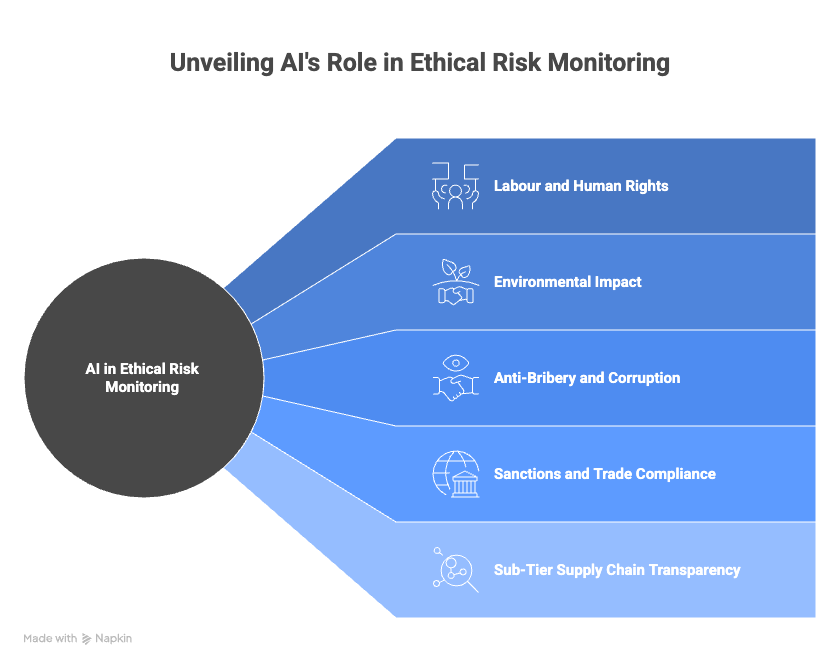
- Labour and human rights: Modern slavery, forced labour, child labour, working conditions, wage practices, and freedom of association — monitored through adverse media, NGO reports, regulatory actions, and supplier disclosures.
- Environmental impact: Pollution incidents, deforestation, emissions disclosures, waste management failures, and water stewardship issues — monitored through ESG ratings, regulatory filings, and environmental NGO reports.
- Anti-bribery and corruption: Enforcement actions, investigations, and adverse media indicating bribery, kickbacks, or corruption — particularly important in high-risk geographies and government-adjacent supply chains.
- Sanctions and trade compliance: Inclusion on sanctions lists, ownership by sanctioned parties, and trade with restricted entities — risks that change continuously and require automated monitoring.
- Sub-tier supply chain transparency: Visibility into Tier 2 and Tier 3 suppliers — where the highest-risk practices often sit and where direct supplier audits provide no coverage.
KPIs of AI in Ethical Sourcing
| Dimension | Sample KPIs |
| Coverage | % of suppliers under continuous ethical monitoring, sub-tier coverage rate |
| Detection | Mean time from public risk signal to internal notification, % of risks identified by AI vs. manual review |
| Response | Mean time from risk identification to remediation action, % of flagged risks investigated within SLA |
| Program Integrity | False positive rate, audit findings on AI-supported ethical sourcing program |
Key Terms in AI in Ethical Sourcing
- Ethical Sourcing: The discipline of selecting and managing suppliers based on alignment with the organization’s ethical, social, and environmental standards.
- Sub-tier Supply Chain: The suppliers behind direct suppliers — Tier 2, Tier 3, and beyond — where visibility is limited but ethical risk concentration is often highest.
- Adverse Media Screening: The monitoring of news and online sources for negative information about suppliers, used as a continuous risk signal.
- Modern Slavery: Forced labour, debt bondage, human trafficking, and similar practices — a category of ethical risk subject to specific regulatory disclosure obligations in many jurisdictions.
- Supplier Resolution: The process of matching external risk signals to the correct internal supplier record, accounting for entity variations and corporate structures.
Technology Enablement
Modern Source-to-Pay platforms embed AI-powered ethical sourcing capabilities — continuous adverse media screening, sanctions monitoring, ESG signal integration, and supplier risk scoring — directly into supplier management and sourcing workflows. Platform-native deployment ensures that risk signals reach the procurement decisions they should inform, with the audit trail and reporting structure ethical sourcing programs require.
FAQs
Q1. What is AI in ethical sourcing?
The application of artificial intelligence to continuously monitor suppliers for labour, environmental, anti-corruption, sanctions, and other ethical risks — surfacing signals manual review cannot catch at scale.
Q2. How is AI different from supplier audits?
Audits are periodic, sample-based, and self-disclosure dependent. AI monitoring is continuous, broad, and draws on external sources suppliers do not control — complementing audits rather than replacing them.
Q3. Can AI replace human judgement in ethical sourcing?
No. AI surfaces and prioritises signals; humans make decisions. Removing human judgement creates due-process and accuracy risks the program exists to manage.
Q4. What data is required for AI ethical sourcing to work?
Accurate supplier master data with legal entity and parent-subsidiary relationships, integrated external risk sources, and a defined ethical risk framework AI can apply.
Q5. Does AI provide visibility into sub-tier suppliers?
Partly. AI can analyse trade data, customs records, and disclosure patterns to infer sub-tier relationships — though depth of visibility decreases at each tier.
References
For further insights into these processes, explore Zycus’ dedicated resources related to AI In Ethical Sourcing:










