



Charts of Accounts (COA) is the structured list of all accounts used by an organization to record financial transactions in its general ledger. The COA structure in finance defines how revenues, expenses, assets, liabilities, and equity are categorized and coded. For procurement, the chart of accounts determines how purchases are classified, which cost centers are charged, and how spend data flows into financial reporting. Understanding COA structure is essential for accurate coding of purchase transactions and meaningful spend analysis.
Read more: Gaining Actionable Insights with Zycus Accounts Payable (AP) ROI Calculator
Why Charts of Accounts (COA) Matter in Procurement
Every purchase transaction must be coded to the correct accounts. Wrong coding distorts financial statements, confuses budget tracking, and undermines spend visibility. Procurement professionals need to understand the COA structure to ensure requisitions are properly classified, invoices are posted to correct accounts, and the spend data is accurate for analysis and reporting. The chart of accounts is the bridge between procurement transactions and financial reporting — errors here propagate through all downstream analytics and decision-making.
The Core Process of Charts of Accounts (COA)
The process begins with COA design. Finance establishes the account structure, defining account types, numbering conventions, and hierarchies. Procurement should participate to ensure the structure supports spend analysis and category management needs.
Account master data is maintained in the ERP or financial system. New accounts are added as business needs evolve, and obsolete accounts are inactivated. Governance processes control who can create or modify accounts.
During procurement transactions, users assign account codes to requisitions and purchase orders. This determines where costs are recorded in the general ledger and which cost centers are charged.
At invoice processing, account coding is validated against purchase orders and receiving records. Correct coding ensures expenses post accurately, enabling reliable financial reporting and spend analysis.
Core Components of Charts of Accounts (COA)
- Account Number: The unique numeric or alphanumeric code that identifies each account in the ledger.
- Account Description: The name or description explaining what type of transaction the account captures.
- Account Type: Classification as asset, liability, equity, revenue, or expense, determining financial statement presentation.
- Account Hierarchy: Parent-child relationships that roll up detailed accounts into summary categories for reporting.
- Cost Center: Organizational unit codes are often combined with accounts to track where costs are incurred.
- Segments: Additional coding dimensions, such as project, location, or department, that provide analytical granularity.
Common Pitfalls of Charts of Accounts (COA)
- Overly complex structures: Too many accounts or segments create confusion and coding errors. Design for usability.
- Inconsistent coding practices: Without clear guidance, users code similar purchases differently. Provide training and defaults.
- Stale account masters: Obsolete accounts remain active, cluttering selection lists. Regularly clean up unused accounts.
- Procurement-finance misalignment: If COA does not support spend categories, analysis is limited. Collaborate on structure design.
How the Chart of Accounts Supports Procurement
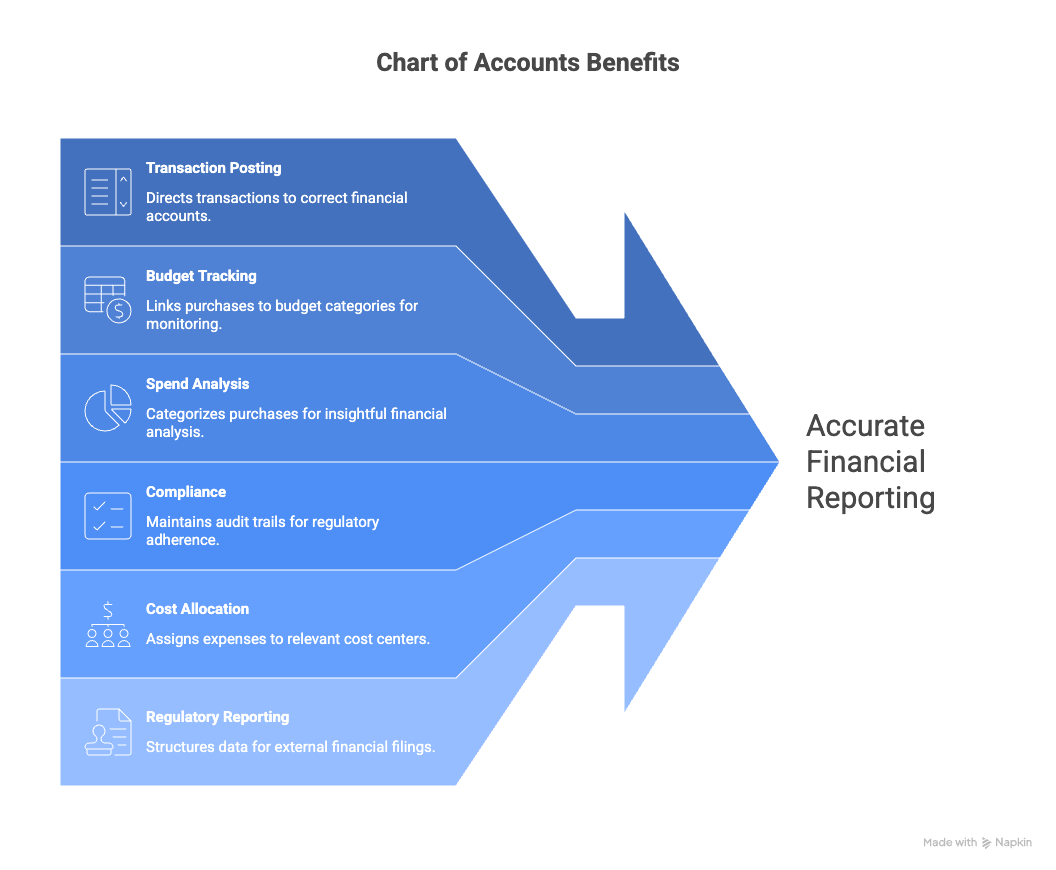
- Spend categorization: Account structure determines how purchases are grouped for category management and analysis.
- Budget control: Account and cost center coding links requisitions to budgets for validation and tracking.
- Accrual management: Proper coding enables accurate accruals for goods received but not yet invoiced.
- Supplier payments: Account codes determine expense classification when invoices are processed and paid.
- Reporting dimensions: Segment coding provides drill-down capability for analyzing spend by location, project, or business unit.
- System integration: COA serves as a common language between procurement, accounts payable, and general ledger systems.
KPIs of Charts of Accounts (COA)
| Dimension | Sample KPIs |
| Data Quality | Coding error rate, reclassification adjustments, and default account usage |
| Governance | New account request cycle time, unauthorized account creation incidents |
| Usability | Account selection time, user satisfaction with the coding process |
| Analytics | Spend visibility percentage, uncategorized spend rate |
Key Terms in Charts of Accounts (COA)
- Chart of Accounts (COA): The structured list of accounts used to record and classify financial transactions.
- General Ledger: The master accounting record where all transactions are posted by account code.
- Cost Center: An organizational unit to which expenses are charged for tracking and accountability.
- Account Segment: An additional coding dimension that provides analytical granularity beyond the base account.
- Natural Account: The portion of the account code identifying the type of expense or revenue.
- Account String: The complete coding combination, including account, cost center, and all segments.
Technology Enablement
Modern Source-to-Pay platforms integrate with ERP chart of accounts structures, providing guided account selection, validation against valid combinations, default coding based on category or supplier, and automated mapping to ensure procurement transactions flow accurately into financial systems.
FAQs
Q1. What is a chart of accounts?
A structured list of all accounts used to record and classify financial transactions in the general ledger.
Q2. Why does procurement need to understand COA?
Accurate account coding ensures purchases post correctly, budgets track properly, and spend data is reliable.
Q3. Who owns the chart of accounts?
Finance typically owns COA governance, but procurement should participate in design to support spend analysis needs.
Q4. What is an account string?
The complete combination of account number and all segments (cost center, project, location) that codes a transaction.
Q5. How often should COA be reviewed?
Annually at a minimum, or when business changes create new classification needs or render existing accounts obsolete.
Q6. What causes account coding errors?
Complex structures, unclear guidance, inadequate training, and a lack of defaults for common transaction types.
References
For further insights into these processes, explore the following Zycus resources related to Charts of Accounts (COA):










