



Spend Cube Analysis examines procurement expenditure across multiple dimensions simultaneously — typically supplier, category, and business unit — to uncover patterns and opportunities that single-dimension reports cannot reveal. By analyzing how these dimensions intersect, procurement gains a multidimensional view of spend that supports category strategy, supplier rationalization, and compliance monitoring.
Read more: The Role of Spend Analysis Solutions in Modern Procurement
Why Spend Cube Analysis Matters in Procurement
Spend data viewed in isolation — total spend by supplier, or total spend by category — tells only part of the story. A supplier may appear small when viewed at the enterprise level but dominant within a specific business unit. A category may show stable total spend while the number of suppliers serving it has doubled. Spend Cube Analysis surfaces these cross-dimensional insights that single-axis reporting misses, enabling procurement teams to make better-informed sourcing and supplier management decisions grounded in the full picture of how money flows through the organization.
The Core Process of Spend Cube Analysis
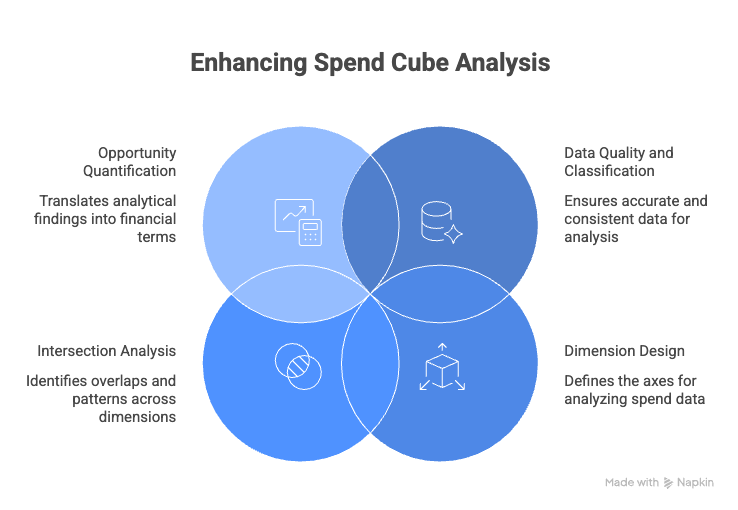
The process begins with data consolidation. Spend data is extracted from ERP systems, procurement platforms, p-card programs, and other transaction sources and loaded into an analytical environment. Data cleansing addresses inconsistencies in supplier naming, cost center coding, and category classification that would otherwise distort the analysis.
Spend is classified across the three primary dimensions of the cube: category (what was bought), supplier (who it was bought from), and business unit or cost center (who bought it). Additional dimensions such as geography, contract type, or time period can be layered in to deepen the analysis. Classification quality at this stage directly determines the reliability of the insights generated.
With the cube populated, analysts examine spend patterns across dimension intersections — which suppliers serve which units, where the same category is purchased from multiple suppliers, and where tail spend concentrates. These findings generate a prioritized list of consolidation, rationalization, and compliance opportunities.
Findings are presented to category managers with recommended actions. Each opportunity is assessed for addressability and a prioritized action plan is developed. The spend cube is refreshed regularly, typically quarterly, to track progress and identify new patterns.
Key Benefits of Spend Cube Analysis
- Reveals cross-dimensional spend patterns that single-axis reports cannot show, enabling more targeted and evidence-based sourcing decisions.
- Identifies supplier fragmentation within categories and business units, prioritizing consolidation opportunities by addressable spend volume.
- Surfaces maverick or off-contract spend by identifying transactions that fall outside approved suppliers or categories.
- Supports category strategy development by providing a complete picture of who is buying what, from whom, and at what scale.
- Tracks savings realization by comparing spend patterns before and after category interventions across all relevant dimensions.
Common Pitfalls of Spend Cube Analysis
- Analyzing unclean data: Running spend cube analysis on data with poor classification or inconsistent supplier naming produces misleading outputs. Data quality validation must precede analysis, not follow it.
- Focusing only on large spend concentrations: The most visible spending patterns are not always the most actionable. Tail spend fragmentation, identified through intersection analysis, often represents a higher proportion of addressable savings.
- Treating the spend cube as a one-time deliverable: A spend cube built once and not refreshed rapidly becomes stale. Regular updates are needed to track whether category interventions are delivering and to identify emerging patterns.
- Reporting findings without actionable recommendations: Spend cube outputs must be translated into specific, prioritized actions with owners and timelines. Analysis without a clear action pathway delivers no commercial value.
Analytical Questions a Spend Cube Should Answer
- Where is spend fragmented across too many suppliers? Identifying categories with high supplier counts relative to spend volume reveals consolidation opportunity.
- Which business units are buying outside preferred contracts? Cross-referencing business unit spend against contracted suppliers surfaces compliance gaps.
- Where are the same goods or services being bought at different prices in different locations? Price variation for equivalent purchases across geographies or units indicates arbitrage opportunity through centralized contracting.
- What proportion of spend is with strategic versus transactional suppliers? Mapping supplier spend against the segmentation model confirms whether strategic partners are receiving appropriate volume commitment.
KPIs of Spend Cube Analysis
| Dimension | Sample KPIs |
| Data Quality | % of spend classified to all three dimensions, supplier deduplication rate |
| Opportunity Coverage | Addressable spend identified vs. total spend analyzed, # of opportunities by type |
| Action Rate | % of identified opportunities with active category initiatives, conversion rate |
| Insight Freshness | Spend cube refresh frequency, data lag vs. transaction date |
Key Terms in Spend Cube Analysis
- Spend Cube: A multidimensional data structure that organizes procurement spend across category, supplier, and business unit axes for analytical purposes.
- Spend Classification: The process of assigning procurement transactions to taxonomy categories, suppliers, and cost centers to enable dimensional analysis.
- Addressable Spend: The portion of total spend that procurement can realistically influence through sourcing, contract management, or supplier strategy decisions.
- Tail Spend: Low-value, high-volume transactions spread across a large number of suppliers, typically identified through spend cube analysis as a consolidation target.
- Dimension Intersection: The analytical view produced by examining two or more spend cube dimensions simultaneously, such as supplier-by-business-unit or category-by-geography.
Technology Enablement
Spend analytics platforms automate spend cube construction by ingesting transaction data from multiple source systems, applying classification rules, and rendering interactive multidimensional dashboards. Category managers can filter and drill across dimensions in real time, eliminating the manual data preparation that historically made spend cube analysis a periodic rather than continuous capability.
FAQs
Q1. What is Spend Cube Analysis?
The examination of procurement expenditure across multiple dimensions simultaneously — typically category, supplier, and business unit — to reveal patterns and opportunities.
Q2. How is Spend Cube Analysis different from basic spend reporting?
Basic reporting shows spend on a single dimension. Spend Cube Analysis examines how dimensions intersect, revealing insights that flat reports cannot show.
Q3. What data is needed to build a spend cube?
Transaction-level spend data with supplier, category, and business unit fields, cleansed and classified before analysis begins.
Q4. How often should a spend cube be refreshed?
Quarterly is the standard for most organizations; monthly for categories with high volatility or active savings programs.
Q5. Who uses spend cube analysis outputs?
Category managers, procurement directors, and finance stakeholders use spend cube outputs to prioritize category strategies and track savings delivery.
Q6. Can spend cube analysis be automated?
Yes. Modern spend analytics platforms automate data ingestion, classification, and cube construction, with interactive dashboards that allow dimension filtering without manual analysis.
References
For further insights into these processes, explore Zycus’ dedicated resources related to Spend Cube Analysis:










