



A just-in-time (JIT) supply chain is an inventory management and logistics strategy where materials arrive at production facilities precisely when needed for manufacturing, minimizing storage time and inventory holding costs. In procurement, just-in-time requires coordinating supplier deliveries with production schedules so materials flow directly into manufacturing processes rather than accumulating in warehouses. This approach originated in automotive manufacturing and has expanded across industries seeking to reduce inventory investment while maintaining production continuity and operational efficiency.
Read more: What is Just-in-Time (JIT) Inventory Strategy
Why Just-in-Time (JIT) Supply Chain Strategy Matters in Procurement
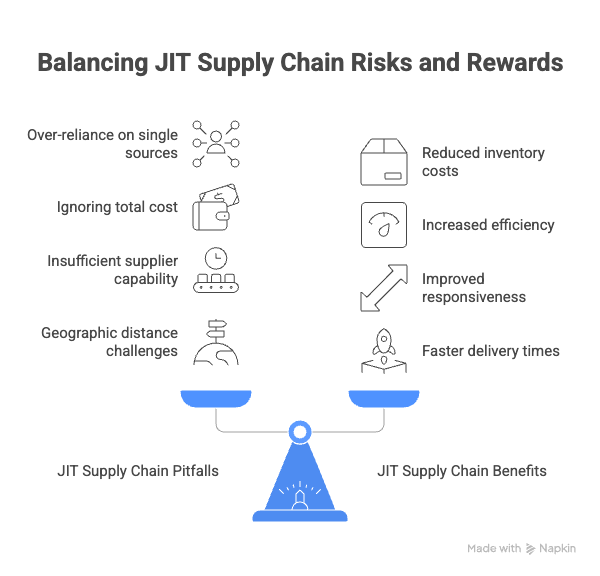
Inventory represents significant working capital that could be deployed elsewhere in the business. Just-in-time supply chains release this capital by reducing the gap between material receipt and consumption. However, JIT places substantial demands on procurement to ensure reliable, precisely-timed deliveries from suppliers. Any disruption in the supply chain immediately impacts production since buffer inventory no longer exists to absorb delays or shortages. Procurement must balance the financial benefits of reduced inventory against the operational risks of supply chain disruption, developing strategies that capture JIT advantages while maintaining acceptable supply continuity for critical operations.
The Core Process of JIT Supply Chain Strategy
Just-in-time implementation begins with production schedule stabilization, creating predictable demand patterns that procurement can communicate to suppliers with adequate advance notice. Highly variable production undermines JIT by making delivery timing unpredictable.
Supplier selection and development identifies partners capable of reliable, frequent deliveries with minimal lead time variation. Suppliers must demonstrate process stability and logistics capabilities before JIT relationships begin.
Delivery scheduling synchronizes supplier shipments with production requirements precisely. This may involve daily or even multiple daily deliveries for high-consumption items, with precise timing windows for arrival at the facility.
Continuous monitoring tracks supplier performance against delivery requirements rigorously. Small variations that might be acceptable in traditional supply chains can cause production stoppages in JIT environments, requiring close performance management.
Core Components of JIT Supply Chain Strategy
Supplier reliability forms the foundation of JIT success. Procurement must select and develop suppliers who consistently meet delivery windows, maintain quality standards, and communicate proactively about potential issues that could affect timing.
Logistics coordination ensures transportation supports JIT timing requirements effectively. This may involve dedicated delivery routes, cross-docking facilities, or milk-run collection patterns that enable frequent small deliveries economically.
Information systems provide visibility into supplier shipments, production schedules, and inventory positions across the supply chain. Real-time data enables rapid response when timing issues threaten production continuity.
Contingency planning addresses supply disruption scenarios despite the JIT philosophy of minimal inventory. Strategic safety stocks, backup suppliers, and expediting protocols protect against events that would otherwise halt production.
Key Benefits of Just-in-Time Supply Chain Strategy
- Working capital reduction: Minimizing inventory releases capital for other business investments while reducing carrying costs significantly.
- Space efficiency: Less warehouse space required for material storage reduces facility costs and enables production expansion.
- Quality visibility: Small, frequent deliveries enable rapid detection of quality issues before large quantities are affected.
- Reduced obsolescence: Faster inventory turnover minimizes risk of materials becoming obsolete or expiring before use.
- Supplier discipline: JIT requirements drive supplier process improvements that benefit overall supply chain performance.
Prerequisites for JIT Success
- Stable production schedules: JIT requires predictable demand patterns that can be communicated to suppliers with adequate advance notice for planning.
- Capable supplier base: Suppliers must demonstrate reliable delivery performance, quality consistency, and communication responsiveness over time.
- Robust logistics infrastructure: Transportation systems must support frequent, time-sensitive deliveries economically and reliably without failure.
- Information system integration: Real-time visibility into schedules, shipments, and inventory enables coordination across the entire supply chain.
- Management commitment. JIT requires sustained organizational focus since backsliding to buffer inventory is always tempting when issues arise.
KPIs of Just-in-Time (JIT) Supply Chain Strategy
| Dimension | Sample KPIs |
| Inventory | Days of supply, inventory turns, raw material holding costs |
| Delivery Performance | On-time delivery rate, delivery window compliance, lead time consistency |
| Production Impact | Line stoppages due to material shortages, schedule adherence |
| Cost | Total logistics cost, carrying cost reduction, expediting expenses |
Key Terms in Just-in-Time (JIT) Supply Chain Strategy
- Lead Time: The elapsed time from order placement to material delivery at the point of use in production.
- Delivery Window: The acceptable time range for material arrival, often measured in hours for JIT operations.
- Milk Run: A logistics pattern collecting materials from multiple suppliers on a single route to enable frequent small pickups.
- Cross-Docking: A distribution method where incoming materials are immediately transferred to outbound transport without warehousing.
- Safety Stock: Buffer inventory maintained to protect against supply or demand variability in uncertain conditions.
- Vendor-Managed Inventory: An arrangement where suppliers monitor customer inventory and initiate replenishment automatically.
Technology Enablement
Advanced planning systems, supplier portals, and real-time tracking technologies enable the visibility and coordination that just-in-time supply chains require. These platforms synchronize production schedules with supplier deliveries while providing early warning of timing issues that could disrupt operations.
FAQs
Q1. What is a just-in-time supply chain?
A strategy where materials arrive precisely when needed for production, minimizing inventory holding between receipt and use.
Q2. What are the main risks of JIT?
Supply disruptions immediately impact production since buffer inventory no longer absorbs delays or shortages.
Q3. How do we select JIT suppliers?
Evaluate delivery reliability, quality consistency, geographic proximity, and willingness to support frequent small deliveries.
Q4. Does JIT eliminate all inventory?
No. Strategic safety stocks and pipeline inventory remain necessary, but levels are significantly reduced from traditional approaches.
Q5. What industries use JIT most?
Automotive manufacturing pioneered JIT. Electronics, consumer goods, and discrete manufacturing widely adopt these practices.
Q6. How do we handle JIT during disruptions?
Contingency plans including backup suppliers, expediting protocols, and temporary safety stocks address extraordinary situations.
References
For further insights into these processes, explore Zycus’ dedicated resources related to Just-in-Time (JIT) Supply Chain Strategy:
- Responsible Procurement has to be Actionable and go Beyond Compliance
- Strategic Vendor Sourcing: Best Practices for Cost, Risk, and Sustainability
- Building a Best-in-Class Procurement Approval Workflow: Key Considerations and Strategies
- Finance Experts Outlook
- Mastering Supply Chain Risks with Merlin Force Majeure De-Risker










