



Supply chain modeling is the use of mathematical and analytical representations of a supply chain to evaluate decisions, test scenarios, and quantify trade-offs before committing to action. A model abstracts the real supply chain — its nodes, flows, capacities, costs, and constraints — into a structure that can be analysed quickly and varied easily. Modeling is used for strategic decisions (network design, sourcing strategy, capacity planning) and tactical decisions (inventory policy, demand-supply matching, scenario response). It is the discipline that lets procurement and supply chain leaders test the future before betting on it.
Read more: Modern Supply Chain Models: From Linear Chains to Intelligent Networks
Why Supply Chain Modeling Matters in Procurement
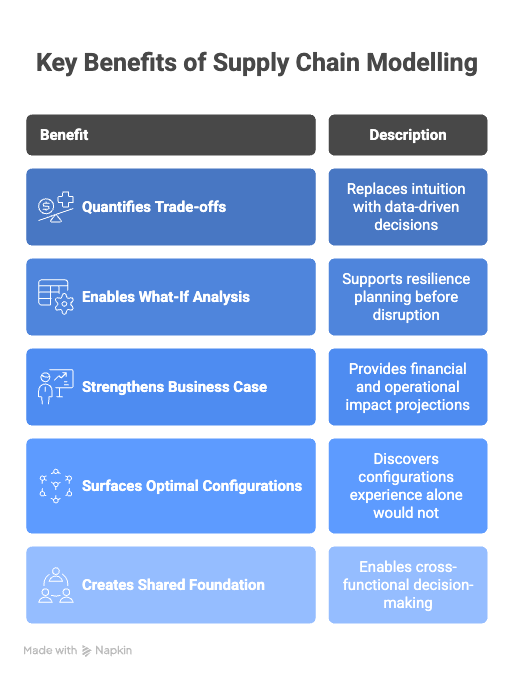
Supply chain decisions are expensive to make and even more expensive to reverse. Opening a distribution centre, consolidating suppliers, switching modes of transport, or committing to a new sourcing region carries multi-year financial and operational consequences. Supply chain modeling converts these high-stakes decisions from intuition into quantified scenarios, surfacing trade-offs between cost, service, risk, and resilience that would otherwise be invisible. For procurement, modeling provides the rigour to defend sourcing decisions, the structure to evaluate supplier proposals, and the foresight to anticipate the downstream effects of category choices.
The Core Process of Supply Chain Modeling
- Decision Definition. Modeling begins with the decision the model is meant to support — network configuration, sourcing footprint, capacity addition, response strategy. The decision frames everything that follows: which variables matter, which constraints bind, which outcomes count.
- Data Collection and Validation. The model is fed with the data it needs — costs, volumes, capacities, lead times, demand patterns, service requirements. Data quality is the limiting factor of model quality; an elegantly designed model on bad data produces confident wrong answers.
- Model Construction. The supply chain is represented in mathematical form — typically optimisation models for prescriptive questions (“what should we do?”) and simulation models for descriptive questions (“what would happen if?”). Model design decides which dynamics are captured and which are abstracted away.
- Baseline Calibration. Before testing scenarios, the model is calibrated against current reality. If the model cannot reproduce known outcomes from known inputs, its predictions for unknown scenarios cannot be trusted.
- Scenario Analysis. The model is run across the scenarios the decision requires — varying assumptions, constraints, and external conditions. The output is not a single answer but a structured view of how outcomes vary with conditions.
- Decision Recommendation and Sensitivity. Results are translated into recommendations, with explicit treatment of sensitivity — which assumptions, if wrong, would change the answer. The recommendation is paired with the confidence range, not delivered as a single point estimate.
Core Components of Supply Chain Modeling
- Model architecture defines what is represented — nodes, flows, costs, constraints — and what is abstracted away. Architecture decides which questions the model can answer reliably.
- Data foundation is the structured input the model operates on — master data, transactional data, market data, scenario assumptions. Without disciplined data, modeling produces precision without accuracy.
- Solver and analytical engine is the computational core that processes the model — optimisation engines, simulation platforms, or analytical environments depending on model type.
- Scenario library captures the alternative conditions tested — demand shocks, supply disruptions, cost shifts, regulatory changes. A reusable scenario library accelerates response when conditions change.
- Output layer translates model results into formats decision-makers can act on — dashboards, comparison tables, sensitivity charts. Models that produce technically correct output decision-makers cannot interpret deliver little value.
Common Pitfalls of Supply Chain Modeling
- Building models more complex than the decision requires. A model that takes three months to build and tune for a decision that needed an answer in three weeks is a failure regardless of mathematical elegance. Match complexity to decision urgency and stakes.
- Treating model output as truth rather than informed analysis. Models are simplifications. Their output guides judgement; it does not replace it. Decision-makers who treat model results as deterministic miss the assumption sensitivities that should shape confidence.
- Underinvesting in data validation. The phrase “garbage in, garbage out” applies precisely. Models reproduce the structure of the data they receive; bad data produces confident wrong answers harder to challenge than no answer at all.
- Failing to refresh models as conditions change. A model built around 2020 supply chain assumptions answers 2020 questions. Continuous use requires continuous recalibration as costs, lead times, and constraints evolve.
Types of Supply Chain Models Procurement Encounters
- Network design models. Optimise the configuration of facilities, flows, and sourcing locations across the network — typically used for major strategic decisions with multi-year horizons.
- Sourcing optimisation models. Determine the lowest-cost or best-value allocation of demand to suppliers given volume, capacity, and constraint inputs — used in sourcing events to evaluate complex supplier proposals.
- Inventory optimisation models. Determine optimal stocking policies — safety stock, reorder points, target levels — across SKUs and locations to meet service requirements at minimum total cost.
- Capacity and demand-supply matching models. Match production and supply capacity against forecast demand, surfacing gaps, bottlenecks, and reallocation opportunities.
- Simulation models for disruption analysis. Test how the supply chain responds to specific disruptions — supplier failure, port closure, demand shock — to inform resilience investments.
- Scenario and what-if models. Lighter-weight analytical models that explore the cost or service impact of specific decisions or assumption changes — used for tactical decision support.
KPIs of Supply Chain Modeling
| Dimension | Sample KPIs |
| Decision Quality | % of major decisions supported by validated model, post-decision variance vs. modeled outcome |
| Model Reliability | Baseline accuracy (model output vs. observed reality), data refresh cycle time |
| Speed to Insight | Mean time from question to modeled answer, % of decisions modeled within decision window |
| Scenario Coverage | Number of scenarios tested per major decision, % of identified disruption types modeled |
Key Terms in Supply Chain Modeling
- Optimisation Model: A mathematical model that finds the best solution given an objective and constraints — answering “what should we do?”
- Simulation Model: A mathematical model that reproduces system behaviour under defined conditions — answering “what would happen if?”
- Network Design: The strategic configuration of supply chain facilities, flows, and sourcing — a primary application of optimisation modeling.
- Sensitivity Analysis: The process of varying assumptions to see which most affect outcomes — essential for understanding confidence in model recommendations.
- Calibration: Tuning a model against known outcomes to confirm its representation of reality before using it for forecasting.
- Digital Twin: A continuously updated digital representation of the physical supply chain — an emerging extension of modeling toward real-time operational support.
Technology Enablement
Modern Source-to-Pay platforms embed modeling capabilities — particularly sourcing optimisation, scenario analysis, and increasingly digital-twin-style continuous modeling — directly into procurement workflows. Platform-native modeling lets procurement professionals run scenarios on their own data without parallel environments, accelerating decisions and keeping assumptions aligned with operational reality.
FAQs
Q1. What is supply chain modeling?
The use of mathematical and analytical representations of a supply chain to evaluate decisions, test scenarios, and quantify trade-offs before committing to action.
Q2. How is it different from forecasting?
Forecasting predicts what will happen. Modeling evaluates what would happen under different decisions or conditions. Forecasting is one input to modeling; modeling supports decisions forecasting alone cannot.
Q3. When should procurement use supply chain modeling?
For decisions with significant financial or operational consequences — network configuration, major sourcing events, capacity decisions, resilience planning, and any decision where intuition is insufficient.
Q4. What is the difference between optimisation and simulation?
Optimisation finds the best decision given an objective (“what should we do?”). Simulation reproduces system behaviour under conditions (“what would happen?”). Many decisions require both.
Q5. Do you need specialist analysts to use models?
For complex strategic models, yes — model design and validation require expertise. For routine scenario analysis, increasingly platform-based modeling tools enable procurement professionals to run scenarios directly.
References
For further insights into these processes, explore Zycus’ dedicated resources related to Supply Chain Modeling:










