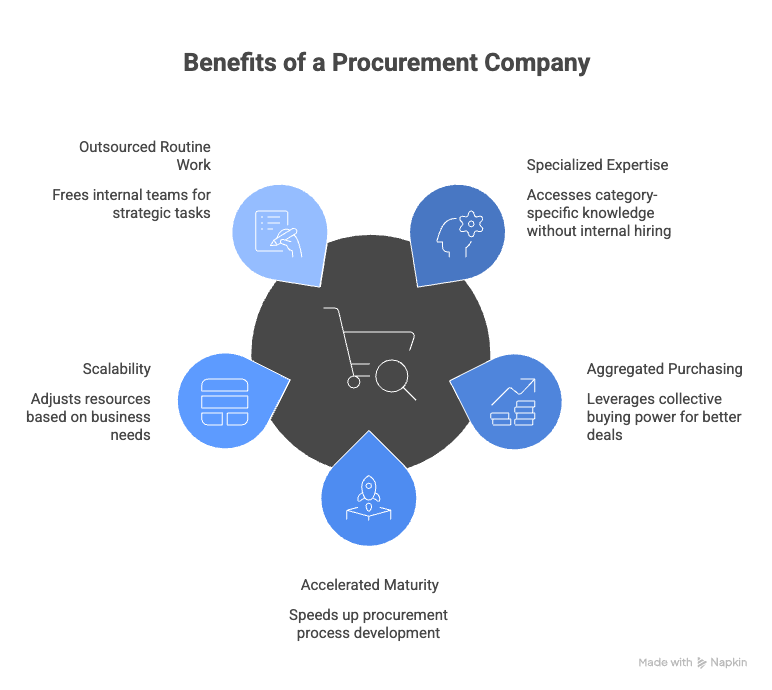
A procurement company is an external organization that provides procurement services on behalf of other businesses. Also known as a procurement service provider, these firms offer services ranging from strategic sourcing and category management to transactional purchasing, supplier management, and procurement technology implementation. Procurement companies help organizations access specialized expertise, leverage aggregated buying power, or outsource procurement functions they cannot efficiently perform in-house.
Read more: What is Procurement? A Guide to Strategies, Software & AI Solutions
Why It Matters in Procurement
Not every organization has the scale, expertise, or resources to build a world-class procurement function internally. A procurement service provider can fill capability gaps — whether that means accessing category specialists, leveraging group purchasing volume, or implementing procurement technology without building internal teams. For mid-sized companies or those with immature procurement functions, partnering with a procurement company can accelerate savings, improve compliance, and professionalize purchasing faster than organic growth would allow. The decision to use external procurement services is itself a strategic sourcing question.
Download eBook: 6 Must-Have Reports for Any Procurement Leader
The Core Process
The engagement typically begins with a needs assessment. The organization evaluates which procurement functions to retain in-house versus outsource, considering factors like spend volume, category complexity, internal capabilities, and strategic importance.
Once scope is defined, the organization selects a procurement service provider through a competitive process. Evaluation criteria include category expertise, technology platforms, pricing models, cultural fit, and track record with similar organizations.
After selection, a transition period establishes governance, integrates systems, and transfers knowledge. Clear roles and responsibilities are defined — what the provider manages, what stays internal, and how decisions are escalated.
During ongoing operations, the procurement company executes sourcing events, manages suppliers, processes transactions, or provides advisory services depending on the engagement model. Performance is measured against agreed KPIs, and the relationship is reviewed periodically to assess value and adjust scope.
Read more: Procurement Management: A Complete Guide to Building Smarter Source-to-Pay Processes
Core Components
- Strategic Sourcing Services: Category strategy development, market analysis, supplier negotiations, and contract management performed by external specialists.
- Group Purchasing Organizations (GPOs): Aggregated buying cooperatives that leverage collective volume to negotiate better pricing and terms for members.
- Managed Procurement Services: Full or partial outsourcing of procurement operations, including requisition processing, PO management, and supplier coordination.
- Procurement Consulting: Advisory services for procurement transformation, process improvement, technology selection, and organizational design.
- Technology and Platform Services: Implementation and managed services for procurement technology, often bundled with process expertise.
- Tail Spend Management: Specialized services focused on managing low-value, high-volume transactions that internal teams lack capacity to address.
Common Pitfalls
Outsourcing without clear governance: Without defined escalation paths and decision rights, accountability becomes unclear and performance suffers.
Losing internal knowledge: Over-reliance on external providers can erode institutional knowledge, making it difficult to bring functions back in-house or switch providers.
Misaligned incentives: If the provider’s compensation is not tied to outcomes, their interests may diverge from yours. Structure contracts to align incentives.
Underestimating change management: Stakeholders accustomed to internal procurement may resist external providers. Communication and engagement are essential.
When to Consider a Procurement Service Provider
- Limited internal expertise: You lack specialists in high-value categories where market knowledge drives significant savings.
- Insufficient scale: Your spend volume is too small to command competitive pricing or justify dedicated resources.
- Capacity constraints: Your team is stretched thin and cannot address tail spend or transactional workload effectively.
- Transformation needs: You need to rapidly professionalize procurement but lack the time or capability to build from scratch.
- Technology gaps: You need procurement technology but lack the expertise to select, implement, and manage it internally.
KPIs
| Dimension | Sample KPIs |
| Savings | Negotiated savings, cost avoidance, price benchmarking results |
| Service | Cycle time, stakeholder satisfaction, issue resolution time |
| Compliance | Contract compliance rate, policy adherence, audit findings |
| Value | Total cost of service vs. savings delivered, ROI on engagement |
Key Terms
- Procurement Service Provider: An external firm that delivers procurement services on behalf of client organizations.
- Group Purchasing Organization (GPO): A cooperative that aggregates purchasing volume from multiple members to negotiate better contracts.
- Managed Services: Outsourced operational execution where the provider takes responsibility for defined procurement processes.
- Procurement Outsourcing: Transferring some or all procurement functions to an external provider.
- Tail Spend: Low-value, high-volume purchases often managed inefficiently due to limited attention from strategic procurement.
- Category Specialist: An expert with deep knowledge of a specific spend category, market dynamics, and supplier landscape.
Technology Enablement
Many procurement service providers deliver their services through integrated Source-to-Pay platforms, combining process expertise with technology. This enables seamless collaboration between internal teams and external providers while maintaining visibility and control over procurement activities.
FAQs
Q1. What is a procurement company?
An external organization that provides procurement services — sourcing, purchasing, supplier management, or consulting — on behalf of other businesses.
Q2. What is the difference between a GPO and a procurement service provider?
A GPO focuses on aggregating volume to negotiate contracts. A procurement service provider may offer broader services including sourcing execution, managed services, and consulting.
Q3. When should an organization consider outsourcing procurement?
When internal expertise, scale, or capacity is insufficient to achieve procurement goals cost-effectively.
Q4. What are the risks of using a procurement company?
Loss of internal knowledge, misaligned incentives, governance gaps, and dependency on external parties.
Q5. How are procurement service providers typically compensated?
Models include fixed fees, percentage of spend managed, gainsharing on savings, or hybrid arrangements.
Q6. Can you partially outsource procurement?
Yes. Many organizations outsource specific categories, tail spend, or transactional work while retaining strategic functions internally.
References
For further insights into these processes, explore Zycus’ dedicated resources related to the Procurement Company:
- Source-to-pay – The Cross Functional Way
- Gaining Actionable Insights with Zycus Accounts Payable (AP) ROI Calculator
- Transforming Procurement: The Power of e Procurement Tools
- Procurement Leadership Essentials: Strategic Insights on transforming procurement
- Microsoft & Zycus: Transforming Procurement with AI at Horizon US 2024