


Backflush, also known as backflush accounting or backflush costing, is an inventory management and costing method where material consumption is recorded automatically when finished goods are completed rather than when materials are physically issued from inventory. In procurement contexts, backflush affects how material requirements are tracked, when replenishment is triggered, and how inventory accuracy is maintained for production-related purchases. This approach simplifies transaction processing while requiring disciplined master data management.
Why Backflush in Manufacturing Matters in Procurement
Procurement teams supporting manufacturing operations must understand backflush because it fundamentally changes how material consumption signals reach purchasing systems. Under traditional methods, each material issue generates immediate inventory transactions that trigger reorder points and purchasing actions. With backflush, consumption records only post upon production completion, creating different timing for inventory visibility and replenishment signals. Procurement must adjust safety stock calculations, lead time buffers, and supplier coordination to account for these timing differences and maintain material availability without excessive inventory investment or stockout risks.
The Core Process of Backflush in Manufacturing
The backflush process begins with production order creation, where the bill of materials defines which components and quantities will be consumed to produce each finished unit. This BOM data becomes the foundation for all subsequent consumption calculations.
During manufacturing, materials are physically consumed from production floor inventory or point-of-use locations. However, no inventory transactions are recorded at this stage—the system still shows materials as available in inventory even though they have been physically used in production.
When production completes and finished goods are reported, the backflush transaction automatically deducts component materials based on the bill of materials quantity multiplied by units completed. This single transaction relieves inventory for all consumed materials simultaneously and efficiently.
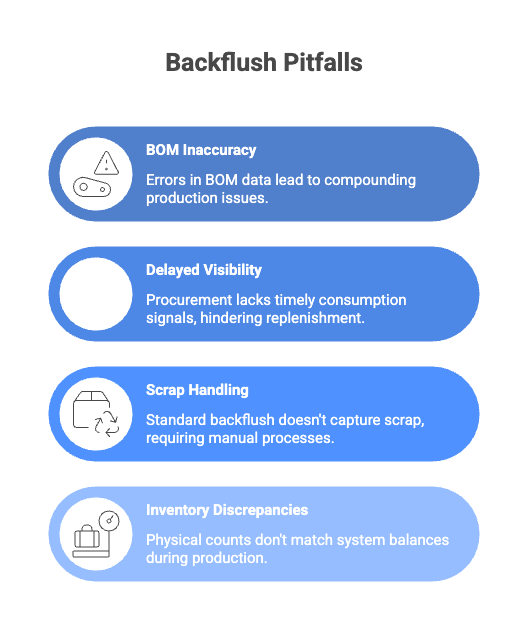
Variance analysis follows to compare backflushed quantities against actual consumption patterns. Discrepancies may indicate bill of materials errors, unrecorded scrap rates, or other production issues requiring procurement attention for accurate material planning.
Core Components of Backflush in Manufacturing
Bills of materials serve as the foundation for backflush calculations. Accuracy in component quantities and unit conversions is essential because backflush relies entirely on BOM data rather than actual issue transactions to determine consumption amounts.
Trigger points define when backflush transactions execute in the system. Common triggers include production completion reporting, movement to finished goods inventory, or shipment to customers, depending on organizational process design and timing requirements.
Variance tracking identifies differences between expected and actual material consumption. Without individual issue transactions providing real-time visibility, variance analysis becomes the primary method for detecting consumption anomalies and quality issues.
Inventory adjustment processes handle corrections when backflushed quantities differ from physical counts. Cycle counting and reconciliation procedures must account for the delayed transaction timing inherent in backflush environments.
Key Benefits of Backflush in Manufacturing
- Reduced transaction volume: Eliminating individual material issues dramatically reduces data entry requirements and system processing demands.
- Simplified shop floor processes: Production workers focus on manufacturing activities rather than recording each material movement transaction.
- Lower administrative costs: Fewer transactions mean less time spent on inventory paperwork, system entries, and transaction reconciliation.
- Support for lean manufacturing: Backflush aligns with just-in-time and lean principles that minimize non-value-added administrative activities.
- Streamlined costing: Product costs are calculated from standard bills of materials without tracking actual issue costs for each production run.
Procurement Considerations for Backflush Environments
- Safety stock adjustments: Buffer stock calculations must account for consumption visibility delays inherent in backflush timing to prevent stockouts.
- Supplier lead time coordination: Replenishment triggers may fire later than in traditional environments, requiring adjusted lead time expectations with suppliers.
- Production schedule visibility: Procurement benefits from forward visibility into production schedules rather than relying solely on inventory-based consumption signals.
- Variance monitoring: Systematic variance review helps procurement identify materials with consumption patterns that differ materially from BOM expectations.
- Cycle counting frequency: More frequent counts for critical materials help maintain inventory accuracy despite reduced transaction-level visibility.
KPIs of Backflush in Manufacturing
| Dimension | Sample KPIs |
| Accuracy | BOM accuracy rate, backflush variance percentage by material |
| Inventory | Inventory record accuracy, cycle count adjustment frequency |
| Efficiency | Transaction reduction versus traditional methods, processing time savings |
| Material Availability | Stockout incidents, production delays due to material shortages |
Key Terms in Backflush in Manufacturing
- Bill of Materials (BOM): The structured list of components and quantities required to manufacture a finished product.
- Point of Use: Floor stock locations where materials are staged for immediate production consumption.
- Phantom Item: A BOM component that exists for planning purposes but is not stocked or transacted separately.
- Standard Cost: The predetermined cost used for inventory valuation and backflush costing calculations.
- WIP (Work in Process): Inventory that has entered production but has not yet completed as finished goods.
- Variance: The difference between backflushed quantities and actual material consumption amounts.
Technology Enablement
ERP systems supporting manufacturing operations include backflush functionality with configurable trigger points and comprehensive variance reporting. Integration with procurement modules ensures that consumption signals, whether immediate or backflushed, flow appropriately to material planning and purchasing processes for timely replenishment action.
FAQs
Q1. What is backflush in manufacturing?
Backflush is an inventory method where material consumption is recorded automatically upon production completion rather than when materials are physically issued.
Q2. When is backflush appropriate?
Backflush works best with stable, repetitive manufacturing processes and highly accurate bills of materials.
Q3. How does backflush affect procurement?
Procurement must adjust replenishment timing expectations and often requires greater production schedule visibility to maintain material availability.
Q4. What about scrap and waste?
Scrap must be recorded through separate transactions since standard backflush only deducts standard BOM quantities automatically.
Q5. Can backflush work with variable consumption?
High variability reduces backflush effectiveness. Traditional issue transactions may be more appropriate for unpredictable processes.
Q6. How do we maintain inventory accuracy?
Regular cycle counting, variance analysis, and BOM audits compensate for reduced transaction-level visibility.
References
For further insights into these processes, explore Zycus’ dedicated pages and case studies related to Backflush in Manufacturing: