

Improving profits through contracting is the deliberate use of contract design, negotiation, and execution to capture margin that less disciplined contracting leaves on the table. It treats contracts not as legal formalities to be completed after the commercial deal is struck, but as the primary instrument through which procurement’s value is captured, protected, and grown. Strong contracting practice contributes directly to gross margin (through pricing structures, rebates, and cost-down mechanisms) and to operating margin (through obligation enforcement, risk allocation, and renewal discipline). For most organizations, contracting is among the highest-leverage tools available to procurement — but only when treated as a continuous discipline rather than a transactional step.
Why it Matters in Procurement
Industry analyses consistently show that 5 to 15 percent of negotiated contract value erodes during contract execution — through missed obligations, auto-renewals on outdated terms, scope creep, off-contract spend, and unenforced commitments. Contracting done well closes those leaks. Equally importantly, contract design itself creates the conditions for ongoing margin improvement — index-linked pricing that captures commodity declines, performance-tied incentives that align suppliers with buyer outcomes, rebate structures that reward volume aggregation. Contracting is where strategy meets execution, and where the difference between announced savings and realised profit gets decided.
The Core Process
- Contract Strategy Setting. The process begins before drafting. The contract’s commercial structure — pricing model, term length, performance regime, change mechanism — is the strategic question. Drafting executes a strategy; it does not invent one.
- Drafting and Negotiation. Once strategy is set, drafting translates it into specific terms, and negotiation tests how much survives contact with the supplier. Strong negotiation preserves the design principles, conceding tactically without compromising structurally.
- Execution and Activation. A signed contract delivers no profit until its terms are applied. Activation pushes contracted pricing into systems, communicates the new terms to internal users, and ensures the supplier transitions to contracted operation.
- Obligation and Performance Management. Through the contract life, obligations are tracked and deviations addressed. This is where profit-capture work happens — negotiated terms only deliver value if they are operationally enforced.
- Change Management. Contracts evolve. Change orders, scope expansions, and pricing adjustments are managed through controlled processes that preserve commercial integrity rather than accepting whatever supplier or stakeholder pressure produces.
- Renewal and Renegotiation. As contracts approach expiry, renewal is treated as a deliberate decision — renew, renegotiate, retender, or exit. Auto-renewals on outdated terms are a major source of profit erosion.
Core Components
- Contract strategy framework translates category objectives into contract design principles — pricing model, term structure, performance regime, risk allocation — before drafting begins.
- Pricing architecture is the structural design of how the supplier gets paid — fixed, indexed, tiered, performance-linked, rebated — and the lever through which most profit improvement flows.
- Performance and obligation framework sets out what the supplier commits to, how it is measured, and what happens when performance falls short.
- Change and renewal mechanisms define how the contract evolves over its life — preserving commercial integrity while accommodating legitimate change.
- Active obligation tracking monitors both supplier and buyer commitments through the term — the operational layer that prevents quiet leakage.
- Spend visibility against contract connects what was contracted to what is actually being spent, surfacing off-contract patterns in time to act.
Key Benefits Improving Profits Through Contracting
- Captures negotiated savings in delivery by closing the gap between contract intent and operational reality.
- Creates ongoing margin improvement through index-linked pricing, rebate structures, and performance-tied incentives that adjust over the contract life.
- Reduces working capital pressure through payment term optimisation and supplier financing arrangements.
- Protects margin in adverse conditions through risk allocation, force majeure design, and price adjustment limits.
- Strengthens negotiating position at renewal by accumulating performance and spend data that supports evidence-based renegotiation.## Common Pitfalls
Treating contracts as legal documents rather than commercial instruments. A contract that is legally sound but commercially uninspired captures less value than the negotiation could have delivered. Legal review confirms protection; commercial design creates value.
Underinvesting in execution after signature. Most profit erosion happens after signature — through unenforced obligations, off-contract spend, and untracked renewals. Signature is when execution discipline begins, not when contracting ends.
Allowing auto-renewals to drive the portfolio. Auto-renewal clauses convert deliberate procurement decisions into administrative inertia. Every renewal should be deliberate — even if the deliberate choice is to renew on current terms.
Confusing aggressive negotiation with strong contracting. Squeezing every concession at negotiation creates suppliers who recover margin through scope changes, quality drift, and renewal pricing.
Contract Levers That Most Directly Improve Profit
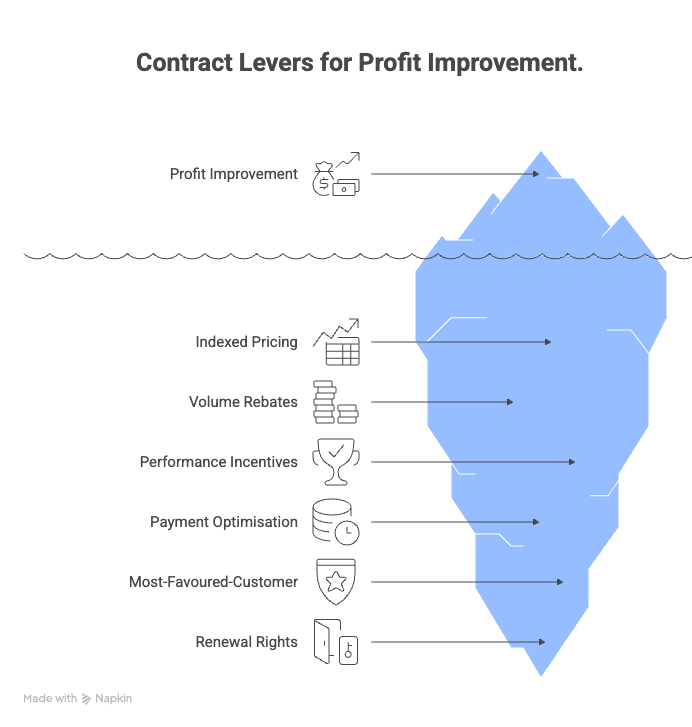
- Indexed and adjustable pricing. Contracts that link price to commodity indices, currency baskets, or input cost benchmarks capture cost declines fixed pricing would lock out — and provide a defensible mechanism for supplier increases when costs genuinely rise.
- Volume-based rebates and tier breaks. Pricing structures rewarding volume aggregation incentivise both supplier and buyer to consolidate spend through the contract — capturing scale benefits and reducing maverick spend.
- Performance-tied incentives and penalties. Pricing or rebate structures linked to supplier performance — on-time delivery, quality, responsiveness — align supplier behaviour with buyer outcomes and create financial accountability.
- Payment term optimisation. Days payable outstanding (DPO) is a working capital lever. Contracts that align payment terms with supply chain finance arrangements can extend DPO without disadvantaging the supplier.
- Most-favoured-customer protections. Clauses ensuring the buyer receives at least as favourable terms as the supplier offers comparable customers — closing the gap where supplier pricing drifts in competitors’ favour.
- Renewal and termination rights. Early termination rights for cause, opt-out windows, and explicit renewal triggers preserve the buyer’s negotiating position — preventing the lock-in that erodes leverage.
KPIs
| Dimension | Sample KPIs |
| Value Capture | Realised savings vs. signed, % of contracts with active obligation tracking |
| Pricing Discipline | % of contracts with adjustable pricing where appropriate, rebate capture rate |
| Compliance | % of spend on contracted terms, maverick spend rate |
| Renewal Discipline | % of renewals managed deliberately (vs. auto-renewed), savings achieved at renewal |
Key Terms
- Indexed Pricing: A pricing model linking the contract price to an external index — commodity, currency, labour, or composite — adjusting automatically as the index moves.
- Rebate Structure: A payment mechanism where the supplier returns a portion of revenue to the buyer, typically tied to volume or performance thresholds.
- Most-Favoured-Customer (MFC) Clause: A provision ensuring the buyer receives at least as favourable terms as comparable customers — protecting against pricing drift.
- Days Payable Outstanding (DPO): The average time between receiving an invoice and paying it — a working capital metric directly shaped by contract payment terms.
- Auto-Renewal: A contract clause extending the term automatically unless one party gives notice — a structural risk if not actively managed.
Technology Enablement
Modern Source-to-Pay platforms support contract-driven profit improvement through integrated contract authoring, clause libraries, AI-powered obligation extraction, performance dashboards, renewal alerting, and analytics that connect contract terms to actual spend behaviour. Platform-native deployment ensures contracted savings flow into purchasing systems and obligations get tracked actively rather than discovered at audit.
FAQs
Q1. What is improving profits through contracting?
The deliberate use of contract design, negotiation, and execution to capture margin that less disciplined contracting leaves on the table — through pricing structures, obligation enforcement, and renewal discipline.
Q2. Why is so much contract value lost after signature?
Because terms only deliver value if operationally enforced. Studies show 5–15% of negotiated value erodes through missed obligations, off-contract spend, auto-renewals on outdated terms, and unenforced commitments.
Q3. What are the most powerful contract levers for profit?
Indexed pricing, volume-based rebates, performance-tied incentives, payment term optimisation, and disciplined renewal management. The mix depends on category and supplier dynamics.
Q4. Are aggressive contracts always good contracts?
No. Contracts that squeeze every concession at signature often produce suppliers who recover margin through scope changes, quality drift, or hard renewal pricing.
Q5. Who owns contract-driven profit improvement?
Procurement designs and negotiates. Operations and category teams enforce performance. Finance tracks financial outcomes. Effective contracting integrates all three.