



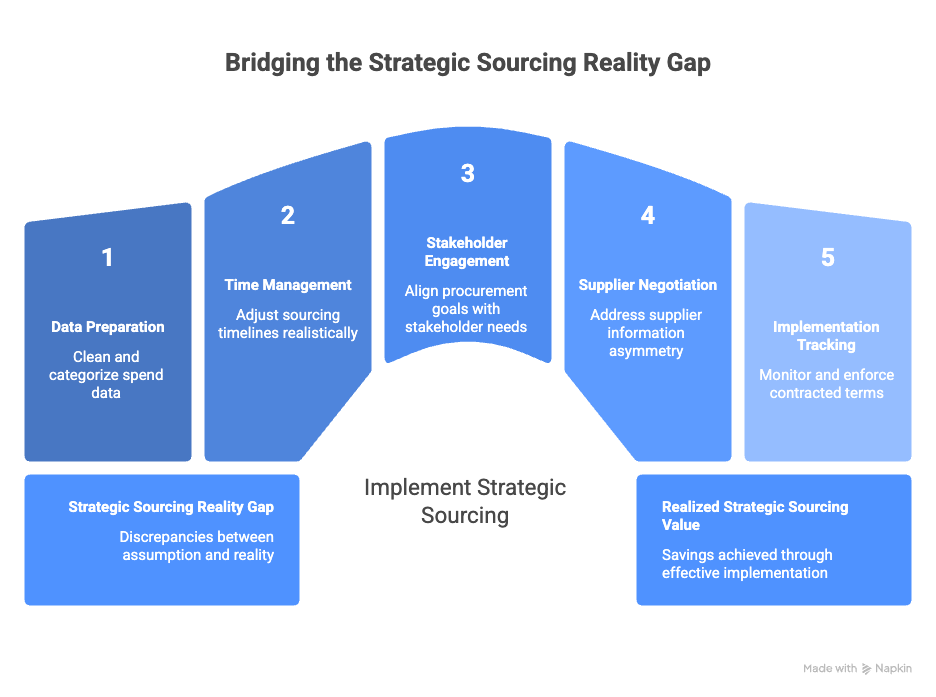
Strategic sourcing reality is the practical version of strategic sourcing as it actually plays out — the gap between the textbook seven-step process and how the work gets done under real-world constraints. Strategic sourcing in theory follows a clean linear flow: spend analysis, market research, strategy development, RFP, supplier selection, negotiation, implementation. In practice, it operates inside compressed timelines, incomplete data, stakeholder politics, supplier asymmetries, and the constant pull of urgent tactical demands. Understanding the reality — not the model — is what separates teams that consistently deliver strategic value from those that run sourcing events without fully realising the strategy.
Why Strategic Sourcing Reality Matters in Procurement
Most procurement teams know the strategic sourcing playbook. Fewer execute it consistently. The reasons are rarely about knowledge — they are about the friction between the methodology and the operational environment procurement actually works inside. Recognising this friction is what allows leaders to design realistic sourcing programs, set credible expectations with stakeholders, and avoid the cycle of declared transformation followed by quiet retreat to tactical purchasing. Strategic sourcing reality is the honest version that lets the discipline succeed.
The Core Process of Strategic Sourcing Reality
- Spend and Opportunity Identification. In theory, this starts with clean spend data. In reality, it starts with whatever data exists — often partial, inconsistently categorised, and missing critical attributes. The process begins by working with what is available while improving the data foundation in parallel.
- Category Strategy Development. Theory calls for deep market analysis and category strategy before sourcing begins. Reality demands strategy that is good enough to act on, sharpened through the sourcing event itself. Perfect strategy delivered late loses to good-enough strategy delivered in time.
- Stakeholder Alignment. The textbook lists stakeholder engagement as a step. The reality is that alignment runs as a continuous background process — and breakdown here is the single most common cause of sourcing failure. The work is relational, not procedural.
- Supplier Engagement and Event Execution. Sourcing events are where reality and theory diverge most visibly — incumbents protect position, new suppliers may underbid to enter, and RFP responses rarely answer the question that was actually asked. Effective execution requires reading supplier behaviour, not just the responses.
- Award and Contracting. Award decisions look analytical in the model and political in practice. The deal that gets done is rarely the deal the spreadsheet recommends, because the spreadsheet does not capture relationship history, executive preference, or business risk appetite.
- Implementation and Value Realisation. This is the step strategic sourcing programs most often skip. Negotiated value only materialises if implementation actually transfers spend to the new contract — and most studies show 30–50% of forecast savings never get realised because implementation is under-resourced.
Core Components of Strategic Sourcing Reality
- Realistic data foundation acknowledges that data will be imperfect and designs sourcing to operate with sensible approximations rather than waiting for ideal data that never arrives.
- Stakeholder relationship capital is the operational currency strategic sourcing runs on — accumulated through reliability, transparency, and shared wins across categories.
- Time-boxed strategy treats category strategy as iterative — good enough at start, sharpened through execution, refined for the next cycle.
- Supplier behaviour intelligence reads not just what suppliers submit but what their submissions reveal about capacity, motivation, and position — the analytical layer beyond pricing.
- Implementation discipline is the often-missing component that converts negotiated outcomes into realised value — through contract activation, catalog updates, communication, and spend tracking.
Key Benefits of Strategic Sourcing Reality
- Closes the gap between announced sourcing strategy and realised sourcing outcomes — the most common source of credibility erosion for procurement.
- Reduces the lost-savings problem by treating implementation as part of sourcing rather than as a follow-up activity.
- Builds stakeholder trust by setting expectations grounded in operational reality.
- Sharpens category strategy through experience-based iteration rather than reliance on upfront perfect analysis.
- Creates a sustainable strategic sourcing program that survives leadership transitions and organizational change.
Common Pitfalls of Strategic Sourcing Reality
- Treating the methodology as the goal. Strategic sourcing is a means to an outcome — value delivered. Programs that measure adherence to the seven-step process rather than value realised optimise the wrong variable.
- Underinvesting in implementation. Sourcing teams celebrate at award. Implementation often falls to under-resourced category teams, where carefully negotiated value quietly leaks away.
- Mistaking stakeholder compliance for stakeholder alignment. Stakeholders who do what procurement asks but disagree with the direction will undermine implementation and resurface the issue at renewal. Alignment is different from compliance.
- Confusing event completion with strategy execution. Running an RFP is not the same as executing a category strategy. Many programs conflate the two — and end up with completed events but no category-level progress.
KPIs of Strategic Sourcing Reality
| Dimension | Sample KPIs |
| Strategy Execution | % of categories with current strategy, % of sourcing events aligned to category strategy |
| Realisation Gap | Savings realised vs. signed, % of negotiated terms reflected in actual spend |
| Stakeholder Health | Stakeholder satisfaction by category, % of sourcing events with stakeholder alignment at award |
| Implementation Discipline | Time from contract signature to spend transition, % of contracts with active implementation tracking |
Key Terms in Strategic Sourcing Reality
- Strategic Sourcing: The end-to-end discipline of analysing spend, developing category strategy, engaging suppliers, and contracting to deliver sustained value.
- Category Strategy: A multi-year plan for how a spend category will be managed — supplier base, sourcing approach, value targets, risk posture.
- Realised Savings: Savings appearing in invoiced spend, as opposed to savings projected at award. The gap is often substantial.
- Stakeholder Alignment: Active agreement from internal customers on sourcing direction, distinct from passive compliance.
- Implementation Gap: The difference between negotiated value and realised value, attributable to incomplete spend transition, off-contract buying, or missed obligation enforcement.
- Maverick Spend: Spend that bypasses approved suppliers or contracts — a primary cause of the realisation gap.
Technology Enablement
Modern Source-to-Pay platforms close the reality gap by automating the data work that consumes sourcing time, embedding implementation tracking into contract execution, and providing the spend visibility that surfaces realisation gaps in time to correct them. Platform-native deployment shifts sourcing team effort from preparation to strategy and from event execution to value realisation.
FAQs
Q1. What is strategic sourcing reality?
The practical version of strategic sourcing as it actually plays out — the gap between methodology and how the work gets done under real-world constraints.
Q2. How is it different from strategic sourcing methodology?
Methodology describes the ideal process. Reality describes how organizations actually execute it within data, time, stakeholder, and supplier constraints. Methodology is the map; reality is the terrain.
Q3. Why does so much sourcing value go unrealised?
Because negotiated value only materialises through implementation — the step most programs under-resource. Spend transition, compliance enforcement, and obligation tracking are where 30–50% of savings typically leak.
Q4. Can strategic sourcing methodology be followed exactly?
Rarely. The discipline lies in adapting methodology to operational reality without losing the strategic intent — using methodology as scaffolding, not a script.
Q5. What separates teams that consistently deliver value?
Stakeholder relationship discipline, implementation focus, and willingness to operate with imperfect data — not deeper methodology knowledge.










