



Supplier management building blocks are the foundational capabilities, processes, and data structures that an organization must have in place before advanced supplier management can be effective. They include a clean supplier master, a documented segmentation framework, baseline performance metrics, structured review processes, and the governance rules that define how supplier relationships are managed. Organizations that attempt sophisticated supplier relationship management, innovation programmes, or supplier development initiatives without these foundations consistently underdeliver — because the infrastructure required to manage suppliers systematically is absent.
Read more: Building Success Through a Solid Supplier Management Framework
Why Supplier Management Building Blocks Matter in Procurement
Supplier management failures are rarely caused by a lack of strategic ambition — they are caused by missing or weak foundational capabilities. An organization cannot run meaningful performance reviews if it has no baseline performance data. It cannot develop strategic suppliers if it has not identified which suppliers are strategic. It cannot manage risk if it has no supplier risk register. Building blocks are not prerequisites that slow progress — they are the investment that makes every subsequent supplier management activity more effective and more credible. Procurement teams that invest in foundations first consistently achieve better results faster than those that reach for advanced programmes on a weak base.
Download eBook: Building Blocks Suppliers for Improved Building Blocks Supplier Management
The Building Blocks of Supplier Management
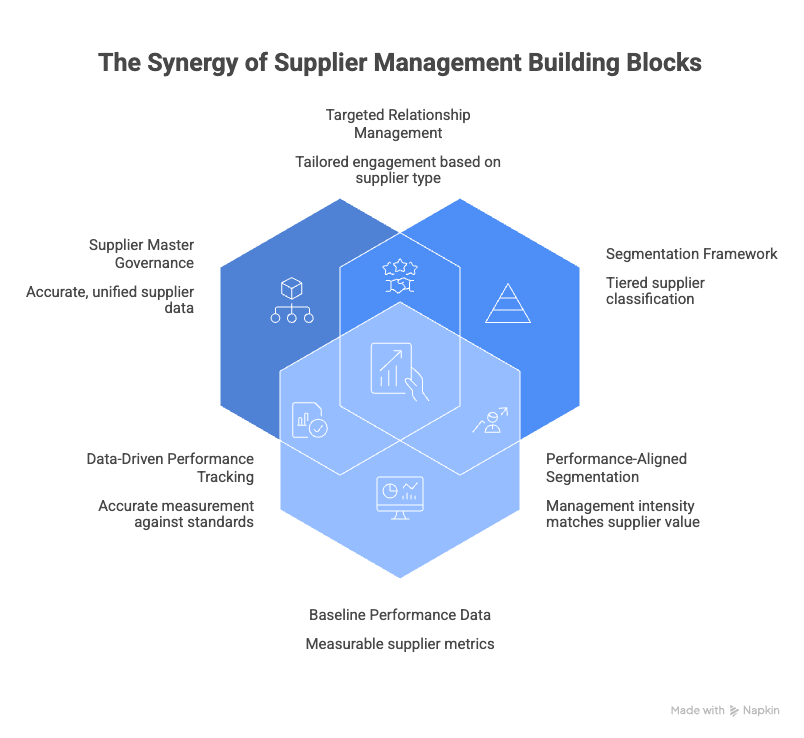
- Supplier Master Governance: The first building block is a clean, deduplicated, current record of every active supplier — one canonical record per supplier group with complete contact, financial, and category data. Without this, every subsequent process starts from a flawed foundation.
- Segmentation Framework: Suppliers are classified into defined tiers — strategic, preferred, approved, transactional — using documented criteria that reflect spend, strategic importance, risk profile, and performance history. The segmentation determines what management approach each supplier receives and ensures that investment in relationship management is proportionate to value delivered.
- Baseline Performance Data: Before performance management can begin, baseline metrics must be established for each supplier in scope — on-time delivery rates, quality acceptance rates, invoice accuracy, and responsiveness scores. Without a baseline, it is impossible to measure improvement or credibly identify underperformance.
- Structured Review Cadence: Business reviews are scheduled on a defined cadence — quarterly for strategic suppliers, annually for preferred — with standard agendas, documented outputs, and action tracking. Informal conversations do not constitute supplier management; structured reviews with outputs do.
Core Components of Supplier Management Building Blocks
- Supplier data quality governance maintains the accuracy, completeness, and currency of supplier records across procurement systems. Data quality is not a one-time exercise — it requires ongoing controls, regular audits, and clear ownership to prevent degradation.
- Documented segmentation criteria make segmentation decisions transparent, consistent, and defensible. Without documented criteria, segmentation reflects individual judgment rather than organizational strategy — and changes when the individual moves on.
- KPI framework defines the specific metrics used to assess supplier performance across delivery, quality, cost, and compliance dimensions — enabling consistent comparison and portfolio-level reporting.
Key Benefits of Supplier Management Building Blocks
- Creates the data foundation that makes every subsequent supplier management activity — risk assessment, performance management, development investment — reliable and actionable.
- Establishes governance clarity about which suppliers receive which level of management attention, preventing both over-investment in transactional relationships and under-investment in strategic ones.
- Enables meaningful performance improvement conversations with suppliers by establishing the baseline metrics against which progress can be measured.
- Builds organizational capability that survives staff turnover — documented processes and data infrastructure that are institutionalized rather than dependent on individual knowledge.
Common Pitfalls of Supplier Management Building Blocks
- Skipping the supplier master clean-up: Organizations that attempt to build supplier management programmes on a fragmented, duplicated supplier master spend more effort managing data inconsistencies than managing suppliers.
- Segmenting by spend alone: A supplier that receives small spend but holds a sole-source position for a critical component is strategic regardless of spend level. Segmentation criteria must incorporate risk and strategic importance, not just volume.
- Setting performance metrics without supplier input: KPIs that suppliers view as unfair, unmeasurable, or disconnected from what they actually control create dispute and resentment rather than improvement. The best-performing reviews are built on metrics both parties understand and accept.
- Treating building blocks as a one-time implementation: Supplier master quality degrades, segmentation becomes outdated, and performance baselines drift if not actively maintained. Building blocks require ongoing governance, not a project-style deployment.
The Building Blocks in Sequence
- First: Supplier master quality: A reliable record of who your suppliers are. Without this, everything else is built on a flawed foundation.
- Second: Segmentation: Classify suppliers by strategic value, risk, and spend to determine who receives what level of management investment.
- Third: Baseline performance data: Establish where each supplier stands today so there is something measurable to manage against.
- Fourth: Review cadence: Schedule structured reviews that translate data into action — quarterly for strategic suppliers, annually for preferred.
- Fifth: Governance and escalation: Define what happens when performance falls below threshold and the conditions under which a relationship is formally reviewed for continuation.
KPIs of Supplier Management Building Blocks
| Dimension | Sample KPIs |
| Data Foundation | % of suppliers with complete master records, deduplication rate, data refresh frequency |
| Segmentation Coverage | % of active suppliers segmented, segmentation review completion rate |
| Performance Baseline | % of strategic and preferred suppliers with active KPI baselines |
| Review Completion | % of scheduled reviews conducted on time, % with documented outputs and action tracking |
Key Terms in Supplier Management Building Blocks
- Supplier Master: The authoritative record of all active suppliers in an organization’s procurement systems, containing identification, contact, financial, and category data.
- Supplier Segmentation: The classification of suppliers into management tiers based on documented criteria reflecting spend, strategic importance, risk profile, and performance.
- Performance Baseline: The current measured level of a supplier’s performance across defined KPIs, used as the reference point for improvement tracking.
- Business Review: A structured, scheduled meeting between buyer and supplier to assess performance, discuss strategic priorities, and agree on actions.
- KPI Framework: The set of metrics used to consistently measure and compare supplier performance across delivery, quality, cost, and compliance dimensions.
Technology Enablement
Supplier management platforms support the building blocks through supplier information portals that maintain master data, segmentation tools that classify and track supplier tiers, performance dashboards that automate KPI calculation from transaction data, and review management modules that schedule, conduct, and document business reviews. These capabilities convert manual, spreadsheet-based supplier management into governed, consistent processes that scale across the supply base.
FAQs
Q1. What are supplier management building blocks?
The foundational capabilities, data structures, and processes — supplier master, segmentation, performance baselines, review cadence — that must be in place before advanced supplier management can be effective.
Q2. Why do building blocks matter before advanced programmes?
Because advanced supplier management built on weak foundations consistently underdelivers. Clean data, clear segmentation, and baseline metrics are what make performance management and development programmes credible.
Q3. How often should supplier segmentation be reviewed?
Annually, and whenever significant changes occur in spend patterns, supplier performance, or organizational strategy.
Q4. What makes a good business review?
A structured agenda covering performance data, strategic priorities, issues and actions, and forward planning — conducted on a regular schedule with documented outputs and tracked action items.
Q5. Who is responsible for maintaining the building blocks?
Procurement operations typically own data quality and governance. Category managers own segmentation decisions and review conduct for their supplier portfolios.
References
- Supplier Management–Benefits, Process, & Best Practices
- Building Success Through a Solid Supplier Management Framework
- Supplier Relationship Management: A Complete Guide to Strategic SRM
- A 5-Step Process to Effective Supplier Management
- Unlocking Efficiency: The Pros and Cons of Supplier Managed Inventory










