Procurement initiatives are structured, time-bound programs of work designed to deliver specific improvements in cost, risk, compliance, supplier performance, or process efficiency across the procurement function. They translate category strategies, savings targets, and organizational priorities into defined projects with owners, timelines, and measurable outcomes. Procurement initiatives are the operational units of procurement strategy — the mechanism through which strategic ambitions are converted into managed, accountable workstreams.
Why Procurement Initiatives Matter
Without a structured initiative pipeline, procurement strategy remains aspirational. Category managers may understand where value exists but lack the framework to prioritize, resource, and track progress on the actions required to capture it. A well-managed initiative portfolio converts procurement’s strategic intent into delivered outcomes, creates visibility for leadership into what is being worked on and why, and provides the accountability structure that separates high-performing procurement functions from those that identify savings but fail to realize them.
Read more: Procurement Cost Saving Initiatives That Will Deliver Value
The Core Process of Procurement Initiatives
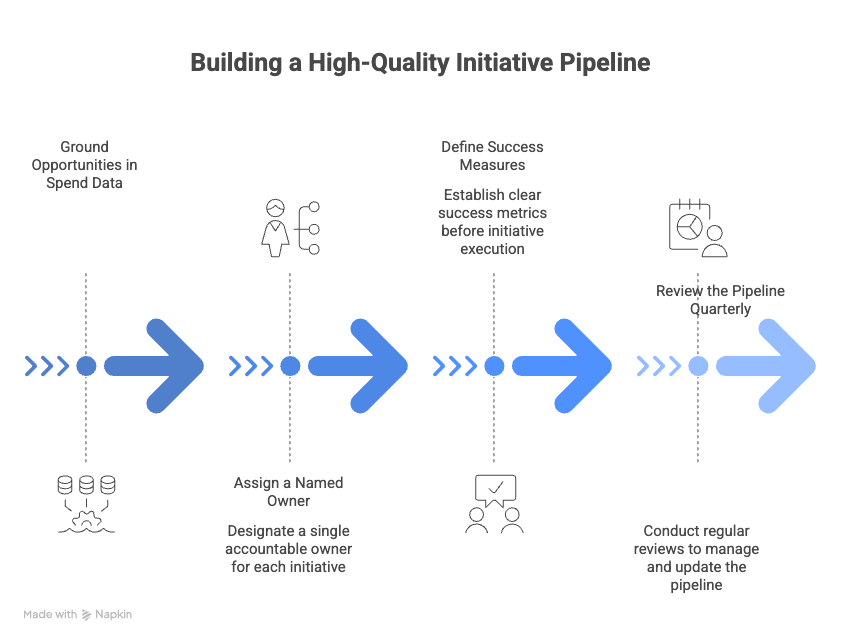
- Opportunity Identification: Initiatives originate from spend analysis, supplier performance reviews, contract renewal pipelines, category strategy development, or stakeholder demand. Each opportunity is assessed for its potential value — savings, risk reduction, compliance improvement — and its feasibility given current market conditions, contract status, and resource availability.
- Initiative Definition: Approved opportunities are converted into defined initiatives with a clear scope, target outcome, owner, timeline, dependencies, and success measures. A poorly defined initiative — one without a clear owner or measurable target — will not be delivered consistently regardless of its potential.
- Prioritization and Resource Allocation: The initiative portfolio is prioritized against the procurement function’s capacity and the organization’s strategic priorities. High-value, high-feasibility initiatives with near-term delivery are prioritized ahead of longer-horizon or lower-impact work. Resource is allocated accordingly.
- Execution and Tracking: Initiatives are executed through sourcing events, negotiations, supplier development programmes, or contract renegotiations. Progress is tracked against milestones, issues escalated through governance, and status reported at a defined cadence.
- Outcome Measurement: On completion, the delivered outcome is measured against the target using actual spend data. Savings are validated with finance, and learnings inform future initiative design.
Core Components of Procurement Initiatives
- Initiative register is the central record of all active, pipeline, and completed procurement initiatives. It captures scope, owner, target outcome, timeline, status, and delivered value — providing the portfolio view that procurement leadership requires to manage workload and report performance.
- Prioritization framework ranks initiatives by expected value, feasibility, strategic alignment, and resource requirement. Consistent prioritization criteria prevent the initiative portfolio from being driven by stakeholder pressure rather than strategic merit.
- Governance and reporting rhythm defines how frequently initiative progress is reviewed, what escalation paths exist for blocked initiatives, and how results are reported to leadership and finance. Without a governance rhythm, initiative progress is invisible until delivery fails.
- Savings validation confirms that completed initiatives have delivered the outcomes they committed to, using actual spend data rather than projected figures. Finance involvement in validation builds credibility for procurement’s reported performance.
Key Benefits of Procurement Initiatives
- Converts procurement strategy into accountable, tracked workstreams with defined owners, timelines, and measurable outcomes.
- Creates transparency for leadership and finance stakeholders into what procurement is working on, why, and when results are expected.
- Enables resource allocation decisions based on initiative value and feasibility rather than urgency or stakeholder pressure.
- Provides the governance structure that ensures savings identified in strategy are actually realized in organizational expenditure.
Common Pitfalls of Procurement Initiatives
- Defining too many initiatives without adequate resources: An overloaded pipeline creates the appearance of activity without delivering outcomes. Procurement should maintain a manageable portfolio where every initiative has sufficient resource to progress.
- Vague initiative definitions without measurable targets: Initiatives without specific targets, owners, and timelines will not be delivered consistently or measured credibly.
- Treating initiative completion as the end of value delivery: An initiative is complete when its outcome is validated in actual spend data — not when the contract is signed. Post-implementation validation must be built in.
KPIs of Procurement Initiatives
| Dimension | Sample KPIs |
| Pipeline Health | # of active initiatives by stage, total pipeline value vs. target |
| Delivery Rate | % of initiatives completed on schedule, initiative value delivered vs. committed |
| Validation Quality | % of completed initiatives with finance-validated outcomes |
| Portfolio Balance | Distribution of initiatives across savings, risk, compliance, and efficiency types |
Key Terms in Procurement Initiatives
- Initiative Register: A central record of all active, pipeline, and completed procurement initiatives, tracking scope, ownership, timeline, status, and delivered value.
- Savings Pipeline: The forward-looking view of savings opportunities identified but not yet committed or realized, used to forecast future procurement performance.
- Initiative Owner: The named individual accountable for delivering a specific procurement initiative against its defined scope, timeline, and outcome target.
- Value Realization: The confirmation that a completed initiative has delivered the financial or operational improvement it committed to, verified against actual spend or performance data.
Technology Enablement
Source-to-Pay platforms support procurement initiative management through savings tracking modules that record opportunity baselines, commitment milestones, and realization against actual spend. Portfolio dashboards provide procurement leadership with a consolidated view of initiative status, value delivery, and resource utilization — enabling active portfolio management rather than periodic reporting.
FAQs
Q1. What are procurement initiatives?
Structured, time-bound programs of work designed to deliver specific improvements in cost, risk, compliance, or process efficiency — the operational units through which procurement strategy is executed.
Q2. How is a procurement initiative different from a sourcing event?
A sourcing event is one possible activity within a procurement initiative. An initiative has a broader scope — defining the opportunity, executing the sourcing or negotiation activity, and validating the delivered outcome.
Q3. How many initiatives should a procurement team manage at once?
Enough to meet savings and improvement targets without exceeding the team’s capacity to execute well. Quality of delivery is more important than volume of initiatives in progress.
Q4. Who should own procurement initiatives?
Category managers for sourcing and supplier-related initiatives; procurement operations leads for process improvement initiatives. Every initiative requires a named owner with the authority and capacity to drive it.
Q5. What happens when an initiative is blocked?
It should be escalated through the governance process. If the blocker cannot be resolved within one review cycle, the initiative should be formally deprioritized or redesigned.
Q6. How is initiative value validated?
By comparing actual spend data before and after the initiative against the agreed baseline, with finance sign-off confirming the saving is genuine and non-duplicated.
References
- What is Procurement? Guide to Strategies, Software & AI Solutions
- Procurement vs Purchasing: The Definitive Guide
- Procurement Explained: Your Why, What & How
- What is 3 Types of Procurement?
- Procurement Budgeting Process: Save Your Bucks Effectively
- Optimizing Success through Advanced Procurement Analytics
- Revolutionizing Procurement The Rise of Intake Management