BAFO (Best and Final Offer) is the final commercial and technical proposal submitted by shortlisted suppliers at the end of a competitive sourcing or negotiation process.
It typically follows one or more rounds of bids, clarifications, and negotiations. The BAFO round is the point where buyers ask suppliers to submit their most competitive, fully refined offer after which no further revisions are normally expected.
BAFO is widely used in RFPs, large services contracts, complex indirect categories, and strategic sourcing events where both cost and value need to be optimized before award.
Why BAFO Matters in Procurement
BAFO is not just “one more bid round.” When used properly, it becomes a structured decision enabler that helps procurement balance price, risk, service quality, and long-term value.
1. Cost Savings and Value Extraction
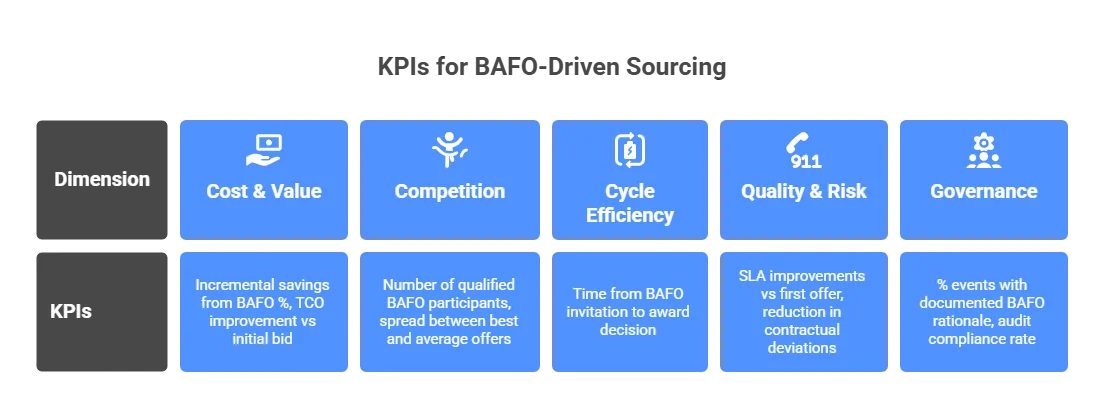
By explicitly signalling a final round, procurement encourages suppliers to sharpen pricing, optimize commercial structures, and remove padding. This often unlocks incremental savings or better total cost of ownership (TCO) without restarting the entire event.
2. Better Supplier Selection
BAFO allows evaluation of suppliers based on their best possible combination of price, service levels, risk terms, and value adds. This leads to higher confidence in the final award decision.
3. Transparency and Fairness
All shortlisted suppliers receive the same instructions, timelines, and evaluation criteria. This reduces bias, supports auditability, and demonstrates fairness — especially important in regulated or public-sector environments.
4. Stronger Alignment with Business Goals
BAFO gives procurement and stakeholders one last chance to steer proposals toward target outcomes — such as improved SLAs, tighter contract terms, or sustainability commitments — not just lower unit costs.
5. Risk and Compliance Control
Through BAFO, procurement can clean up residual risks in earlier proposals: ambiguous clauses, incomplete scope, misaligned SLAs, or compliance gaps. The final offer becomes a cleaner input into contract drafting.
Where BAFO Fits in the Sourcing Process
BAFO usually appears toward the end of a structured sourcing event. A typical flow looks like this:
- Requirements and RFP Design
Business and procurement define scope, technical requirements, evaluation criteria, and baseline commercial expectations. - Initial Bid Submission
Suppliers submit their first proposals (commercial + technical). These often contain assumptions, ranges, or non-standard terms. - Evaluation, Shortlisting, and Clarifications
Procurement and stakeholders assess responses, clarify open points, and shortlist a smaller group of qualified suppliers. - Negotiation or Optimization Round(s)
There may be one or more commercial or technical negotiation rounds — through negotiations, optimization scenarios, or eAuctions — to refine proposals. - BAFO Invitation
Shortlisted suppliers receive a formal BAFO request, including clarified scope, updated volumes, evaluation priorities, and a deadline for submitting their best and final positions. - BAFO Submission and Evaluation
Suppliers submit their BAFOs. Procurement evaluates them holistically — price, SLAs, TCO, risk, flexibility, and value-added elements. - Award Recommendation and Contracting
The chosen supplier’s BAFO becomes the commercial reference point for contract drafting and final negotiations on legal form (not on core commercial commitments, unless exceptions are explicitly allowed).
Key Components of a BAFO Submission
A robust BAFO is not just a revised price sheet. It typically includes:
- Final Pricing and Rate Cards
Firm unit prices, hourly or daily rates, discount structures, and volume-based tiers. - Total Cost of Ownership (TCO) View
Implementation fees, onboarding costs, recurring charges, support fees, penalties, exit costs, and any optional modules. - Service-Level Agreements (SLAs) and Performance Metrics
Response and resolution times, uptime targets, quality levels, and associated service credits or remedies. - Contractual and Risk Terms
Liability caps, indemnities, termination rights, data protection commitments, compliance with relevant standards (e.g., ISO, SOC, ESG requirements). - Scope Clarifications and Assumptions
Refined scope boundaries, exclusions, dependencies, and responsibilities between buyer and supplier. - Value-Added Elements
Innovation proposals, process improvements, training, co-development options, or continuous-improvement frameworks.
BAFO consolidates all these elements into a single, clear “final position” from each supplier.
Best Practices for Running a BAFO Round
To get the most from BAFO, leading procurement teams:
1. Define Clear Rules and Timelines
Communicate that this is the final offer, specify allowed changes, and set a firm submission deadline. Ambiguity weakens the effect of BAFO.
2. Refine and Share Updated Scope
Ensure suppliers are quoting against the same clarified scope and assumptions, so BAFOs are comparable and evaluation is fair.
3. Balance Price and Non-Price Criteria
Clarify that evaluation will consider both cost and value — SLAs, risk, quality, and innovation — not just lowest price.
4. Use Structured Templates
Standard templates for BAFO submissions simplify comparison, reduce errors, and support faster stakeholder review.
5. Maintain Fairness and Auditability
Give all shortlisted suppliers equal access to information, and record decisions for audit, governance, and internal review.
BAFO in Digital & Autonomous Sourcing
In modern digital procurement:
- eSourcing platforms manage BAFO invitations, communication, and structured response capture.
- Scenario analysis tools compare BAFOs across TCO, multi-year impact, and risk-weighted value.
- AI and optimization engines can suggest negotiation levers, identify outliers, and highlight the best value mix per category strategy.
In more advanced setups, autonomous or semi-autonomous negotiation agents can run multi-round negotiations and then invite BAFOs within predefined governance boundaries, while humans retain control of award decisions.
When BAFO Is Most Useful (and When It Isn’t)
BAFO is especially effective for:
- High-value, strategic contracts
- Complex services or long-term agreements
- Competitive markets with multiple qualified suppliers
- Situations where TCO and SLAs matter as much as price
BAFO is less useful when:
- The category is highly standardized with fixed pricing
- There are very few viable suppliers
- Timelines are extremely constrained and a single-shot RFP is more appropriate
Key Terms in BAFO
| Term | Meaning |
| RFP | Request for Proposal — formal document inviting suppliers to propose |
| TCO | Total Cost of Ownership — full lifecycle cost of a solution |
| Shortlisting | Narrowing down suppliers based on initial evaluation |
| Award Decision | Final supplier selection based on BAFO and evaluation criteria |
FAQs
Q1. What is BAFO in procurement?
BAFO (Best and Final Offer) is the final, most competitive proposal submitted by shortlisted suppliers at the end of a sourcing event, after which no further revisions are typically allowed.
Q2. What is the difference between BAFO and an RFP?
An RFP invites suppliers to submit their initial proposals, while BAFO is the final round where selected suppliers refine pricing, SLAs, TCO, and terms after clarifications and negotiations.
Q3. When should BAFO be used in sourcing?
BAFO is ideal for high-value, complex, or strategic categories where multiple qualified suppliers can improve pricing and value after initial negotiations.
Q4. Does BAFO always mean choosing the lowest price?
No. BAFO evaluates both cost and value—SLAs, risks, service levels, and innovation—ensuring the best overall commercial outcome, not just the cheapest bid.
Q5. How does BAFO improve negotiation outcomes?
It creates a structured, fair, and competitive environment, prompting suppliers to optimize pricing, refine assumptions, and align final offers with clarified requirements.
References
For further insights into these processes, explore Zycus’ dedicated resources related to Best and Final Offer: