



Catalog visibility is the degree to which approved items, contracted suppliers, and negotiated prices are accessible, searchable, and usable by requesters at the point of purchase. It covers what the catalog contains, how easily requesters can find what they need, and whether the buying experience guides them toward compliant choices. High catalog visibility means a requester looking for a laptop, a chemical reagent, or a marketing service finds the contracted option within seconds — at the right price, from the right supplier, with the right terms applied. Low catalog visibility produces the opposite: requesters search externally, raise off-contract requisitions, or default to whichever supplier they used last.
Why Catalog Visibility Matters in Procurement
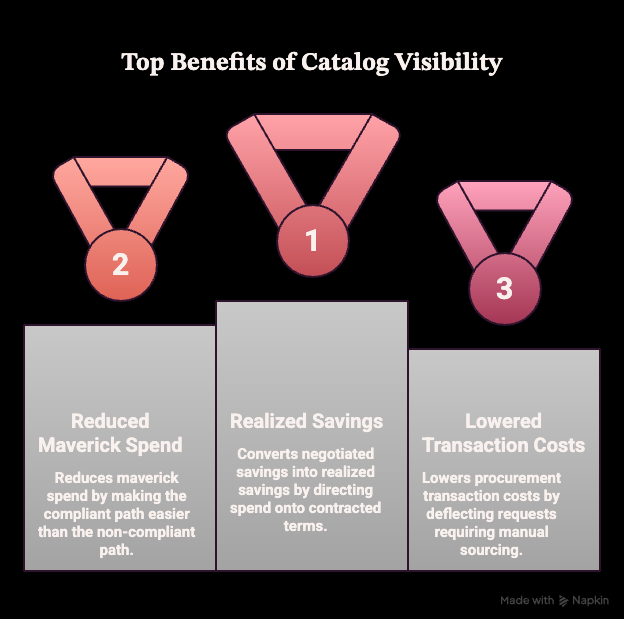
Procurement spends enormous effort negotiating prices and terms with suppliers. None of that value flows through to the P&L unless requesters actually buy through the contracted catalog — and they will only do so if the catalog is genuinely visible and usable. Poor catalog visibility is one of the largest silent leaks in procurement value, producing maverick spend, off-contract buying, and the slow drift of negotiated savings into unrealised projections. Catalog visibility is the operational bridge between sourcing outcomes and spend reality.
The Core Process of Catalog Visibility
- Catalog Population and Content Management. The process begins with deciding what goes into the catalog — which suppliers, which items, which contract pricing. Population is not a one-time activity; catalogs require continuous content management as items change, prices update, and contract scope shifts.
- Categorisation and Searchability Design. Items are categorised, attributed, and tagged so requesters can find them through the search and browse paths they actually use. The question is not “is the item in the catalog?” but “can a requester find it within three seconds?”
- Channel Integration. Catalog content is exposed through the channels requesters use — procurement portal, mobile apps, embedded ERP screens, guided buying flows, and conversational interfaces. Content invisible in the requester’s workflow is functionally absent.
- Search and Recommendation Optimisation. The search experience determines whether the catalog gets used. Strong search handles synonyms, partial matches, supplier variations, and suggests appropriate alternatives when the exact item is unavailable.
- Compliance Guidance. As requesters interact with the catalog, the system guides them toward compliant choices — preferred suppliers highlighted, contracted items surfaced first, non-compliant alternatives flagged or blocked. Visibility is paired with nudge architecture.
- Ongoing Performance Monitoring. Catalog usage, search success rate, off-catalog buying patterns, and requester feedback are monitored continuously. Patterns of failure — items requesters search for but don’t find — drive catalog updates and supplier conversations.
Core Components of Catalog Visibility
- Catalog content is the curated set of items, suppliers, and contracted terms accessible through the buying experience — the foundation everything else builds on.
- Item attribution and taxonomy make catalog content findable — categories, attributes, search terms, and synonyms matching how requesters describe what they need.
- Search and discovery layer turns catalog content into a usable buying experience — search algorithms, filtering, faceting, and recommendation logic.
- Guided buying experience integrates catalog into the requester journey, surfacing the right options at the right moment and steering away from off-contract choices.
- Punchout and external content integration connects to supplier-hosted catalogs and external content sources, extending visibility beyond internally maintained content.
- Usage analytics measure how the catalog is performing — search success rate, off-catalog spend patterns, item-level usage, requester behaviour signals.
Common Pitfalls of Catalog Visibility
- Confusing catalog existence with catalog visibility. A catalog requesters cannot find, cannot search effectively, or cannot trust to be current is invisible regardless of how comprehensive its content is.
- Letting content age. Prices drift, items get discontinued, suppliers exit categories. Stale catalogs lose requester trust quickly — and trust, once lost, is hard to rebuild.
- Optimising the procurement view rather than the requester view. Catalogs designed for procurement category structure rather than how requesters search produce poor adoption. The requester is the customer.
- Treating compliance guidance as friction. Heavy-handed blocking without explaining why drives requesters around the catalog rather than through it. Guidance works better than gates for most categories.
What Strong Catalog Visibility Looks Like in Practice
- Requesters find what they need within seconds. A laptop, a lab consumable, a marketing service — searched by description, by part number, by common name — appears at the top of results with contracted pricing visible.
- Search handles real-world language. Suppliers’ technical names, common shorthand, partial spellings, and synonyms all resolve to the right item. The search bar performs like the consumer e-commerce sites requesters use daily.
- Punchout and hosted catalogs are seamless. When a supplier hosts their own catalog, the requester experiences integrated browsing without realising they have moved between systems — with negotiated pricing applied automatically at return.
- Out-of-stock items are handled gracefully. When an exact item is unavailable, the catalog suggests qualified alternatives — keeping the requester in the compliant channel rather than driving them outside.
- Compliance is suggested, not blocked. When a requester searches for an item available off-contract, the catalog shows the contracted option, explains the benefit, and lets the requester choose — with reporting on the choices made.
- Updates are continuous. New items appear when contracts are signed. Discontinued items disappear when supplier relationships end. The catalog reflects current reality, not the state at last quarterly refresh.
KPIs of Catalog Visibility
| Dimension | Sample KPIs |
| Content Coverage | % of contracted spend with active catalog content, item count by category vs. demand pattern |
| Findability | Search success rate (% of searches returning click-throughs), mean time to find requested item |
| Adoption | % of eligible spend transacted through catalog, requester catalog usage rate |
| Compliance Outcome | Maverick spend rate, % of spend on contracted terms |
Key Terms in Catalog Visibility
- Hosted Catalog: Catalog content stored and managed within the procurement platform, presented to requesters as part of the buying experience.
- Punchout Catalog: Supplier-hosted catalog accessed from the procurement platform — the requester experiences a unified flow with supplier catalog content rendered live.
- Maverick Spend: Purchases made outside approved suppliers, contracts, or channels — typically a primary symptom of poor catalog visibility.
- Guided Buying: The buying experience that surfaces compliant options and steers requesters toward them, paired with catalog visibility.
- Item Master: The structured record of items available through procurement, including categorisation, attributes, supplier sources, and pricing.
- Search Success Rate: The proportion of catalog searches that result in successful item selection — a primary visibility metric.
Technology Enablement
Modern Source-to-Pay platforms embed catalog visibility through consumer-grade search, AI-powered categorisation, integrated punchout, continuous content management, and guided buying experiences that meet requesters in the channels they use. Platform-native deployment connects catalog directly to contracts, supplier records, and spend data — ensuring visibility reflects current sourcing reality rather than last manual refresh.
FAQs
Q1. What is catalog visibility?
The degree to which approved items, contracted suppliers, and negotiated prices are accessible, searchable, and usable by requesters at the point of purchase.
Q2. Why is catalog visibility a procurement priority?
Because negotiated savings only flow to the P&L if requesters actually buy through contracted channels. Catalog visibility is the operational bridge between sourcing outcomes and spend reality.
Q3. How is catalog visibility different from catalog coverage?
Coverage measures what is in the catalog. Visibility measures how easily it can be found and used. A high-coverage catalog with poor visibility is functionally low-coverage.
Q4. What causes poor catalog visibility?
Stale content, poor categorisation, weak search, requester-unfriendly design, and disconnection from the channels requesters use. Catalog tools are rarely the limit — content quality and design choices usually are.
Q5. Should catalogs block non-compliant choices?
Generally no — heavy blocking drives requesters around the catalog. Strong guidance with reporting works better for most categories, with hard controls reserved for high-risk or regulated items.
References
Explore Zycus resources to learn more about Catalog Visibility:
- Fine Tuning the Procurement Symphony with Source-to-Pay Automation – Part 1; Smart Data, Visibility and more..
- 4 Key Procurement Objectives for 2014: Part 2 – Improving Visibility
- Spend Analysis: Visibility for Intelligent decision-making – Benchmark Report
- Revolutionize Procurement with Zycus Catalog Solution










