



Enterprise procurement refers to the end-to-end management of purchasing activity across a large, complex organization encompassing strategy, policy, processes, systems, and people required to source goods and services, manage supplier relationships, and control expenditure at scale. It operates across multiple business units, geographies, and spend categories, with a governance framework that balances central control with operational flexibility. Enterprise procurement is distinguished from departmental or project-level buying by its scope, integration, and strategic mandate.
Why Enterprise Procurement Matters in Procurement
At enterprise scale, procurement is a significant driver of financial performance. The difference between well-governed and poorly governed procurement in a large organization can represent hundreds of millions in cost variance, compliance exposure, and supplier risk. Enterprise procurement structures the function so that strategic decisions — which suppliers to use, what contracts to put in place, how much to spend — are made deliberately and consistently rather than by default across thousands of individual transactions.
The Core Process of Enterprise Procurement
- Strategic Planning: Enterprise procurement operates across a continuous cycle anchored in the Source-to-Pay framework. Planning sets category strategies, savings targets, and supplier management priorities aligned with organizational objectives — establishing what procurement will focus on, how much it aims to spend, and which relationships require investment or restructuring.
- Sourcing Execution: Strategies are executed through competitive processes, supplier evaluation, and contract award. At enterprise scale, sourcing is category-managed, meaning related spend is grouped and handled by specialists who develop deep market and supplier knowledge within their domain.
- Contract Management: Agreed terms are actively enforced and commercial rights — including savings triggers, service level credits, and renewal options — are exercised. Enterprise procurement maintains a governed contract portfolio with defined review cycles and ownership.
- Procure-to-Pay: Contracted agreements are converted into operational purchasing through purchase orders, goods receipts, and invoice processing. At enterprise scale, P2P automation is essential to maintain compliance and spend visibility across high transaction volumes.
Core Components of Enterprise Procurement
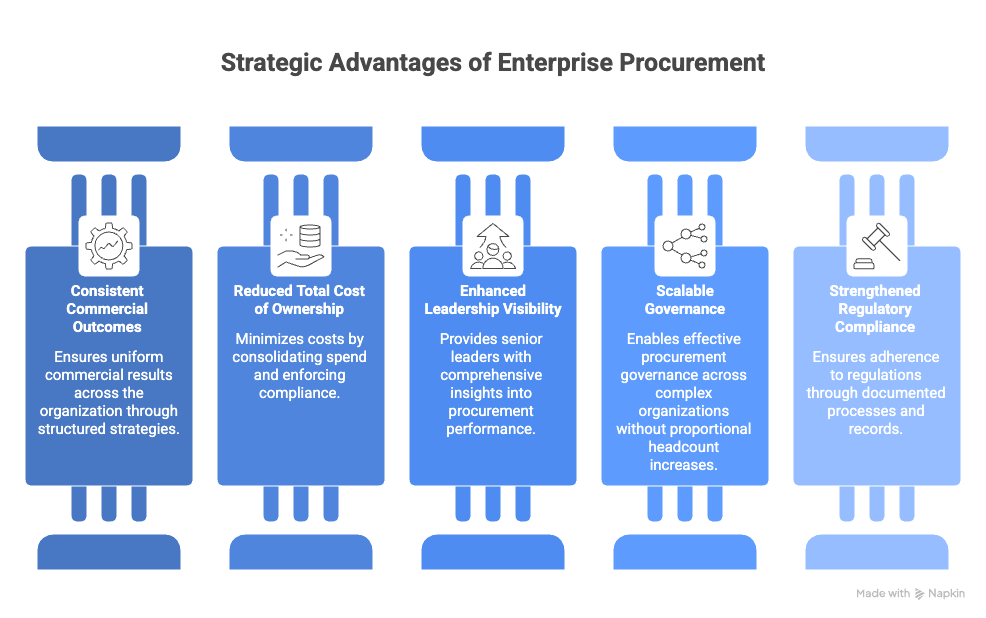
- Category management organizes spend into managed groups with dedicated strategies, enabling procurement specialists to develop deep market knowledge and deliver consistent commercial outcomes across their categories.
- Governance and policy framework defines who can commit organizational spend, under what conditions, and through which approved channels. It is the control layer that prevents maverick buying and ensures compliance at scale.
- Technology infrastructure connects the Source-to-Pay cycle through integrated platforms covering sourcing, contract management, supplier management, and procure-to-pay, providing end-to-end spend visibility and process automation.
- Performance management tracks procurement’s contribution to organizational objectives through savings delivery, supplier performance, process efficiency, and risk management metrics reported to senior leadership.
Common Pitfalls of Enterprise Procurement
- Centralizing control without enabling business unit flexibility: Overly rigid enterprise procurement models create workarounds. Governance must balance central control with enough flexibility for business units to meet their operational needs.
- Under-investing in technology integration: Disconnected systems — separate sourcing, contract, supplier, and P2P platforms that do not share data — create visibility gaps and process inefficiencies that undermine enterprise procurement effectiveness.
- Measuring procurement only on savings: Enterprise procurement creates value through risk management, compliance, supplier innovation, and process efficiency as well as cost reduction. Single-metric evaluation creates distorted incentives.
- Treating enterprise procurement as a cost centre rather than a value function: Organizations that position procurement as administrative overhead rather than a strategic function consistently underinvest in capability and miss significant value creation opportunities.
What Distinguishes High-Performing Enterprise Procurement Functions
- Board-level visibility and mandate: High-performing enterprise procurement teams report at a senior level, with direct access to CFO or CEO and a mandate that spans the full organizational spend base.
- Integrated technology stack: A connected Source-to-Pay platform that shares data across sourcing, contracts, suppliers, and P2P provides the visibility needed to manage spend at enterprise scale without manual aggregation.
- Category management maturity: Specialist category managers with deep market knowledge and multi-year category strategies consistently outperform generalist buying teams operating transactionally.
- Supplier relationship investment: Strategic suppliers receive structured relationship management — not just performance monitoring — enabling access to innovation, priority capacity, and preferential terms.
KPIs of Enterprise Procurement
| Dimension | Sample KPIs |
| Financial Impact | Savings delivered vs. target, spend under management as % of total |
| Compliance | % of spend through approved channels, contract coverage rate |
| Efficiency | P2P cycle time, touchless invoice rate, sourcing cycle time |
| Supplier Performance | % of strategic suppliers meeting SLAs, supplier risk incident rate |
Key Terms in Enterprise Procurement
- Source-to-Pay (S2P): The end-to-end procurement process from identifying requirements through sourcing, contracting, purchasing, and payment.
- Category Management: A procurement approach that groups related spend and manages it strategically through dedicated specialists with deep category knowledge.
- Spend Under Management (SUM): The proportion of total organizational spend actively governed through procurement processes, contracts, and supplier strategies.
- Maverick Spend: Purchases made outside approved contracts or channels, representing a governance failure that enterprise procurement frameworks are designed to prevent.
- Procure-to-Pay (P2P): The operational cycle from purchase requisition through goods receipt and invoice payment, the transactional backbone of enterprise procurement.
Technology Enablement
Enterprise procurement is enabled by integrated Source-to-Pay platforms that connect sourcing, contract management, supplier management, and procure-to-pay in a unified data environment. Advanced analytics, AI-assisted spend classification, and real-time dashboards give procurement and finance leadership the visibility needed to manage spend at scale and demonstrate the function’s contribution to organizational performance.
FAQs
Q1. What is enterprise procurement?
The end-to-end management of purchasing activity across a large, complex organization, encompassing strategy, governance, processes, systems, and people.
Q2. How does enterprise procurement differ from departmental purchasing?
Enterprise procurement operates across the full organization with a strategic mandate, category management structure, and integrated governance. Departmental purchasing is typically operational and transaction-focused.
Q3. What is the role of technology in enterprise procurement?
Technology connects the Source-to-Pay cycle, providing spend visibility, process automation, and data integration across sourcing, contracts, suppliers, and payment.
Q4. What is the biggest challenge in enterprise procurement?
Balancing central governance with business unit flexibility, and maintaining consistent policy compliance across geographically dispersed operations.
Q4. How does category management support enterprise procurement?
By organizing spend into managed groups with dedicated strategies, category management enables specialist expertise and consistent outcomes across each area of organizational spend.
Q5. What is spend under management and why does it matter?
It measures the proportion of total spend actively governed by procurement. Higher SUM indicates broader policy compliance and greater procurement influence over organizational cost.
References
Explore Zycus resources to learn more about Enterprise Procurement:










