



An online catalog in procurement is a digital product and service directory integrated into a purchasing system that allows employees to browse, select, and order approved goods or services directly without raising a manual purchase requisition or engaging procurement for each transaction. Catalogs present pre-negotiated items from contracted suppliers at agreed prices, guiding users toward compliant purchasing decisions at the point of need. They are the operational mechanism through which sourcing outcomes are converted into day-to-day purchasing behavior.
Read more: What is Procurement Catalog Management: Your AIO Guide
Why Online Catalog Matters in Procurement
The gap between a well-negotiated contract and what employees actually buy is where procurement value leaks. Without a catalog, users default to familiar suppliers or direct contact, bypassing negotiated pricing. Online catalogs close this compliance gap by making the contracted option the easiest option. When buying from approved suppliers is simpler than going off-contract, compliance rises organically. For high-frequency indirect categories, a well-managed catalog can deliver more sustained savings than the sourcing event that produced the contract.
The Core Process of Online Catalog
- Catalog Setup and Supplier Onboarding: Procurement configures the catalog by onboarding contracted suppliers and loading their approved product or service listings. Supplier content may be managed by procurement through direct data entry, by the supplier through a self-service portal, or through a punch-out connection to the supplier’s own e-commerce environment.
- Content Management and Pricing Maintenance: Catalog content is maintained to ensure that listed items reflect current contracted pricing, product availability, and specification. Price updates are applied when contracts are amended. Out-of-stock items are flagged or removed. Content quality directly determines how useful and trusted the catalog is in daily use.
- User Search and Selection: Employees search the catalog by keyword, category, or supplier to find the items they need. The catalog presents available options alongside price, delivery time, and supplier details, enabling informed selection within approved parameters. Guided buying logic can surface preferred items or apply spending rules that steer users toward the most cost-effective compliant option.
- Order Placement and Approval: Selected items are submitted as a purchase order, routing through the appropriate approval chain before being transmitted to the supplier — faster and less administratively burdensome than manual requisitioning.
Core Components of Online Catalog
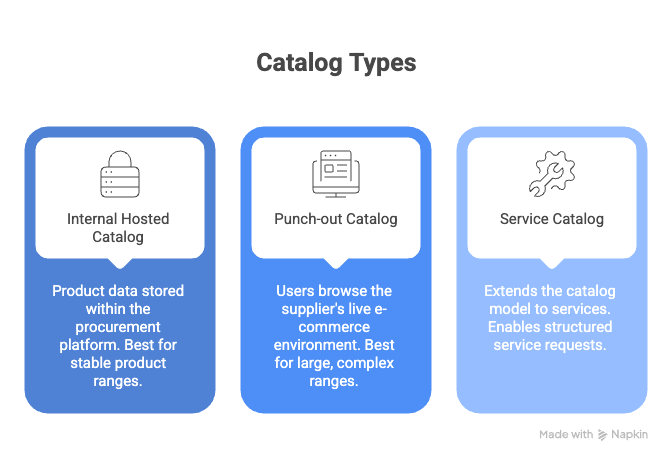
- Hosted catalog stores supplier product data — descriptions, prices, and specifications — within the procurement platform. Procurement controls the content and update cycle, providing a consistent experience across all catalog suppliers.
- Punch-out catalog connects the procurement system to a supplier’s external e-commerce site. Users browse the supplier’s platform and their basket is transmitted back for approval and order processing — suited to large, frequently changing product ranges.
- Guided buying rules steer users toward preferred items, highlight negotiated pricing, and enforce spend controls — such as requiring justification for items above a set value.
Key Benefits of Online Catalog
- Drives purchasing compliance by making contracted suppliers and negotiated prices the default and easiest option for users.
- Reduces administrative overhead by replacing manual purchase requisitions with streamlined, pre-approved catalog ordering.
- Provides real-time spend visibility as catalog orders are captured in the procurement system at the point of purchase rather than after invoicing.
- Enables savings realization by ensuring that negotiated contract pricing is applied consistently to every transaction rather than only at contract award.
Common Pitfalls of Online Catalog
- Poor catalog content quality: Catalogs with outdated pricing, missing products, or inaccurate descriptions lose user trust and drive off-catalog purchasing. Content maintenance is not a one-time setup task — it requires ongoing governance.
- Too few suppliers in the catalog: Users who cannot find what they need in the catalog will go outside it. Catalog coverage of high-frequency categories must be comprehensive enough to meet most routine purchasing needs.
- Overly complex ordering process: Catalog adoption is highest when the purchase experience is simpler than the alternative. Approval chains with too many steps, confusing navigation, or slow system performance erode the user experience that drives compliance.
- Treating catalog deployment as a one-time project: Catalogs require active management — supplier onboarding, content refreshes, guided buying rule updates, and adoption monitoring. Organizations that deploy and neglect see compliance rates decline steadily.
KPIs of Online Catalog
| Dimension | Sample KPIs |
| Adoption | % of eligible spend placed through catalog, catalog order rate by category |
| Compliance | % of catalog orders at contracted price, off-catalog spend ratio |
| Content Quality | % of items with current pricing, out-of-stock rate, search success rate |
| Efficiency | Average time from catalog search to order submission vs. manual requisition |
Key Terms in Online Catalog
- Punch-Out Catalog: A catalog configuration that connects the procurement system to a supplier’s external e-commerce site, transmitting the selected basket back for internal processing.
- Hosted Catalog: A catalog where product data is stored directly within the procurement platform, managed by procurement or the supplier through a content portal.
- Guided Buying: A procurement system feature that steers users toward preferred items, suppliers, or categories at the point of purchase.
- Maverick Spend: Purchasing that occurs outside approved catalog channels, bypassing negotiated prices and preferred supplier commitments.
Technology Enablement
Procurement platforms support online catalogs through hosted and punch-out catalog configurations, guided buying interfaces, contract price validation tools, and spend analytics that track catalog adoption and off-catalog purchasing by category. AI-powered search and recommendation features improve catalog discovery, helping users find the right item faster and reducing the friction that drives non-compliant purchasing.
FAQs
Q1. What is an online catalog in procurement?
A digital directory of approved products and services at pre-negotiated prices, integrated into the procurement system to guide employees toward compliant purchasing.
Q2. What is the difference between a hosted and punch-out catalog?
A hosted catalog stores product data within the procurement platform. A punch-out catalog connects to the supplier’s external e-commerce site, transmitting the basket back for processing.
Q3. How does a catalog improve procurement compliance?
By making contracted suppliers and negotiated prices the default, easiest option — so employees comply naturally rather than through enforcement.
Q4. How often should catalog content be updated?
Pricing should be updated whenever contracts are amended. Product availability should be reviewed monthly, with triggered updates when suppliers notify of changes.
Q5. What is guided buying and how does it support catalog use?
Guided buying rules surface preferred items, highlight price comparisons, and enforce spend controls at the point of selection — steering users toward the most compliant and cost-effective option.
Q6. Can catalogs be used for services as well as goods?
Yes. Service catalogs enable structured ordering of standard service packages — maintenance, training, consulting — applying the same compliance and visibility benefits as goods catalogs.
References
For further insights into these processes, explore Zycus’ dedicated resources related to Online Catalog:










