



A Contract Repository is a centralized digital system designed to store, organize, and manage all contractual documents across an organization. It serves as the single source of truth for contracts—ensuring that agreements are accessible, searchable, traceable, and governed throughout their lifecycle.
Read more: Contract Management: A Complete Guide to Managing Contracts Effectively
Unlike fragmented storage methods such as shared drives, emails, or local folders, a contract repository brings structure and intelligence to contract storage. It not only preserves documents but also captures key metadata, such as contract values, obligations, renewal dates, and compliance requirements, making contracts actionable assets rather than static files.
In modern procurement and legal environments, the contract repository forms the backbone of effective contract lifecycle management, supporting sourcing, supplier governance, compliance, and financial control.
Why a Contract Repository Is Critical
Contracts define commercial intent, risk exposure, and supplier accountability. When contracts are scattered or poorly managed, organizations face risks such as missed renewals, value leakage, non-compliance, and legal exposure.
A well-structured contract repository ensures:
- Clear visibility into active, expired, and upcoming contracts
- Timely renewals and renegotiations
- Consistent enforcement of contractual terms
- Reduced legal and compliance risk
- Faster decision-making across procurement, legal, and finance
In essence, a contract repository transforms contracts from passive documents into governed, traceable, and insight-driven business instruments.
Read more: Leveraging Technology to Resolve Post-War Contract Management Challenges
The Contract Repository Operating Model
A contract repository functions as an intelligent layer across the contract lifecycle, supporting storage, discovery, governance, and integration with downstream processes.
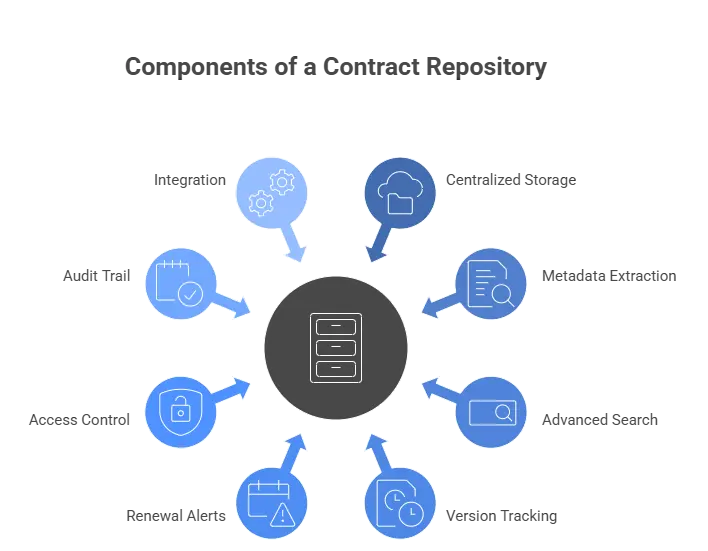
1. Centralized Contract Capture and Storage
All contracts—supplier agreements, MSAs, NDAs, SLAs, amendments, and addenda—are stored in a centralized digital environment. Documents may be uploaded manually, ingested from sourcing or contract authoring workflows, or synchronized from external systems.
Contracts are categorized by type, supplier, region, business unit, and status, ensuring structured organization from the moment they enter the repository.
2. Metadata Extraction and Indexing
Beyond document storage, a contract repository captures structured metadata from contracts. This includes contract value, duration, renewal dates, obligations, pricing terms, penalties, and governing jurisdictions.
Advanced repositories use AI-assisted extraction to identify key clauses and attributes automatically, reducing manual effort and improving accuracy. This metadata indexing enables contracts to be searched, filtered, and analyzed efficiently.
3. Search, Retrieval, and Accessibility
A core strength of a contract repository is fast and intuitive access. Users can locate contracts using keyword search, filters, clause-level queries, or metadata attributes such as supplier name, contract type, or expiry date.
Role-based access ensures that stakeholders—procurement, legal, finance, audit—can access relevant contracts without compromising confidentiality or governance.
4. Version Control and Amendment Management
Contracts evolve over time. A contract repository maintains complete version history, tracking every amendment, redline, and renegotiation.
Each version is time-stamped and traceable, ensuring clarity on which terms are active and eliminating confusion caused by outdated documents. This version control is critical for audits, dispute resolution, and compliance verification.
5. Renewal, Expiry, and Obligation Tracking
Repositories actively monitor key contract milestones such as renewals, expirations, notice periods, and obligation deadlines.
Automated alerts notify stakeholders well in advance, preventing auto-renewals, missed renegotiation opportunities, or compliance lapses. This proactive governance helps organizations retain commercial leverage and avoid unnecessary costs.
6. Compliance, Audit, and Risk Governance
Every interaction with a contract—upload, edit, access, approval—is logged within an immutable audit trail. This ensures transparency, accountability, and audit readiness.
The repository also supports compliance by linking contracts to policies, regulatory requirements, and supplier obligations—helping organizations demonstrate adherence during internal and external audits.
7. Integration with Procurement and Finance Systems
A contract repository does not operate in isolation. It integrates with sourcing, procure-to-pay, supplier management, and ERP systems to ensure contract terms are reflected in operational execution.
Pricing, payment terms, SLAs, and compliance conditions flow downstream into purchase orders, invoices, and supplier evaluations—closing the loop between contract intent and actual spend behavior.
Key Concepts in Contract Repository Management
| Concept | Explanation |
| Single Source of Truth | A unified location where the most current and approved contract versions reside |
| Contract Metadata | Structured data extracted from contracts to enable search, reporting, and governance |
| Clause-Level Visibility | Ability to identify and analyze specific clauses across contracts |
| Version Control | Tracking changes and amendments across contract iterations |
| Obligation Management | Monitoring deliverables, SLAs, and commitments defined in contracts |
| Renewal Governance | Managing contract expiries and renegotiation timelines |
| Audit Readiness | Maintaining traceable records for compliance and legal review |
Key Terms in Contract Repository
- Centralized Contract Repository – A single, unified location to store, manage, and access all organizational contracts securely.
- Contract Lifecycle Management (CLM) – The end-to-end process of creating, approving, storing, and renewing contracts to improve compliance and efficiency.
- Metadata Extraction – The automated capture of key contract details (dates, parties, clauses) to enable fast search and reporting.
- Renewal Alerts & Notifications – Automated reminders that prevent missed renewals and ensure timely renegotiations or terminations.
- Audit Trail & Compliance – A detailed record of every contract action for regulatory compliance, accountability, and risk management.
FAQs
Q1. What is a contract repository?
A contract repository is a centralized digital system that stores, organizes, and manages all contracts, providing easy access, visibility, and traceability across the contract lifecycle.
Q2. What are the benefits of centralized contract storage?
Centralized storage improves contract visibility, reduces search time, prevents missed renewals, strengthens compliance, and lowers legal and commercial risk.
Q3. Contract repository vs CLM — what’s the difference?
A contract repository focuses on secure storage, search, and governance of contracts, while CLM systems manage the full contract lifecycle, including authoring, negotiation, execution, and post-award management.
Q4. Why is a contract repository important for procurement?
It ensures contract terms are visible and enforceable, helping procurement prevent off-contract spend, manage renewals, and maintain supplier compliance.
Q5. How does a contract repository reduce risk?
By tracking versions, obligations, and expirations, it prevents outdated contracts, missed deadlines, and compliance gaps that can lead to financial or legal exposure.
Q6. Can a contract repository integrate with procurement systems?
Yes. Modern contract repositories integrate with sourcing, P2P, ERP, and supplier management systems to ensure contract terms flow into operational processes.
References
For further insights into these processes, explore Zycus’ dedicated resources related to Contract Repository:
- Ways Spend Analytics Can Save Your Business Money
- Upcoming Webinar – ROI of Best in Class Procurement Department
- Top 4 Business Drivers for Investment in Procurement Transformation 2023
- 4 New Business Benchmarks For Digital Procurement In a Post- COVID-19 World!
- AI in Procurement Innovation: Transforming the Industry










